


























Philippines Steel Market Size, Share, Growth & Analysis Report 2026-2034
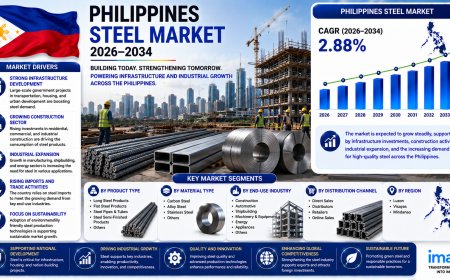
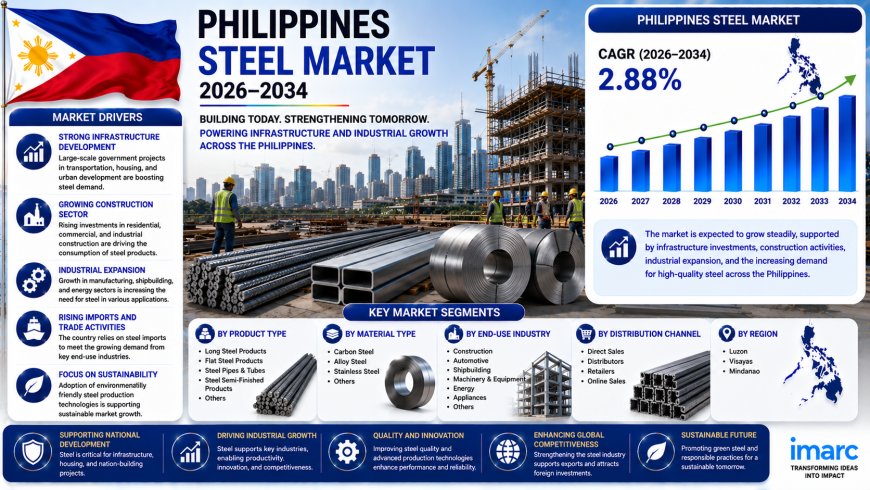
The Philippines steel market size increased from USD 4.1 Billion in 2025 to USD 4.2 Billion in 2026 and is projected to reach USD 5.3 Billion by 2034, at a CAGR of 2.88%.

Market Overview
The Philippines steel market size reached USD 4.1 Billion in 2025 and is projected to reach USD 5.3 Billion by 2034, growing at a compound annual growth rate (CAGR) of 2.88% from 2026 to 2034. The market is driven by infrastructure projects, industrialization, and demand from real estate and housing, supported by government programs that back local manufacturing. Sustainable production and circular economy practices are also expected to reduce import dependence over the forecast period.
Philippines Steel Market Summary
- The Philippines steel market encompasses flat and long steel products, including structural steel, prestressing steel, bright steel, welding wire and rod, and iron steel wire, ropes, and braids.
- These products are valued for their strength and versatility in building and construction, automotive, transportation, and manufacturing applications.
- The ecosystem includes steel producers, scrap and billet suppliers, distributors, importers, construction companies, manufacturers, and government agencies.
- Major segments identified in the market include type (flat steel and long steel), product, application, and region (Luzon, Visayas, and Mindanao).
- The market grew from USD 4.1 Billion in 2025 to USD 4.2 Billion in 2026.
- The market is benefiting from a focus on sustainable steel production, including electric arc furnaces and scrap recycling, and from the expansion of domestic manufacturing scale to support import substitution.
- In July 2024, President Marcos inaugurated SteelAsia’s Compostela Works in Cebu, with one million tons of annual rebar capacity.
Request a Sample Report for In-Depth Market Insights: https://www.imarcgroup.com/philippines-steel-market/requestsample
Porter’s Five Forces Analysis
- Competitive Rivalry: High, with domestic producers competing against imports on price, quality, and delivery. Business implication: Producers must differentiate through scale, reliability, and low-carbon credentials.
- Supplier Power (Raw Materials and Energy): Moderate to high. Producers depend on imported billets and on scrap and energy supplies, so global price swings affect costs. Business implication: Companies should secure domestic scrap supply and invest in efficient electric arc furnace capacity.
- Buyer Power (Construction and Manufacturing Customers): Moderate to high. Large construction and manufacturing customers can negotiate on price and can switch to imports. Business implication: Long-term supply agreements and consistent quality help retain major buyers.
- Threat of Substitutes: Moderate. Concrete, aluminum, and engineered materials can replace steel in some applications, although steel remains essential for structural uses. Business implication: Producers should promote steel’s strength and recyclability advantages.
- Threat of New Entrants: Low to moderate. High capital requirements and logistics fragmentation across the archipelago create barriers, although large foreign-invested projects continue to enter. Business implication: New capacity is most viable where it combines modern technology with strong logistics.
Market Growth Drivers
Industrialization and Infrastructure Growth
Investment in roads, bridges, railways, ports, and urban development is driving steady demand for steel. Government programs such as Build Better More are supporting large-scale construction. This sustained infrastructure activity provides a strong base for long steel products in particular.
Real Estate and Housing Demand
Growth in real estate and mass housing programs is increasing demand for rebar and structural steel. Urbanization is expanding construction activity beyond Metro Manila into regional growth areas. Housing demand is therefore an important long-term driver of steel consumption.
Rising Automotive and Shipbuilding Sectors
Growth in the automotive and shipbuilding sectors is adding demand for steel products beyond construction. These industries require a range of flat and specialty steel products. Their expansion supports a more diversified demand base for domestic producers.
Philippines Steel Market Segmentation
Type Insights:
- Flat Steel
- Long Steel
Product Insights:
- Structural Steel
- Prestressing Steel
- Bright Steel
- Welding Wire and Rod
- Iron Steel Wire, Ropes, and Braids
Application Insights:
- Building and Construction
- Electrical Appliances
- Metal Products
- Automotive
- Transportation
- Mechanical Equipment
- Domestic Appliances
Regional Insights:
- Luzon
- Visayas
- Mindanao
Competitive Landscape
The Philippines steel market features domestic producers, foreign-invested projects, and import suppliers. Competition centers on price, product range, production capacity, and sustainability. Producers are expanding electric arc furnace capacity and investing in solar power and recycling to reduce emissions and replace imports.
Key Players Mentioned in the Report Context Include:
SteelAsia, the country’s largest steel producer, announced capacity expansions in January 2024, including electric arc furnace projects in Luzon and Davao and a 750,000-ton large section mill. It launched a 1.9 MWp rooftop solar system with TotalEnergies ENEOS in March 2025. Panhua Group commissioned a 200,000-ton coated steel production line in Maasim, Sarangani, in May 2025, as part of a USD 3.5 billion integrated steel project.
Regional Analysis
- Luzon: The largest market, driven by Metro Manila’s construction activity and infrastructure projects, and home to SteelAsia’s Meycauayan solar-powered plant and its Lemery Works expansion in Batangas.
- Visayas: A growing market anchored by SteelAsia’s Compostela Works in Cebu, which has one million tons of annual rebar capacity.
- Mindanao: An emerging market where industrial investment is rising, including Panhua Group’s coated steel line in Sarangani and SteelAsia’s planned Davao electric arc furnace project.
Recent Industry Developments
September 2026: SteelAsia, the Philippines’ largest steel producer, said it plans to nearly double its crude steelmaking capacity from 2.5 million tons per year to 4.8 million tons per year by 2029. The buildout starts with the Lemery Works sections mill (500,000 tons per year, commissioning in Q1 2027), followed by Candelaria Works (1 million tons per year, targeted for 2028) and a Concepcion wire rod mill (1 million tons per year, targeted for 2029).
June 2026: SteelAsia said partial operations at its new Lemery Works facility in Batangas could start in October or November 2026, ahead of the original 2027 schedule. The company said that once its new facilities are fully operational, they could cut the country’s trade deficit by up to USD 2 billion through import substitution.
May 2026: The Philippine Iron and Steel Institute forecast that Philippine steel demand will reach a record 11.1 million metric tons in 2027, about 6% higher than the previous year, driven by faster infrastructure construction ahead of the 2028 national election. Consumption in 2026 is expected to stay roughly flat.
Key Aspects Required for the Philippines Steel Market
- Market Performance: USD 4.1 Billion in 2025, with a projected trajectory to USD 5.3 Billion by 2034.
- Market Outlook: A 2.88% CAGR through 2034 indicates steady growth across types, products, applications, and regions.
- Growth Drivers: Industrialization and infrastructure growth, real estate and housing demand, and rising automotive and shipbuilding sectors.
- Competitive Landscape: A mix of domestic producers, foreign-invested projects, and import suppliers competing on price, capacity, and sustainability.
- Challenges: Exposure to global price volatility and import competition; infrastructure limitations and logistics fragmentation across the archipelago; and regulatory complexity and environmental compliance burdens.
- Industry Trends: Sustainable steel production, including electric arc furnaces and scrap recycling, and expansion of domestic manufacturing scale to support import substitution under programs such as Build Better More and Tatak Pinoy.
- Strategic Recommendations: Invest in electric arc furnace capacity and scrap recycling; target metro rail and mass transit projects; serve renewable energy infrastructure in solar, geothermal, and wind; supply special economic zones and industrial parks; and strengthen logistics across islands to reduce import dependence.
Note: If you need any specific information that is not currently covered within the scope of the report, we will provide it as part of customization.
Speak to an Analyst: https://www.imarcgroup.com/request?type=report&id=38153&flag=C
Report Format, Delivery, and Customization Details
- Report Format Mode: PDF and Excel (editable version in PPT/Word format available on special request)
- Report Delivery Mode: Online delivery via email
- Report Customization Mode: Yes, via email/call (10% free customization for the base license)
- Analyst Support: 10–12 weeks for the base license
- Report Table of Content: Yes
- Report List of Figures: Yes
- Report Methodology Mode: Yes
- Request for Sample Report: Yes
What's Your Reaction?