






























India Logistics Market 2026-2034: Size, Share, Industry Growth and Analysis Report
The India logistics market size reached USD 243.82 Billion in 2025 and is projected to touch USD 429.02 Billion by 2034, expanding at a CAGR of 6.48% during 2026-2034.

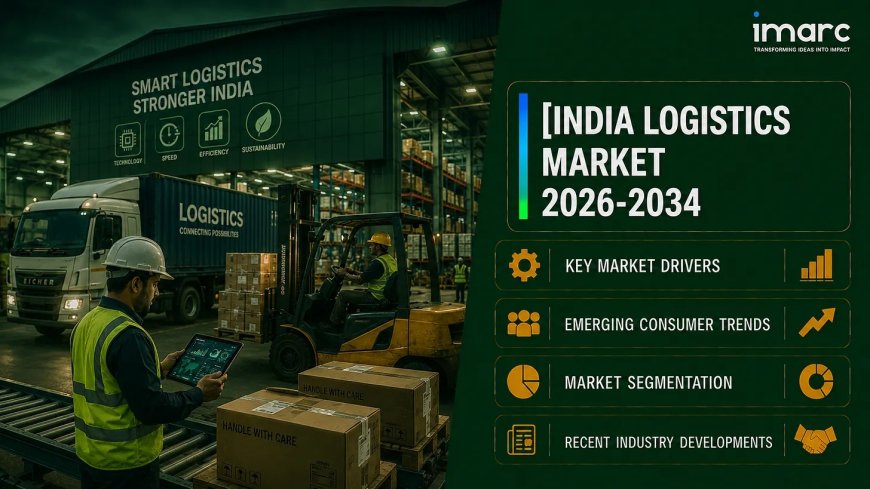
According to IMARC Group’s report titled “India Logistics Market Size, Share, Trends and Forecast by Model Type, Transportation Mode, End Use, and Region, 2026-2034“, the report offers a comprehensive analysis of the industry, including India logistics market trends, share, forecast, growth and regional insights.
The India logistics market size reached USD 243.82 Billion in 2025 and is projected to touch USD 429.02 Billion by 2034, expanding at a CAGR of 6.48% during 2026-2034.
India’s commercial supply networks and industrial freight corridors are undergoing a sweeping structural realignment as corporate supply chains pivot toward organized, multi-modal transport hubs to absorb expanding global trade corridors. Driven by a major federal push to rationalize interstate trade barriers and compress transit timelines, the execution of freight handling and supply chain management has evolved from an fragmented operational overhead into a core competitive advantage for enterprise manufacturers, consumer brands, and global infrastructure funds.
- Dominance of Consolidated Third-Party Logistics: Shippers are extensively outsourcing specialized operations to professional aggregators, with Third-Party Logistics (3PL) capturing a leading 48.0% share of total model-type demand in 2025.
- Entrenched Surface Transport Pipelines: Ground shipping networks continue to anchor core transit requirements across the subcontinent, with roadways commanding a dominant 55.0% share of the transportation mode matrix.
- Geographical Freight Intensification: High concentration densities of manufacturing plants and dense consumption centers continue to position North India at the forefront, with the region securing a leading 30.0% share of overall market revenue.
The Strategic Market Challenge: Navigating the Logistics Market in India
Corporate operations directors and global multi-modal investors frequently overlook the deep structural margins compressed by the high national logistics cost-to-GDP ratio, which currently averages between 13% and 14%, significantly higher than the 8% to 9% benchmarks seen in mature western economies. Failing to establish localized warehouse automation setups or secure dedicated multi-point rail links exposes shipping pipelines to extensive terminal dwell delays and volatile spot-market trucking tariffs. This systemic inflation disrupts just-in-time material flows, increasing inventory holding costs and eroding global export competitiveness for tier-1 manufacturing consortia.
➤ Access Key Market Statistics and Actionable Insights - Request Sample Report
India’s Strategic Vision for the Logistics Market:
- National Reduction of Logistics Costs: Comprehensive central blueprints aim to structurally lower nationwide logistics spending relative to GDP down to single digits by the end of the decade, optimizing overall export and domestic trade efficiency.
- Establishment of Large-Scale Multimodal Corridors: Macro-level state policies focus on constructing interconnected logistics parks and dedicated freight corridors (DFCs) to shift long-haul container volumes smoothly from roadways to energy-efficient rail lines.
- Digital Integration of Supply Tracking Rails: Government trade infrastructure plans look to unify fragmented transport tracking grids, deploying automated documentation and digital data exchanges to simplify cross-border customs clearances.
Why Invest in the India Logistics Market: Key Growth Drivers & ROI
- Robust Sovereign Capital Frameworks and Infrastructure Influx: Massive capital spending under national connectivity masterplans provides private terminal and logistics park developers with highly secure, risk-mitigated volume baselines.
- Escalating Freight Demands from Industrial Scaling: Comprehensive financial backing provided under multi-billion-dollar Production Linked Incentive (PLI) frameworks across 14 manufacturing sectors drives an immense requirement for highly structured, predictable corporate logistics solutions.
- Technological Architecture and Fulfillment Upgrades: Transitioning fulfillment centers toward automated storage and retrieval systems (AS/RS) and robotics yields immediate operational ROI by lowering individual picking errors and maximizing warehouse turnaround velocity.
- Defensible Multi-Year B2B Enterprise Supply Frameworks: Securing direct, multi-year logistics integration contracts with expanding consumer retail majors and massive e-commerce networks locks in predictable cash flow visibility and insulates operators from retail transaction volatility.
India Logistics Market Trends & Future Outlook:
- Dominance of Automated Fulfillment Hub Architectures: Primary distribution centers are comprehensively prioritizing high-capacity, automated sortation arrays to manage expanding order loads from rapid omnichannel retail channels.
- Widespread Deployment of Real-Time AI Control Towers: Industrial shippers are extensively implementing telemetry networks and machine learning models to secure absolute shipment visibility and optimize multi-point route selection.
- Aggressive Proliferation of Last-Mile Electric Fleets: Distribution networks are rapidly deploying electric two- and three-wheelers within dense urban zones, supported by national emission guidelines to slash localized parcel delivery outlays.
- Pervasive Application of GDP-Compliant Cold Storage: Pharmaceutical and fresh food networks are universally requiring specialized, temperature-controlled facilities featuring continuous IoT sensory logging to minimize perishable inventory spoilage.
Regulatory Landscape & Policy Catalysts in India:
- Ministry of Commerce and Industry Masterplans: The central ministry actively administers the National Logistics Policy (NLP) and the PM Gati Shakti framework, coordinating cross-departmental infrastructure execution to eliminate regional transit bottlenecks.
- Goods and Services Tax (GST) Tax Harmonization: The consolidation of a unified interstate indirect tax architecture serves as a powerful catalyst, allowing companies to close inefficient local state depots in favor of massive, centralized fulfillment centers.
- Central Pollution Control Board (CPCB) Green Directives: Tightening environmental compliance standards push corporate fleets toward alternative clean energies and sustainable packaging substrates across high-volume express lines.
- Invest India Supply Chain Sector Facilitation: The national investment promotion agency streamlines multi-tier land permissions and fast-tracks regulatory approvals, optimizing the setup of free trade warehousing zones (FTWZs) for overseas entities.
- Bureau of Indian Standards (BIS) Electronic Logging Codes: According to the Ministry of Consumer Affairs, Food and Public Distribution, strict quality specifications defined for digital tracking devices ensure high hardware performance and secure electronic data transmission across transport routes.
➤ Explore the Exact Chapters and Data Scope - Get Full Brochure
By the IMARC Group, the Top Competitive Landscape & their Positioning:
- Delhivery
- Mahindra Logistics Ltd.
- Allcargo Logistics Limited
- Blue Dart Express Limited
- TCIEXPRESS LIMITED.
India Logistics Market Segmentation:
The market report offers a comprehensive analysis of the segments, highlighting those with the largest India logistics market share. It includes forecasts for the period 2026-2034 and historical data from 2020-2025 for the following segments.
Model Types Covered
- 2 PL (32.0% market share in 2025)
- 3 PL (48.0% market share in 2025)
- 4 PL (20.0% share in 2025)
Transportation Modes Covered
- Roadways (55.0% market share in 2025)
- Seaways (16.2% share in 2025)
- Railways (18.5 market share in 2025)
- Airways (10.3 share in 2025)
End Uses Covered
- Manufacturing
- Consumer Goods
- Retail
- Food and Beverages
- IT Hardware
- Healthcare
- Chemicals
- Construction
- Automotive
- Telecom
- Oil and Gas
- Others
Regions Covered
- North India (30.0% market share in 2025)
- West and Central India (28.5% share in 2025)
- South India (24.6% market share in 2025)
- East India (16.9% majority share in 2025)
Note: If you need specific information that is not currently within the scope of the report, we can provide it to you as a part of the customization.
➤ Shape the Data to Answer Your Specific Questions - Request Customization
Frequently Asked Questions (FAQs)
Q1: What is the current value and projected growth of the India Logistics Market?
A1: According to IMARC Group, the India logistics market size was valued at USD 243.82 Billion in 2025. Looking forward, the market is projected to reach USD 429.02 Billion by 2034, exhibiting a structured compound annual growth rate (CAGR) of 6.48% during the 2026–2034 forecast period.
Q2: Which service framework model currently commands the largest market share in India?
A2: The industry service matrix is distinctly categorized into 2PL, 3PL, and 4PL models. Third-Party Logistics (3PL) commands clear dominance across the domestic sector with a prominent 48.0% market share in 2025, heavily favored by enterprise clients looking to optimize inventory control and freight management.
Q3: How is market demand structured across primary modes of transportation?
A3: The logistical transportation landscape maps across Roadways, Seaways, Railways, and Airways. Roadways command the leading position with a 55.0% volume share due to India’s expansive national highway network and essential requirements for flexible, multi-point door-to-door distribution.
Q4: What core downstream industry represents the largest institutional end user of logistics services?
A4: The business consumer pipeline spans Manufacturing, Consumer Goods, Retail, Food and Beverages, IT Hardware, Healthcare, Chemicals, Construction, and Others. The manufacturing sector accounts for the largest market share, driven by robust industrial corridor expansions and localized raw material assembly requirements.
Q5: Which regional geographic block exhibits the highest concentration of logistics market spending?
A5: The domestic sector maps across North India, West and Central India, South India, and East India. North India holds the top position with a 30.0% revenue share in 2025, anchored by deep population densities, heavy consumption clusters around the National Capital Region (NCR), and intensive northern industrial hubs.
Strategic Insight & Verdict:The structural modernization of India’s transport and warehousing framework presents an exceptional window for high-volume corporate capital deployment. As enterprise shippers and global manufacturing chains permanently shift away from fragmented unorganized trucking pools toward highly automated, technology-enabled 3PL platforms, we at IMARC Group have observed that the highest financial returns will belong to investors who secure positions inside integrated multimodal logistics parks and deploy real-time AI-driven supply tracking platforms. Moving forward, the strategic positioning of transportation capital must focus on vertical supply integration, automated fulfillment hubs, and rail-road intermodal capabilities to capture dominant equity across the expanding domestic industrial economy.
Verified Data Source: India Logistics Market Report by IMARC Group
What's Your Reaction?