






























Latin America Agricultural Equipment Market Size, Share and Growth Report 2034
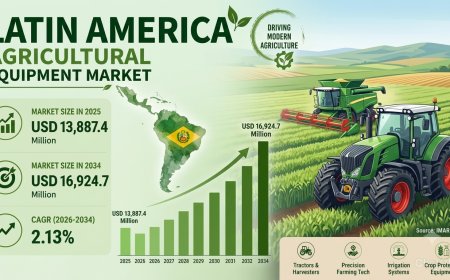
Latin America Agricultural Equipment Market size reached USD 13,887.4 Million in 2025 and grow at a CAGR of 2.13% to reach USD 16,924.7 Million by 2034.

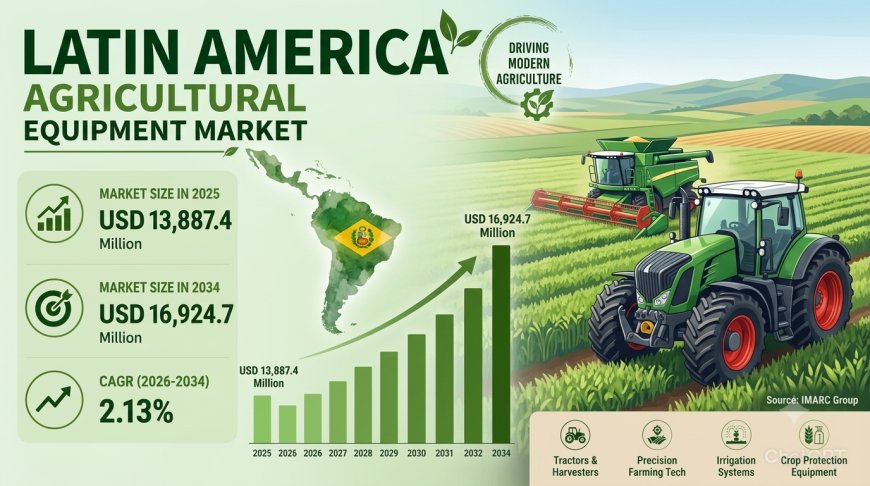
The Latin America agricultural equipment market is expected to see steady but moderate growth, supported by rising food production requirements, growing adoption of precision farming technologies, government-backed machinery financing, rising farm labor costs, and the need for higher efficiency across large commercial farms. The market size reached USD 13,887.4 Million in 2025 and is projected to reach USD 16,924.7 Million by 2034, exhibiting a compound annual growth rate (CAGR) of 2.13% during 2026-2034. Brazil's 2026/27 Plano Safra, which makes BRL 525.1 billion available for commercial agriculture, together with the new Finep-backed Move Agro machinery credit line, is helping sustain the replacement and modernization of tractors, harvesters, planters, and sprayers across the region. This market is strategically important to Latin America's economy as it directly supports the region's grain, oilseed, sugarcane, coffee, and livestock value chains, which are central to global food security and export earnings.
The Latin America agricultural equipment market is poised for gradual expansion as farmers move toward connected, precision-enabled, and locally manufactured machinery. With a projected CAGR of 2.13% through 2034, the market offers selective opportunities for established OEMs, regional implement makers, and technology providers that can pair equipment with affordable financing, after-sales service, and digital agronomy solutions.
LATIN AMERICA AGRICULTURAL EQUIPMENT MARKET SUMMARY
· Scope: The Latin America agricultural equipment market covers machinery used to prepare land, sow, protect, harvest, and process crops, including tractors, trailers, harvesters, planting equipment, irrigation and crop processing equipment, spraying equipment, and hay and forage equipment.
· Ecosystem: The value chain includes steel, engine, hydraulics, and electronics suppliers; global and regional equipment manufacturers; dealer and distributor networks; rural credit providers and development banks; and end users such as large commercial farms, medium-sized producers, family farms, and agricultural cooperatives.
· Key segments: The market is segmented by equipment (tractors, trailers, harvesters, planting equipment, irrigation and crop processing equipment, spraying equipment, hay and forage equipment, and others), application (land development and seed bed preparation, sowing and planting, weed cultivation, plant protection, harvesting and threshing, and post-harvest and agro processing), and region (Brazil, Mexico, Argentina, Colombia, Chile, Peru, and others).
· Regional leadership: Brazil is the largest national market, accounting for more than 40% of regional equipment demand according to third-party estimates, followed by Argentina and Mexico.
· Competitive structure: Global leaders such as John Deere, CNH Industrial, AGCO, and Kubota are estimated to hold over 60% of regional industry share, alongside strong regional specialists such as Jacto and Stara in spraying and planting equipment.
· Near-term context: Brazilian domestic agricultural machinery sales fell 19.9% in the first quarter of 2026 due to high interest rates, currency swings, and weaker commodity prices, which explains the moderate 2.13% forecast CAGR and the importance of subsidized financing in the recovery.
PORTER'S FIVE FORCES ANALYSIS - LATIN AMERICA AGRICULTURAL EQUIPMENT MARKET
The competitive dynamics of the Latin America agricultural equipment market can be analyzed using Porter's Five Forces framework.
Porter's Five Forces Analysis - Latin America Agricultural Equipment Market
· Competitive Rivalry: High. Global OEMs and regional manufacturers compete intensely on technology, pricing, financing packages, dealer coverage, and after-sales service, particularly in a three-year soft demand cycle in Brazil and Argentina. Business implication: Manufacturers must differentiate through precision-farming integration, locally adapted products, flexible financing, and strong parts and service networks to protect share.
· Supplier Power: Moderate. Steel, engines, transmissions, hydraulics, and electronic components are sourced from a concentrated group of suppliers, and global steel and component price swings can squeeze margins. Business implication: OEMs should secure long-term supply agreements, deepen localization of components, and diversify sourcing to reduce cost volatility and currency exposure.
· Buyer Power: Moderate to High. Farmers and cooperatives are price-sensitive, depend heavily on subsidized credit such as Moderfrota and Move Agro, and can postpone purchases when commodity prices or interest rates are unfavorable. Business implication: Suppliers must offer total-cost-of-ownership value, bundled financing, trade-in programs, and productivity guarantees to convert cautious buyers.
· Threat of Substitutes: Low to Moderate. Used machinery, equipment rental, custom-hire and contract harvesting services, retrofit kits that upgrade older fleets, and drone-based spraying can replace new equipment purchases. Business implication: Companies should build rental, refurbishment, and equipment-as-a-service offerings and certified pre-owned programs to retain customers across the lifecycle.
· Threat of New Entrants: Moderate. High capital needs, dealer and service network requirements, local-content rules, and brand trust create barriers, but lower-priced imports from China and India and local assembly partnerships are lowering entry hurdles. Business implication: Incumbents should strengthen service coverage and local manufacturing, while new entrants should pursue assembly alliances and niche or entry-level segments.
Competitive Rivalry - Moderate to High (Healthy)
· Multi-tier competition spans multinational leaders (John Deere, CNH Industrial, AGCO), Asian players (Kubota, Mahindra), European specialists (CLAAS, KUHN), and strong regional manufacturers (Jacto, Stara, Pauny), driving differentiation through precision technology, localization, and service quality rather than only price competition.
· FPT Industrial's partnership with Argentina's Pauny to supply 100% nationally built tractors, AGCO's 2025 investment in a remanufacturing transmissions center and technician academy in Jundiai, Brazil, and Deere's Argentine leadership in combines (52.3% of June 2026 registrations) reflect active strategic repositioning that is strengthening the overall market ecosystem.
Request for Sample Report: https://www.imarcgroup.com/latin-america-agricultural-equipment-market/requestsample
MARKET GROWTH DRIVERS:
Several key factors are propelling the expansion of the Latin America agricultural equipment market. Government support and rural credit serve as a powerful demand driver. Brazil's 2026/27 Plano Safra provides BRL 525.1 billion for commercial agriculture, cuts the Moderfrota machinery financing rate to 12.5% from 13.5%, and lowers the Pronamp rate to 11.5%. This is complemented by a new Move Agro line under the Finep program, with funds of up to BRL 10 billion backed by Provisional Measure 1,377/2026 and a targeted interest rate of 9.2% per year. Earlier, Brazil's 2023/24 Crop Plan earmarked BRL 364.22 billion for agricultural financing, a 27% increase over the previous cycle, and raised the Pronamp income ceiling from BRL 2.4 million to BRL 3 million. Additionally, the adoption of precision agriculture technologies such as GPS guidance, drones, satellite connectivity, and IoT-enabled machinery is lifting productivity, as shown by Hydrosat's 2024 agreements with Mexican and Guatemalan partners to deliver thermal-imaging water stress data to growers.
MARKET GROWTH DRIVERS:
The Latin America agricultural equipment market is also benefiting from rising food demand, labor cost pressures, and the need to renew aging fleets. In Argentina, around 80% of tractors are more than 15 years old, creating a substantial replacement backlog as soon as financing conditions improve, while the country's installed manufacturing capacity could produce roughly 11,600 tractors and 4,000 combines. Efficiency and sustainability goals, including climate-resilient farming, reduced chemical use through targeted spraying, and lower fuel consumption, are encouraging farmers to move to modern, more efficient equipment. Furthermore, local manufacturing and inclusive innovation are widening market access, with New Holland's TL5 Acessivel tractor for operators with lower limb disabilities, built in Curitiba with support from Brazil's Rota 2030 program, and growing local assembly partnerships that improve affordability and after-sales support.
LATIN AMERICA AGRICULTURAL EQUIPMENT MARKET MARKET SEGMENTATION
Segmentation analysis provides a detailed view of the Latin America agricultural equipment market by category:
· Equipment Insights: Tractors, Trailers, Harvesters, Planting Equipment, Irrigation and Crop Processing Equipment, Spraying Equipment, Hay and Forage Equipment, Others.
· Application Insights: Land Development and Seed Bed Preparation, Sowing and Planting, Weed Cultivation, Plant Protection, Harvesting and Threshing, Post-Harvest and Agro Processing.
· Regional Insights: Brazil, Mexico, Argentina, Colombia, Chile, Peru, Others.
COMPETITIVE LANDSCAPE
The Latin America agricultural equipment market features a moderately consolidated competitive landscape, with global OEMs holding a large share of tractor and harvester sales and strong regional players leading in spraying, planting, and implements. Key companies operating in the market include:
· Deere & Company
· CNH Industrial N.V. (Case IH and New Holland)
· AGCO Corporation (Massey Ferguson, Valtra, and Fendt)
· Kubota Corporation
· Mahindra & Mahindra Ltd.
· CLAAS KGaA mbH
· KUHN Group
· Jacto
· Stara S.A.
· Pauny
Strategic developments are shaping the competitive arena, notably FPT Industrial's August 2024 partnership with Pauny to offer fully nationally built tractors in Argentina and AGCO's 2025 investment of USD 3.2 million in a transmissions remanufacturing center and training academy in Jundiai, Brazil, as manufacturers localize production, improve service, and adapt to weaker near-term demand.
REGIONAL ANALYSIS:
Regional dynamics within the Latin America agricultural equipment market are shaped by crop mix, farm size, credit availability, and macroeconomic conditions.
· Brazil: The largest market, driven by soybean, corn, sugarcane, and coffee production. Domestic machinery sales fell 19.9% in Q1 2026 and Agrishow 2026 recorded BRL 11.4 billion in business intentions, down 22% year-on-year, yet the Plano Safra 2026/27 and Move Agro financing are expected to support recovery.
· Argentina: A major grain and oilseed producer with strong domestic output of planters and sprayers. In the first half of 2026, 7,907 units were sold, down 7.1%, with tractors down 26.6%, while imports of agricultural machinery rose 82% in 2025. John Deere leads in combines and tractors.
· Mexico: A diversified market spanning grains, horticulture, and export crops, where precision technology and irrigation solutions are gaining traction, supported by partnerships such as Hydrosat's collaboration with Rex Irrigacion Huasteca and Grupo INDERS.
· Colombia: Demand is supported by coffee, sugarcane, palm oil, and flower production, with rising mechanization among small and medium-sized farms.
· Chile and Peru: Fruit, wine, and export-oriented horticulture drive demand for irrigation, spraying, and crop processing equipment, supported by growing use of precision tools.
· Others: Paraguay, Uruguay, Bolivia, and Central American countries are expanding mechanization, with Mahindra and other Asian brands extending their presence through value-focused tractors.
RECENT INDUSTRY DEVELOPMENTS
July 2026: Brazil's government released BRL 9 billion through Provisional Measure 1,377/2026 for the Move Agro line, operated by Finep, to finance Brazilian-made agricultural machinery at an expected 9.2% annual interest rate, pending regulation.
June 2026: Brazil launched the 2026/27 Plano Safra with BRL 525.1 billion for commercial agriculture, lowering Moderfrota to 12.5% and Pronamp to 11.5% per year while reducing Moderfrota funding to BRL 5.8 billion.
May 2026: Agrishow 2026 in Ribeirao Preto closed with BRL 11.4 billion in business intentions across agricultural machinery, irrigation, and storage, a 22% decline from the previous year, with the fair emphasizing automation, connectivity, and satellite-enabled tractors.
April 2026: Abimaq reported a 19.9% decline in domestic agricultural machinery sales in Brazil in the first quarter of 2026, attributed to high interest rates, exchange rate variation, and unfavorable commodity prices.
2025: AGCO invested USD 3.2 million to open a remanufacturing transmissions center and AGCO Academy headquarters in Jundiai, Brazil, strengthening local production and technician training.
September 2024: Hydrosat signed four new commercial agreements in Latin America, including Rex Irrigacion Huasteca, EE Print Pack (Agrolika division), and Grupo INDERS, to bring thermal-imaging water stress solutions to growers in Mexico and Guatemala.
August 2024: FPT Industrial announced a partnership with Argentine tractor maker Pauny to offer 100% nationally built tractors for the Argentine agricultural market.
August 2023: Brazil's Ministry of Agriculture and Livestock launched the 2023/2024 Crop Plan with BRL 364.22 billion, and New Holland Agriculture launched the TL5 Acessivel, the world's first accessible farm tractor, manufactured in Curitiba.
Key Aspects Required for the Latin America Agricultural Equipment Market
· Market Performance: USD 13,887.4 Million in 2025, with a projected trajectory to USD 16,924.7 Million by 2034.
· Market Outlook: A 2.13% CAGR through 2034 indicates stable, financing-sensitive growth across tractors, harvesters, planting, spraying, and irrigation equipment.
· Growth Drivers: Government credit programs such as Plano Safra, Moderfrota, and Move Agro; precision agriculture adoption; fleet renewal needs; rising labor costs; and sustainability-led farming practices.
· Competitive Landscape: A multi-tier structure with global leaders (Deere & Company, CNH Industrial, AGCO, Kubota), international specialists (CLAAS, KUHN, Mahindra), and regional players (Jacto, Stara, Pauny), with moderate market concentration.
· Value Chain Analysis: From raw material and component supply (steel, engines, hydraulics, electronics) through OEM manufacturing and assembly, dealer distribution, and financing to after-sales service, parts, and digital agronomy support.
· Industry Trends: Rapid uptake of GPS, drones, IoT, and satellite connectivity; localization of production; inclusive and accessible machinery design; growing competition from lower-cost Asian imports; and shifting demand toward rental and refurbished equipment.
· Strategic Recommendations: Expand precision-ready and connected product portfolios, partner with banks and development agencies on affordable financing, deepen local manufacturing and dealer service networks, and target replacement demand in aging-fleet markets such as Argentina.
Note: If you need any specific information that is not covered currently within the scope of the report, we will provide the same as a part of customization.
Request Customization: https://www.imarcgroup.com/request?type=report&id=30009&flag=E
· Report Format, Delivery, and Customization Details
· Report Format Mode: PPT, PDF, and Excel
· Report Delivery Mode: Online Delivery, Physical Delivery
· Report Delivery Time: Report Delivered Over Email within 24 to 48 hours. If requested by the client, a physical copy will be delivered within three to ten days.
· Report Confirmation Mode: Yes via Email
· Report Customization Mode: Yes via Email / Call
· Report Table of Content: Yes
· Report List of Figures: Yes
· Report Methodology Mode: Yes
· Request For Sample Report: Yes
What's Your Reaction?