
























Indian Shrimp Market 2026-2034: $23.2 Bn Industry Growth, Trends & Strategic Outlook
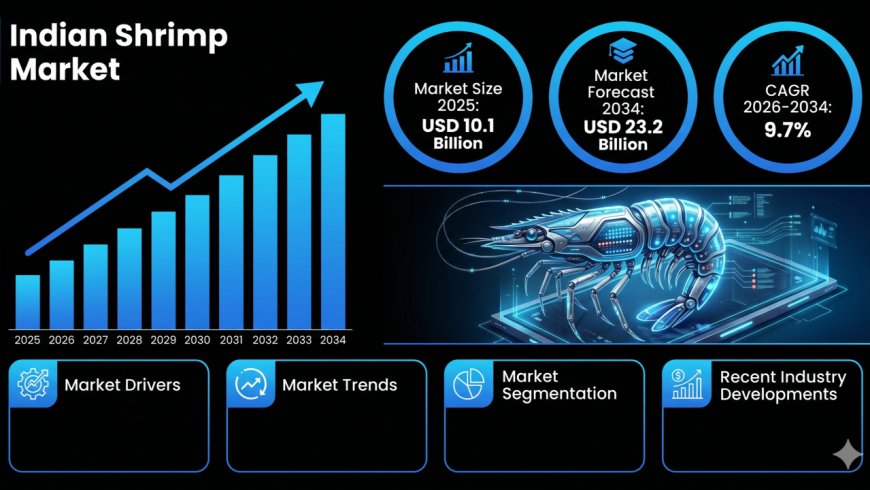
The Indian shrimp industry size was valued at USD 10.1 Billion in 2025 and is projected to reach USD 23.2 Billion by 2034, growing at a compound annual growth rate of 9.7% from 2026-2034.

According to IMARC Group’s report titled “Indian Shrimp Market Size, Share, Trends and Forecast by Species, Shrimp Size, and State, 2026-2034“, The report offers a comprehensive analysis of the industry, including Indian shrimp market forecast, growth and regional insights.
The Indian shrimp industry size was valued at USD 10.1 Billion in 2025 and is projected to reach USD 23.2 Billion by 2034, growing at a compound annual growth rate of 9.7% from 2026-2034.
India's aquaculture and seafood processing sector is structurally pivoting from raw commodity exports toward high-margin, value-added production to solidify its position as a primary global protein supplier.
- Market Expansion: The Indian shrimp market was valued at USD 10.1 Billion in 2025 and is projected to scale to USD 23.2 Billion by 2034.
- Steady Trajectory: Stakeholders can anticipate a robust CAGR of 9.7% during the 2026-2034 forecast period.
- Species Dominance: Penaeus vannamei (Whiteleg shrimp) commands a massive 72.15% market share (2025), driven by its high reproductive capacity and rapid growth cycles.
- Size Optimization: The 41-50 size category leads with a 21.84% share, representing the optimal balance between production economics and high-volume foodservice demand.
- Export Strength: Validating global reliance, India shipped 1.69 million metric tonnes of seafood worth USD 7.45 billion in FY 2024-25, with frozen shrimp dominating foreign exchange earnings.
The Strategic Market Challenge: Navigating the Indian Shrimp Market in India
A critical vulnerability within India’s seafood processing sector is the fragmented traceability and persistent risk of antibiotic residue non-compliance at the farm level. Leaders often overlook how decentralized small-holder farming complicates rigorous bio-security enforcement. This structural opacity exposes processors to severe export rejections from stringent regulatory markets like the EU and USA. Consequently, these supply chain disruptions erode profit margins, inflate testing overheads, and threaten the broader credibility of Indian marine exports on the global stage.
➤ Access Key Market Statistics and Actionable Insights - Request Sample Report: https://www.imarcgroup.com/indian-shrimp-market/requestsample
India's Strategic Vision for the Indian Shrimp Market
- Doubling Fisheries Exports: Under the Pradhan Mantri Matsya Sampada Yojana (PMMSY), the national macroeconomic target focuses on dramatically expanding inland and marine aquaculture infrastructure to double seafood export revenues.
- Disease-Free Broodstock Development: A core government priority is reducing reliance on imported Specific Pathogen Free (SPF) broodstock by establishing highly secure, localized multiplication centers to ensure genetic resilience.
- Value-Added Processing Hub: The strategic vision actively shifts policy support toward subsidizing domestic processing facilities, converting raw frozen blocks into breaded, marinated, and ready-to-cook SKUs for premium retail markets.
Why Invest in the Indian Shrimp Market: Key Growth Drivers & ROI
- High-Margin Value Addition: Global consumption patterns are rapidly shifting toward convenience seafood. Investing in automated processing, peeling, and breading lines allows manufacturers to transition from bulk commodity trading to high-margin retail SKUs, yielding superior ROI in international markets.
- Infrastructure and Capital Subsidies: Aggressive federal allocations for cold chain modernization and refrigerated logistics drastically lower initial capital expenditure. These subsidized frameworks protect operating margins by minimizing post-harvest spoilage and optimizing cold storage turnaround times across major coastal shipping routes.
- Tech-Enabled Aquaculture: The integration of Recirculating Aquaculture Systems (RAS) and biofloc technology allows for high-density, controlled-environment farming. Investors deploying capital into precision aquaculture mitigate weather-related yield volatility and ensure a consistent, year-round raw material supply for processing facilities.
Indian Shrimp Market Trends & Future Outlook
- Blockchain Traceability: The market is rapidly adopting end-to-end digital traceability, tracking harvest data from pond to plate to ensure absolute compliance with international food safety and sustainability certifications.
- Shift to Formulated Functional Aquafeeds: To maximize yield and immunity, farm operators are moving away from traditional feeds toward specialized, probiotic-infused nutritional formulations that lower mortality rates.
- Domestic Consumption Surge: While historically export-driven, expanding urban middle-class demographics and the proliferation of organized retail and foodservice chains are establishing a robust domestic consumption baseline for frozen shrimp.
- Eco-Certification Premiumization: Aquaculture operations are increasingly pursuing Best Aquaculture Practices (BAP) and Aquaculture Stewardship Council (ASC) certifications, enabling processors to command premium pricing in eco-conscious Western markets.
Regulatory Landscape & Policy Catalysts in India
- Coastal Aquaculture Authority (CAA) Mandates: According to the Ministry of Fisheries, Animal Husbandry and Dairying, the CAA stringently regulates farm registrations and enforces strict guidelines on stocking densities and bio-security to prevent disease outbreaks.
- MPEDA Export Facilitation: As managed by the Ministry of Commerce and Industry, the Marine Products Export Development Authority (MPEDA) continuously deploys financial assistance schemes for the modernization of processing plants and cold-chain infrastructure.
- Antibiotic Residue Monitoring: According to the Food Safety and Standards Authority of India (FSSAI) and the Export Inspection Council (EIC), rigorous pre-harvest and pre-shipment testing protocols are legally enforced to ensure zero tolerance for banned pharmacologically active substances.
- PMMSY Infrastructure Allocations: According to the Ministry of Fisheries, the Pradhan Mantri Matsya Sampada Yojana heavily subsidizes the integration of technology, including biofloc and RAS, formally catalyzing the transition to high-yield farming.
- FDI in Food Processing: According to Invest India, 100% Foreign Direct Investment is permitted under the automatic route for the food processing sector, actively encouraging institutional capital to upgrade domestic freezing and packaging capabilities.
➤ Explore the Exact Chapters and Data Scope - Get Full Brochure: https://www.imarcgroup.com/request?type=report&id=849&flag=A
By the IMARC Group, the Top Competitive Landscape & their Positioning:
Some of the key players include:
- Nekkanti Seafoods
- Avanti Frozen Foods Private Limited
- Devi Sea Foods Limited
- Falcon Marine Exports Ltd.
- BMR Group
- Baby Marine Eastern Exports
- Sandhya Marines
- Apex Frozen Foods Limited
- Ananda Aqua Exports Private Limited
- Crystal Sea Foods Private Limited
- Citrus Alpha Marine LLP
- Jaya Lakshmi Sea Foods Private Limited
- Ifb Agro Industries Limited
- S.S.F Limited
- A.M.Fisheries
- JRJ Sea Foods India Private Limited
- Anjaneya Sea Foods
- Kings Infra Ventures Limited
- Kadalkanny Frozen Foods
- The Waterbase Limited
- Geo Sea Foods Exports Private Limited
- Abad Fisheries Private Limited
- K V Marine Exports
- Liberty Group of Seafood Companies (Premier Marine Foods, Kader Exports Private Limited, Liberty Frozen Foods Private Limited, and Devi Marine Foods Exports Private Limited)
- Zeal Aqua Limited
- Frontline Exports Private Limited
- Jude Foods India Private Limited
Indian Shrimp Market Segmentation:
The market report offers a comprehensive analysis of the segments, highlighting those with the largest Indian shrimp market share. It includes forecasts for the period 2026-2034 and historical data from 2020-2025 for the following segments.
Species Insights:
- Penaeus Vannamei
- Penaeus Monodon
- Others
The penaeus vannamei segment dominates with a market share of 72.15% of the total Indian shrimp market in 2025.
Shrimp Size Insights:
- Size 31-40
- Size 41-50
- Size 51-60
- Size 61-70
- Size >70
- Others
The size 41-50 category leads with a share of 21.84% of the total Indian shrimp market in 2025.
State Insights:
- West Bengal
- Gujarat
- Andhra Pradesh
Andhra Pradesh exhibits clear dominance with a 78% share of the total Indian shrimp market in 2025.
Note: If you need specific information that is not currently within the scope of the report, we can provide it to you as a part of the customization.
➤ Shape the Data to Answer Your Specific Questions - Request Customization: https://www.imarcgroup.com/request?type=report&id=849&flag=E
Frequently Asked Questions (FAQs)
1. What is the current value and projected growth of the Indian Shrimp Market?
According to IMARC Group, the market was valued at USD 10.1 Billion in 2025 and is projected to reach USD 23.2 Billion by 2034, growing at a CAGR of 9.7% (2026–2034).
2. What is driving the growth of the market?
Growth is driven by strong global demand for protein-rich seafood, India’s position as a leading exporter, favorable coastal conditions, and advancements in aquaculture technologies.
3. Which shrimp species dominates the Indian market?
Penaeus vannamei dominates with around 72.15% share, due to its fast growth, high adaptability, and strong export demand.
4. What are the key trends in the Indian shrimp market?
Key trends include precision aquaculture, disease management technologies, cold chain development, and increasing focus on value-added shrimp products.
5. Which region leads shrimp production in India?
Andhra Pradesh leads with around 78% share, supported by strong aquaculture infrastructure and favorable farming conditions.
Strategic Insight & Verdict
Having analyzed the trajectory of India’s shrimp market, we observe a decisive shift toward value-added processing and traceability-led exports driven by evolving global quality standards. Demand is increasingly centered on certified, disease-free, and sustainably farmed products. Companies that invest in advanced aquaculture practices, cold chain infrastructure, and diversified export markets will secure long-term advantage as reliability and compliance become critical in global seafood trade.
Gaurav, Digital Market Research Strategist at IMARC Group: https://www.linkedin.com/in/gourav-shah-005425345 Verified Data Source: IMARC Group
Contact Us:
IMARC Group
134 N 4th St. Brooklyn, NY 11249, USA
Email: sales@imarcgroup.com
Tel No:(D) +91 120 433 0800
United States: +1-202071-6302
What's Your Reaction?