






























India Mustard Oil Market Size, Share, Emerging Trends and Outlook Report 2026-2034
The India mustard oil sector reached a valuation of USD 1.3 Billion in 2025. Looking forward, IMARC Group expects the sector to reach USD 1.8 Billion by 2034, exhibiting a compound annual growth rate (CAGR) of 4.03% during 2026-2034.

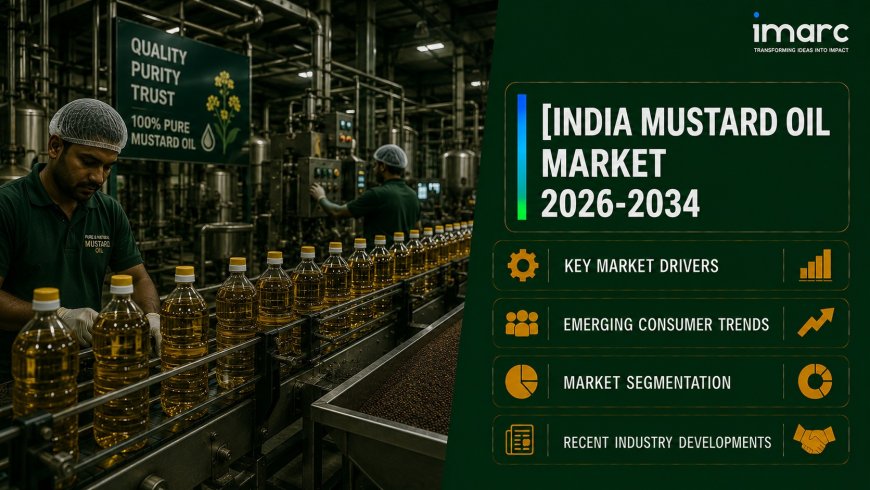
According to IMARC Group’s report titled “India Mustard Oil Market Size, Share, Trends and Forecast by Packaging Type, Packaging Material, Pack Size, Application, Distribution Channel, and Region, 2026-2034“, the report offers a comprehensive analysis of the industry, including market share, forecast, growth and regional insights.
What is the Financial Valuation of the India Mustard Oil Sector?
The India mustard oil sector reached a valuation of USD 1.3 Billion in 2025. Looking forward, IMARC Group expects the sector to reach USD 1.8 Billion by 2034, exhibiting a compound annual growth rate (CAGR) of 4.03% during 2026-2034.
What are the Key Developments and Emerging Shifts in the India Mustard Oil Sector?
Rising Preference for Cold-Pressed and Organic Variants
Consumers are actively seeking traditionally extracted, clean-label oils that retain natural nutrients without chemical processing. Urban populations show a strong willingness to pay premiums for certified organic variants and village-style artisanal extraction methods. For example, Marico Limited launched the Saffola Dual Seed Cold Pressed Oils range in June 2025 to meet the demand for minimally processed, health-focused options.
Expanding E-Commerce and Direct-to-Consumer Channels
Digital commerce is fundamentally reshaping distribution, enabling quick-commerce hyper-local access and subscription-based purchasing convenience. In August 2025, Anjali Gold partnered with Blinkit to enable direct-to-consumer rapid delivery of 100% pure mustard oil across major Indian cities. This rapid expansion particularly benefits specialty brands seeking nationwide reach without heavy physical retail investments.
Growing Emphasis on Sustainable and Traceable Sourcing
Sustainability considerations and supply chain transparency are increasingly influencing consumer purchasing decisions. Following the Union Cabinet's October 2024 approval of the National Mission on Edible Oils–Oilseeds, manufacturers are highlighting domestic farmer partnerships and regional sourcing credentials. Additionally, recyclable packaging and refill stations are emerging in metropolitan markets to address environmental awareness.
What Factors are Driving Growth in the India Mustard Oil Sector?
Deep-Rooted Cultural and Culinary Traditions
Mustard oil's pungent flavor profile defines authentic dish preparation across North and East India, creating a fundamental baseline of sustained demand. This cultural entrenchment, combined with traditional wellness associations documented in Ayurvedic practices, provides high market resilience against alternative cooking mediums.
Expanding Retail Infrastructure and Distribution Networks
The proliferation of organized retail and quick-commerce platforms is significantly enhancing accessibility and stimulating consumption across previously underserved areas. For instance, AWL Agri Business reported its quick-commerce channel growing over 40% annually in October 2025, reshaping how urban and rural consumers purchase daily staples.
How will the India Mustard Oil Sector Evolve in the Coming Years?
The sector is poised for steady revenue expansion supported by resilient domestic consumption, continuous urbanization, and rising household incomes. While challenges such as price volatility linked to mustard seed supply and intense competition from alternative refined oils persist, continuous innovation in sustainable packaging, premium cold-pressed variants, and value-added product lines will ensure robust, long-term industry expansion.
➤ Request Sample Report (TOC & Charts): https://www.imarcgroup.com/india-mustard-oil-market/requestsample
Deep-Dive Segment Insights:
Analysis by Packaging Type:
-
Pouches (Dominates with a 52% market share in 2025 due to cost efficiency, lightweight logistics, and flexible storage suited for budget-conscious households).
-
Jars.
-
Cans.
-
Bottles.
Analysis by Packaging Material:
-
Plastic (Leads with a 67% market share in 2025, favored for excellent moisture barrier properties, durability during transport, and visual transparency).
-
Metal.
-
Paper.
-
Others.
Analysis by Pack Size:
-
1 Litres (Holds a 36% market share in 2025, offering optimal affordability and manageable storage for typical nuclear family consumption cycles).
-
Less than 1 Litres.
-
1 Litres - 5 Litres.
-
5 Litres - 10 Litres.
-
10 Litres and Above.
Analysis by Application:
-
Household Cooking (Constitutes 67% of the market in 2025, driven by deeply embedded cultural culinary practices and high smoke-point frying suitability).
-
HoReCa.
-
Industrial Uses.
Analysis by Distribution Channel:
-
Convenience Stores (Commands 43% of the market in 2025, supported by neighborhood proximity, immediate availability, and localized community relationships).
-
Supermarkets and Hypermarkets.
-
Direct/Institutional Sales.
-
Online.
-
Others.
Regional Insights:
-
North India (Maintains dominance with a 31% market share in 2025 due to centuries-old regional cuisines and proximity to massive mustard seed cultivation hubs).
-
East India.
-
West and Central India.
-
South India.
Recent Market Developments:
-
Premium Product Launch (July 2025): HOAC Foods India Limited partnered with Kailash Foods to produce chemical-free Pure Black Mustard Oil under the "Hariom" brand at a modern Dausa facility, featuring a 5 lakh litre annual capacity.
-
Regenerative Agriculture Initiatives (September 2025): AWL Agri Business partnered with SEA and Solidaridad to establish 3,000 mustard model farms across nine districts, supporting 20,000 farmers under NMEOOS.
-
Health-Focused Additions (November 2025): Nutrica launched Nutrica Yellow Mustard Oil, an unrefined, natural cooking variant designed to retain antioxidants and authentic flavor for clean-label consumers.
-
Packaging Innovation (May 2024): Adani Wilmar introduced Fortune Pehli Dhaar First-Pressed Mustard Oil in both bottles and flexible pouches to cater to authenticity and premium taste preferences.
Competitive Landscape & Key Player Positioning:
Covering an in-depth analysis of the competitive landscape, market structure, key player positioning, competitive dashboards, top winning strategies, and detailed profiles of all major industry participants you will gain access to all these exclusive insights within the full research report.
Some of the key players include:
- Adani Wilmar Limited
- Emami Agrotech Ltd.
- Marico Limited
- Dabur India Ltd.
- Patanjali Ayurved Limited
- K. S. Oils Limited
- Puri Oil Mills Limited
- Bansal Oil Mill Ltd.
- NatureLand Organics
Customization Note: If you require any specific information not covered within this report's scope, we will provide it as part of the customization.
➤ Shape the Data to Answer Your Specific Questions - Request Customization: https://www.imarcgroup.com/request?type=report&id=2404&flag=E
Frequently Asked Questions (FAQs):
Q1. What is the overall valuation of the India mustard oil sector?
Ans. The India mustard oil sector was valued at USD 1.3 Billion in 2025.
Q2. What is the future outlook for the India mustard oil sector?
Ans. The sector is projected to reach USD 1.8 Billion by 2034, growing at a CAGR of 4.03% during 2026-2034.
Q3. Which packaging type held the largest market share?
Ans. Pouches represented the largest segment, commanding a 52% market share in 2025 due to their cost efficiency and flexible handling.
Q4. What is the leading application for mustard oil in India?
Ans. Household cooking dominates consumption, accounting for 67% of the total market in 2025.
Q5. What are the primary factors driving market expansion?
Ans. The market is primarily driven by deep-rooted cultural culinary traditions, expanding organized retail, and a growing consumer preference for natural, cold-pressed cooking oils.
Strategic Insight & Verdict
The India mustard oil sector presents a highly resilient, culturally entrenched expansion opportunity, advancing toward USD 1.8 Billion by 2034. The industry is structurally benefiting from a dual momentum: the steadfast reliance on traditional household cooking mediums across Northern and Eastern regions, and the surging urban demand for premium, clean-label, cold-pressed variants. Supported by government policies bolstering domestic oilseed cultivation and the rapid penetration of quick-commerce distribution networks, the sector offers an excellent environment for growth. Stakeholders who prioritize supply chain traceability, authentic extraction methods, and flexible packaging solutions will remain uniquely positioned to capture dominant market share across both price-sensitive and premium consumer demographics over the forecast period.
What's Your Reaction?