Market Overview
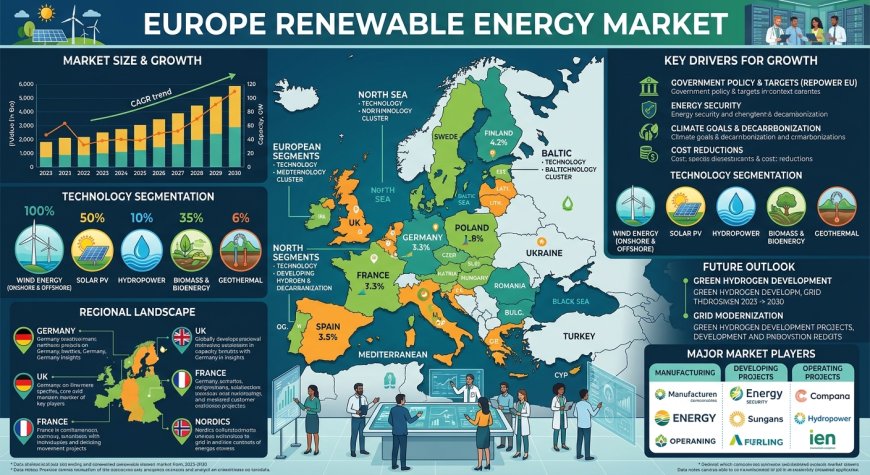
The Europe renewable energy market was valued at USD 258.83 Billion in 2025 and is projected to reach USD 465.13 Billion by 2034, growing at a CAGR of 6.73% during 2026–2034. The market is driven by the acceleration of the EU Green Deal and Fit for 55, the REPowerEU plan's response to energy-security imperatives, falling levelised cost of electricity (LCOE) for wind and solar, rapid scale-up of offshore wind in the North Sea and Baltic, corporate PPA expansion, and the emergence of green hydrogen. Wind power leads the technology mix at 33.1% share in 2025, industrial users account for 47.1% of demand, and Germany dominates country revenue with 24.0% of regional output.
The market encompasses the generation, transmission, and consumption of electricity and heat from renewable sources, including onshore and offshore wind, utility-scale and distributed solar photovoltaic and concentrated solar power, large-scale and run-of-river hydro, bioenergy, and a growing "others" layer that includes geothermal, marine energy, and emerging technologies such as green hydrogen. The market covers project development, equipment manufacturing, EPC services, grid integration, storage, and off-take through utilities, corporate PPAs, and retail supply. Growth from 2020 through 2034 reflects the continent's decisive pivot from fossil fuels to clean generation, propelled by the EU Green Deal, the REPowerEU plan, rapid cost declines in wind and solar, and record corporate and utility power-purchase-agreement activity across Germany, the UK, France, Spain, and Italy.
EUROPE RENEWABLE ENERGY MARKET SUMMARY
The Europe renewable energy market encompasses the generation, transmission, and consumption of electricity and heat from renewable sources, integrating utilities, independent power producers, equipment OEMs, EPC contractors, transmission and distribution system operators, storage integrators, flexibility aggregators, and corporate and retail off-takers across European countries.
The ecosystem spans wind-turbine and solar-module manufacturers, electrolyser and battery suppliers, project developers and IPPs, grid operators and interconnection providers, corporate PPA buyers including hyperscale cloud operators and heavy industry, and end users including industrial, residential, and commercial consumers.
By Type, the market is segmented into Wind Power (dominating, 33.1% share in 2025), Solar Power (32.6%), Hydro Power (18.9%), Bioenergy (10.8%), and Others (4.6%). By End User, the market is segmented into Industrial (dominating, 47.1% share), Residential (30.4%), and Commercial (22.5%). By Country, the market serves Germany (dominating, 24.0% share), United Kingdom (17.1%), France (15.0%), Spain (11.8%), Italy (10.5%), Netherlands (6.3%), Poland (5.7%), Russia (4.8%), Switzerland (2.6%), and Others (2.2%).
Key trends shaping the market include offshore wind industrialisation, green hydrogen and Power-to-X commercialisation, corporate PPAs and industrial electrification, battery storage and grid flexibility, and digitalisation, AI dispatch, and virtual power plants.
PORTER'S FIVE FORCES ANALYSIS – EUROPE RENEWABLE ENERGY MARKET
Competitive Rivalry: High. The market is moderately concentrated at the utility and offshore-wind tier, with Iberdrola, RWE, Ørsted, EDF, and Enel Green Power collectively operating a significant share of installed capacity. A strong challenger tier (Engie, Statkraft, Vattenfall, Equinor) competes alongside equipment OEMs (Vestas, Siemens Gamesa, Nordex), infrastructure funds (Copenhagen Infrastructure Partners, Macquarie Green Investment Group), and a rapidly growing layer of independent developers and storage specialists. Strategic consolidation around offshore wind, hydrogen, and storage platforms is reshaping the competitive landscape through 2034. Business implication: Scaled utilities must defend share through project pipelines, capital access, and integrated development capability while specialist developers and infrastructure funds compete for origination and financing opportunities.
Supplier Power (Equipment OEMs and Supply Chain): High. Critical inputs including wind turbines, PV modules, inverters, electrolysers, and subsea cables are concentrated among a limited number of global manufacturers. European wind OEMs faced persistent margin and quality challenges in 2023–2024, while solar supply chains remain heavily dependent on Chinese imports, exposing the sector to trade and security policy risk. Long procurement lead times, certification requirements, and supply-chain localisation mandates under the Net-Zero Industry Act further constrain substitution options. Business implication: Strategic partnerships with OEMs, long-term procurement frameworks, and investment in domestic manufacturing capability can reduce dependency and secure delivery certainty.
Buyer Power (Utilities, Corporate PPAs, and End Consumers): High. Industrial users account for 47.1% of demand, with hyperscale cloud operators, steel and aluminium producers, and automotive OEMs negotiating long-term corporate PPAs on price, volume, and additionality. Residential and commercial consumers exercise choice through rooftop solar, retail supply, and behind-the-meter generation, while utilities negotiate on wholesale power prices and auction outcomes. Business implication: Developers must deliver competitive LCOE, additionality, and ESG credentials to secure long-term off-take while demonstrating value to corporate and utility buyers.
Threat of Substitutes: Moderate. Renewables compete with fossil-fuel generation, nuclear power, and emerging technologies including carbon capture, small modular reactors, and hydrogen imports. Falling LCOE for wind and solar has made new-build renewables competitive with wholesale power prices across most European markets, while the EU Emissions Trading System carbon price progressively improves renewable economics. However, intermittency and storage gaps limit full substitution, and fossil-fuel backup capacity remains necessary for system security. Business implication: Demonstrating superior cost competitiveness, system integration, and sustainability relative to fossil and nuclear alternatives is essential to drive deployment and justify policy support.
Threat of New Entrants: Moderate. Barriers to entry include substantial capital requirements, permitting and grid-connection complexity, auction and CfD qualification requirements, and technical certification for equipment and grid integration. However, the growth of corporate PPAs, merchant project pipelines, and infrastructure-fund-backed platforms is enabling new developers and specialist investors to enter, while digital platforms and virtual power plants lower barriers in flexibility and aggregation. Business implication: Incumbents must leverage project pipelines, grid access, and long-term off-take relationships while monitoring new entrants targeting merchant, storage, and flexibility opportunities.
KEY ASPECTS REQUIRED FOR THE EUROPE RENEWABLE ENERGY MARKET
Market Performance: USD 258.83 Billion in 2025, projected to reach USD 465.13 Billion by 2034, driven by the EU Green Deal, REPowerEU, falling wind and solar LCOE, offshore-wind scale-up, corporate PPAs, and green hydrogen.
Market Outlook: A 6.73% CAGR through 2034 reflects sustained growth led by wind power dominance (33.1% share), industrial end-user leadership (47.1% share), and Germany's regional dominance (24.0% share), with Offshore Wind growing fastest at roughly 12–14% CAGR through 2030 and Battery Storage & Green Hydrogen as the next most dynamic layers.
Growth Drivers: EU Green Deal and Fit for 55 with the binding 2030 target of at least 42.5% renewable energy share under RED III; REPowerEU mobilising up to EUR 300 billion to accelerate renewables, reduce fossil-fuel imports, and scale hydrogen; falling LCOE of wind and solar unlocking subsidy-free project pipelines; record corporate PPA signings by hyperscale cloud operators, automotive groups, steel, chemicals, and FMCG companies; electrification of heat, transport, and industry; offshore wind scale-up under the European Wind Power Action Plan with over 300 GW of planned capacity by 2050; green hydrogen targets of 20 million tonnes by 2030 supported by the European Hydrogen Bank, H2Global, and IPCEI; grid investment exceeding EUR 584 billion by 2030 under the EU's 10-Year Network Development Plan; battery storage and flexibility scale-up.
Competitive Landscape: A market moderately concentrated at the utility and offshore-wind tier with Iberdrola, RWE, Ørsted, EDF Energy, and Enel Green Power as leaders, a strong challenger tier including Engie, Statkraft, Vestas, Siemens Gamesa, and Equinor, and active infrastructure funds including Copenhagen Infrastructure Partners, Macquarie Green Investment Group, Brookfield, KKR, and EQT Infrastructure. Recent developments include Iberdrola scaling its offshore-wind pipeline in the UK and Germany and expanding green-hydrogen projects across Puertollano and Bilbao in 2025, RWE advancing major German offshore-wind projects and several green-hydrogen-linked FID decisions under H2Global, and Ørsted progressing UK Hornsea extensions and the FlagshipONE and H2RES green-fuels projects.
Value Chain Analysis: From equipment manufacturing and OEMs through EPC and installation, project development and IPPs, grid, storage and flexibility, and off-take and consumption, with project developers and utilities capturing the highest strategic value by integrating origination, financing, construction, and long-term asset ownership. Equipment OEMs and grid specialists capture technology- and scale-driven margins, while TSOs and DSOs occupy regulated but structurally critical positions.
Industry Trends: Offshore wind industrialisation with cross-border North Sea and Baltic cooperation and floating wind advancing to commercial scale; green hydrogen and Power-to-X commercialisation with electrolyser manufacturing scaling in Germany, Spain, Denmark, and the Netherlands; corporate PPAs and industrial electrification led by hyperscale cloud operators and heavy industry; battery storage and grid flexibility expanding in the UK, Germany, Italy, and Spain; digitalisation, AI dispatch, and virtual power plants becoming core competitive tools for utilities, IPPs, and aggregators.
Strategic Recommendations: Invest in offshore and floating wind platforms capturing over 300 GW of planned North Sea and Baltic capacity by 2050; scale green hydrogen and Power-to-X capabilities leveraging the European Hydrogen Bank, H2Global, and IPCEI funding; develop grid-scale battery storage and flexibility platforms as variable-renewable penetration approaches 60–70% in leading markets; expand corporate PPA origination and industrial electrification offerings targeting steel, cement, chemicals, and hyperscale data centres; pursue utility-scale solar and solar-plus-storage opportunities in Spain, Italy, and Poland; invest in grid reinforcement and interconnection projects capturing EUR 584 billion of planned investment by 2030; develop AI-driven dispatch, virtual power plant, and digital flexibility capabilities; target emerging markets including Poland, Greece, Romania, and the Western Balkans supported by EU cohesion funds; strengthen presence in Germany as the largest and deepest renewable market; expand residential rooftop solar and heat-pump offerings under the EPBD and Solar Rooftop Initiative.
Request for Sample Report – https://www.imarcgroup.com/europe-renewable-energy-market/requestsample
MARKET GROWTH DRIVERS
Net-Zero and EU Green Deal Policy
The EU's binding 2030 target of at least 42.5% renewable energy share under RED III, the Fit for 55 package, and national net-zero commitments across Germany, the UK, France, and the Nordics provide a decade-long policy tailwind for new generation capacity and supporting infrastructure. This policy-backed demand foundation transcends short-term economic cycles, with the European Green Deal reinforcing renewables as the backbone of Europe's energy system and supporting structural investment across member states. The Net-Zero Industry Act further supports domestic manufacturing scale-up for wind, solar, batteries, and electrolysers, while the EU Emissions Trading System carbon price progressively improves renewable economics against fossil-fuel generation.
Energy Security and REPowerEU
REPowerEU, adopted in 2022 in response to the Russia-Ukraine conflict, mobilised up to EUR 300 billion to accelerate renewables, reduce fossil-fuel imports, and scale hydrogen. The programme dramatically elevated the political priority of wind, solar, and storage deployment across member states, with energy-security imperatives now reinforcing climate policy as a dual driver of deployment. The EU has mobilised over €700 billion through the Recovery and Resilience Facility, the core instrument of NextGenerationEU, to fund reforms and investments supporting the green transition and infrastructure development across member states. This has accelerated permitting reform under RED III, grid expansion by ENTSO-E member TSOs, and the scale-up of storage and flexibility resources.
Falling LCOE of Wind and Solar
Continued cost declines in solar PV modules, inverters, and onshore and offshore wind turbines have made new-build renewables competitive with wholesale power prices across most European markets, unlocking subsidy-free project pipelines and competitive auction outcomes. Utility-scale solar continues to benefit from record low module pricing, bifacial and TOPCon technology adoption, and dedicated European manufacturing initiatives under the Net-Zero Industry Act. Agri-PV, floating solar, and solar-plus-storage hybrids are emerging sub-segments across Germany, France, the Netherlands, and Spain, while fixed-bottom offshore wind scales rapidly in the North Sea, Baltic, and Irish Sea, and floating offshore wind advances from prototype to commercial scale through projects in Scotland, Norway, and France.
Corporate PPAs and Electrification
Record corporate PPA signings by hyperscale cloud operators, automotive groups, steel, chemicals, and fast-moving-consumer-goods companies, combined with the structural electrification of heat (heat pumps), transport (EVs), and industry, is expanding clean-electricity demand well beyond the traditional utility off-take channel. Industrial users account for 47.1% of consumption, reflecting the decarbonisation of steel, chemicals, cement, and manufacturing through corporate PPAs and on-site generation, with hyperscale cloud operators (Amazon, Microsoft, Google, Meta) now among the largest corporate PPA buyers across the Nordics, Iberia, and Ireland. Industrial electrification—heat pumps for process heat, electric arc furnaces, and green-hydrogen-based DRI steel—is converting a large share of heavy-industry demand into clean-electricity demand through 2034.
Offshore Wind Scale-up
The European Wind Power Action Plan, national North Sea and Baltic Sea agreements, and UK Contracts for Difference rounds are unlocking over 300 GW of planned offshore-wind capacity by 2050, representing a multi-hundred-billion-euro opportunity for developers, EPCs, OEMs, and supply-chain investors. Offshore wind is moving from project-led deployment to industrialised delivery across the North Sea, Baltic Sea, Irish Sea, and Atlantic coasts, with Denmark, the UK, Germany, the Netherlands, and Belgium jointly scaling cross-border cooperation. Floating offshore wind is now advancing from prototype to commercial-scale projects in France, Norway, and the UK, opening deep-water sites that were previously inaccessible.
Green Hydrogen and Power-to-X
REPowerEU targets 20 million tonnes of renewable hydrogen (10 Mt domestic production, 10 Mt imports) by 2030, supported by the European Hydrogen Bank, H2Global, and Important Projects of Common European Interest (IPCEI), anchoring a new demand layer for dedicated renewables and electrolysers. Electrolyser manufacturing capacity is scaling rapidly in Germany, Spain, Denmark, and the Netherlands, with Siemens Energy, Nel, Thyssenkrupp Nucera, Sunfire, McPhy, and ITM Power investing in alkaline, PEM, and emerging SOEC technologies. Flagship green-hydrogen projects such as H2Global, HyDeal, and NortH2 are moving toward final investment decisions, catalysed by the European Hydrogen Bank and IPCEI funding.
Grid Reinforcement and Storage
The EU's 10-Year Network Development Plan and national TSO investment plans together require over EUR 584 billion of grid investment by 2030, alongside rapidly expanding battery-storage deployment, providing long-duration opportunities for grid specialists and storage integrators. Grid-scale battery storage is expanding rapidly in the UK, Germany, Italy, and Spain, supported by capacity-market reforms, ancillary-services revenues, and rising price volatility. Long-duration storage, pumped hydro upgrades, and demand-side flexibility platforms are scaling in parallel to address increasing variable-renewable penetration, with AI-driven forecasting, virtual power plants, and smart-meter-enabled flexibility becoming core competitive tools for utilities, IPPs, and aggregators.
EUROPE RENEWABLE ENERGY MARKET SEGMENTATION
Type Insights: Wind power leads the market with a 33.1% share in 2025, reflecting the scale of onshore capacity across Germany, Spain, France, and the UK, combined with the acceleration of offshore projects in the North Sea, Baltic Sea, Irish Sea, and Atlantic coast under the European Wind Power Action Plan. Onshore wind remains the dominant installed capacity base, while offshore wind is the fastest-growing generation segment, driven by the North Sea and Baltic Sea agreements, UK Contracts for Difference allocations, and accelerating German and Dutch tender pipelines. Solar power accounts for 32.6%, powered by REPowerEU's 600+ GW solar target for 2030, record rooftop penetration in Germany and the Netherlands, and utility-scale additions in Spain, Italy, and Poland. Hydro power (18.9%) remains the largest renewable baseload source, anchored by large reservoir assets in Norway, Sweden, Austria, France, and Switzerland, supporting grid flexibility alongside variable renewables. Bioenergy contributes 10.8%, driven by biomass power, biogas, and biomethane, particularly in Germany, Sweden, Finland, and Italy. The "others" category (4.6%) captures geothermal, marine energy, and emerging technologies such as green hydrogen-to-power and concentrated solar power, all positioned as long-duration growth frontiers through 2034.
End User Insights: Industrial end users represent 47.1% of demand in 2025, reflecting Europe's intensified industrial decarbonisation push. Heavy industry segments—steel, cement, chemicals, aluminium, refining—are procuring renewable electricity through long-term corporate PPAs, direct on-site generation, and green-hydrogen supply agreements, with hyperscale cloud operators now among the largest corporate PPA buyers across the Nordics, Iberia, and Ireland. Residential end users account for 30.4%, supported by rooftop solar, residential battery storage, and heat-pump electrification under the Energy Performance of Buildings Directive, with Germany, the Netherlands, Belgium, Austria, and Italy leading residential PV penetration. Commercial users capture 22.5%, anchored by retail, logistics, healthcare, education, and office sectors deploying rooftop solar, behind-the-meter storage, and corporate PPAs to meet CSRD-aligned emissions targets, with EV-charging infrastructure emerging as a significant commercial-demand driver, particularly in Germany, France, the UK, and the Nordics.
Country Insights: Germany commands 24.0% of Europe renewable energy revenue in 2025, reflecting the scale of its installed onshore-wind and solar base, the Energiewende framework, and the federal EUR 500 billion climate and infrastructure fund. Germany is also the European leader in residential rooftop solar, heat-pump deployment, and emerging green-hydrogen infrastructure under the National Hydrogen Strategy and H2Global. The United Kingdom contributes 17.1%, anchored by the world's most developed offshore-wind cluster, the Contracts for Difference framework, and the Future System Operator reforms, with UK grid-scale battery storage the most liquid market in Europe and the UK also leading on nascent floating-offshore-wind deployment and the Hydrogen Business Model. France accounts for 15.0%, with a balanced portfolio of hydro, onshore wind, solar, and a rapidly scaling offshore-wind pipeline, supported by the €54 billion France 2030 investment plan and the Multiannual Energy Programme (PPE). Spain captures 11.8% on the back of Europe's most active utility-scale solar market, a strong onshore-wind base, corporate PPA leadership, and Andalusia- and Aragón-focused green-hydrogen valleys. Italy represents 10.5%, underpinned by the PNRR Recovery Plan, the PNIEC energy-and-climate plan, and rapid utility-scale solar deployment. The Netherlands (6.3%) leads Europe in rooftop-solar density, offshore-wind tendering, and green-hydrogen infrastructure, while Poland (5.7%) is scaling onshore wind, solar, and early-stage offshore wind in the Baltic. Russia (4.8%), Switzerland (2.6%), and Others (2.2%) complete the regional mix, with the Nordics, Ireland, Austria, Greece, and the Balkans continuing to expand wind, solar, hydro, and geothermal deployment through 2034.
COMPETITIVE LANDSCAPE
The market research report has also provided a comprehensive analysis of the competitive landscape. Competitive analysis such as market structure, key player positioning, top winning strategies, competitive dashboard, and company evaluation quadrant has been covered in the report. Also, detailed profiles of all major companies have been provided.
The Europe renewable energy market's competitive landscape is moderately concentrated at the utility and offshore-wind tier, with Iberdrola, RWE, Ørsted, EDF, and Enel Green Power collectively operating a significant share of installed capacity. A strong challenger tier (Engie, Statkraft, Vattenfall, Equinor) competes alongside equipment OEMs (Vestas, Siemens Gamesa, Nordex), infrastructure funds (Copenhagen Infrastructure Partners, Macquarie Green Investment Group), and a rapidly growing layer of independent developers and storage specialists. Iberdrola is Europe's largest renewable-energy operator by installed capacity, headquartered in Bilbao, Spain, with more than 42 GW of renewable capacity globally and a deep pan-European footprint led by Spain, the UK, and Portugal. RWE is Germany's largest power generator and a global leader in renewable energy, headquartered in Essen, targeting over 65 GW of renewable capacity by 2030 through its Growing Green strategy. Ørsted is the world's most established offshore-wind pure-play, headquartered in Fredericia, Denmark, and remains the largest owner and operator of offshore-wind assets globally, with a European portfolio anchored by the UK, Denmark, Germany, and the Netherlands. EDF Energy operates a pan-European portfolio with offshore and solar scale-up. Enel Green Power leads on Italy base, utility-scale solar, and wind. Engie and Statkraft are challengers with diversified renewables plus energy-services platforms and Europe's largest hydro producer respectively. Vestas and Siemens Gamesa are leading wind-turbine OEMs, while Equinor is an emerging floating offshore-wind pioneer.
Investment opportunities exist in offshore and floating wind, green hydrogen and Power-to-X, utility-scale solar and solar-plus-storage, grid-scale batteries, grid reinforcement and interconnectors, corporate PPA platforms, and digital flexibility and virtual-power-plant operators. Strategic capital continues to concentrate in offshore-wind platforms, battery storage, green hydrogen, digital grid tools, and virtual-power-plant operators, with Copenhagen Infrastructure Partners, Macquarie Green Investment Group, Brookfield, KKR, and EQT Infrastructure among the most active pan-European investors.
REGIONAL ANALYSIS
Germany commands 24.0% of Europe renewable energy revenue in 2025, reflecting the scale of its installed onshore-wind and solar base, the Energiewende framework, and the federal EUR 500 billion climate and infrastructure fund. Germany is also the European leader in residential rooftop solar, heat-pump deployment, and emerging green-hydrogen infrastructure under the National Hydrogen Strategy and H2Global, with a strong industrial-decarbonisation pipeline supported by H2Global and the National Hydrogen Strategy.
The United Kingdom contributes 17.1% of regional revenue, anchored by the world's most developed offshore-wind cluster, the Contracts for Difference framework, and the Future System Operator reforms. UK grid-scale battery storage is the most liquid market in Europe, and the UK also leads on nascent floating-offshore-wind deployment and the Hydrogen Business Model.
France accounts for 15.0%, with a balanced portfolio of hydro, onshore wind, solar, and a rapidly scaling offshore-wind pipeline. France's energy transition is supported by the €54 billion France 2030 investment plan and the Multiannual Energy Programme (PPE), which together drive long-term investment in renewables, low-carbon technologies, and energy infrastructure.
Spain captures 11.8% on the back of Europe's most active utility-scale solar market, a strong onshore-wind base, corporate PPA leadership, and Andalusia- and Aragón-focused green-hydrogen valleys.
Italy represents 10.5%, underpinned by the PNRR Recovery Plan, the PNIEC energy-and-climate plan, and rapid utility-scale solar deployment. The Netherlands (6.3%) leads Europe in rooftop-solar density, offshore-wind tendering, and green-hydrogen infrastructure. Poland (5.7%) is scaling onshore wind, solar, and early-stage offshore wind in the Baltic. Russia (4.8%), Switzerland (2.6%), and Others (2.2%) complete the regional mix, with the Nordics, Ireland, Austria, Greece, and the Balkans continuing to expand wind, solar, hydro, and geothermal deployment through 2034.
RECENT INDUSTRY DEVELOPMENTS
2025–2026 Activity: The Europe renewable energy market continued its growth trajectory from USD 258.83 Billion in 2025 toward USD 465.13 Billion by 2034 at a CAGR of 6.73%, supported by record offshore-wind and solar deployment, corporate PPAs, and accelerating industrial and residential electrification.
2025: Iberdrola continued to scale its offshore-wind pipeline in the UK, Germany, and the US, commissioned new Iberian solar and storage assets, and expanded green-hydrogen projects across Puertollano and Bilbao.
2025: RWE continued delivery of major German offshore-wind projects, expanded its UK and Iberian solar-and-storage portfolio, and advanced several green-hydrogen-linked FID decisions under H2Global.
2025: Ørsted refined its project pipeline following 2023–2024 portfolio repricing, progressed UK Hornsea extensions, and advanced the FlagshipONE and H2RES green-fuels projects.
2022–2025: REPowerEU mobilised up to EUR 300 billion to accelerate renewables, reduce fossil-fuel imports, and scale hydrogen, while the EU mobilised over €700 billion through the Recovery and Resilience Facility to fund green-transition reforms and investments across member states.
FREQUENTLY ASKED QUESTIONS
Q1: What is the current size of the Europe renewable energy market?
A: The market was valued at USD 258.83 Billion in 2025 and is projected to reach USD 465.13 Billion by 2034, exhibiting a CAGR of 6.73% from 2026–2034.
Q2: What are the key drivers of the Europe renewable energy market?
A: The market is driven by: (i) the EU Green Deal and Fit for 55 with the binding RED III target of 42.5% renewable share by 2030; (ii) REPowerEU mobilising up to EUR 300 billion for energy security and renewables; (iii) falling LCOE of wind and solar; (iv) record corporate PPA volumes from hyperscale cloud operators and heavy industry; (v) electrification of heat, transport, and industry; (vi) offshore-wind scale-up under the European Wind Power Action Plan; (vii) green hydrogen targets of 20 million tonnes by 2030 supported by the European Hydrogen Bank, H2Global, and IPCEI; and (viii) grid investment exceeding EUR 584 billion by 2030.
Q3: What are the major segments in the Europe renewable energy market?
A: Major segments include Type (Wind Power dominating at 33.1%, Solar Power at 32.6%, Hydro Power at 18.9%, Bioenergy at 10.8%, Others at 4.6%), End User (Industrial dominating at 47.1%, Residential at 30.4%, Commercial at 22.5%), and Country (Germany dominating at 24.0%, United Kingdom at 17.1%, France at 15.0%, Spain at 11.8%, Italy at 10.5%, Netherlands at 6.3%, Poland at 5.7%, Russia at 4.8%, Switzerland at 2.6%, Others at 2.2%). Wind power dominates reflecting onshore capacity scale and offshore acceleration, while industrial end users dominate driven by corporate PPAs, heavy-industry decarbonisation, and hyperscale data-centre demand.
Q4: Which country leads the Europe renewable energy market?
A: Germany leads with a 24.0% share in 2025, reflecting its installed onshore-wind and solar base, the Energiewende framework, the federal EUR 500 billion climate and infrastructure fund, and a strong industrial-decarbonisation pipeline. The UK at 17.1% is anchored by offshore-wind leadership and CfD rounds, France at 15.0% by its hydro and nuclear backbone plus offshore-wind pipeline, Spain at 11.8% by utility-scale solar and green-hydrogen valleys, and Italy at 10.5% by the PNRR Recovery Plan and utility-scale solar.
Q5: What are the challenges facing the Europe renewable energy market?
A: Key challenges include capex intensity and high interest rates compressing returns on offshore-wind projects and increasing the cost of capital; permitting and grid-connection delays in Germany, France, and the UK remaining the single largest deployment bottleneck; supply-chain and raw-material risk with European wind OEMs facing margin and quality challenges and solar supply chains dependent on Chinese imports; intermittency and storage gaps creating curtailment and negative price events; a structural workforce and skills gap in wind technicians, solar installers, grid engineers, and offshore construction specialists; and social acceptance and land-use opposition lengthening approval timelines.
Q6: What is the outlook for the Europe renewable energy market?
A: The market is projected to grow at a 6.73% CAGR through 2034, reaching USD 465.13 Billion, representing over USD 206 billion of incremental investment and revenue across generation, grid, and storage assets. Three key shifts will reshape the market through 2034: offshore wind transitioning from project-led delivery to industrialised, cross-border scale-up and becoming the single largest incremental generation source by 2030; green hydrogen and Power-to-X moving from pilot to commercial deployment and anchoring a new demand layer for dedicated renewables and grid expansion; and battery storage, grid digitalisation, and flexibility platforms becoming structural revenue engines as variable-renewable penetration approaches 60–70% of generation in leading markets. Germany, the UK, France, Spain, and Italy will retain their combined majority of regional revenue, while the Netherlands, Poland, and the Nordics will outpace the regional average.
Q7: Who are the key players in the Europe renewable energy market?
A: Key players include Iberdrola, RWE, Ørsted, EDF Energy, and Enel Green Power, among others. Iberdrola is Europe's largest renewable-energy operator by installed capacity with more than 42 GW globally and a pan-European footprint led by Spain, the UK, and Portugal, focused on long-term asset ownership, offshore-wind leadership, green-hydrogen integration, and regulated-networks investment. RWE is Germany's largest power generator targeting over 65 GW of renewable capacity by 2030 through its Growing Green strategy, emphasising scaled offshore-wind delivery, hybrid solar-plus-storage, and hydrogen-ready flexible generation. Ørsted is the world's most established offshore-wind pure-play and largest owner-operator of offshore-wind assets globally, focused on disciplined project delivery, selective Power-to-X investment, and geographic diversification. EDF Energy operates a pan-European portfolio with offshore and solar scale-up, while Enel Green Power leads on Italy base, utility-scale solar, and wind. Engie, Statkraft, Vestas, Siemens Gamesa, and Equinor complete the competitive landscape as challengers and emerging players.
Note: If you need any specific information that is not covered currently within the scope of the report, we will provide the same as a part of customization.
https://www.imarcgroup.com/request?type=report&id=20962&flag=E
Report Format, Delivery, and Customization Details
Report Format Mode: PPT, PDF, and Excel
Report Delivery Mode: Online Delivery, Physical Delivery
Report Delivery Time: Report Delivered Over Email within 24 to 48 hours. If requested by the client, a physical copy will be delivered within three to ten days.
Report Confirmation Mode: Yes via Email
Report Customization Mode: Yes via Email / Call
Report Table of Content: Yes
Report List of Figures: Yes
Report Methodology Mode: Yes
Request For Sample Report: Yes