




























Europe Printer Market Projected to Reach USD 19.6 Billion by 2034
Explore the Europe printer market, valued at USD 13.7 billion in 2025, with insights into growth forecasts, multifunction printers, and sustainable printing trends through 2034.

Market Overview
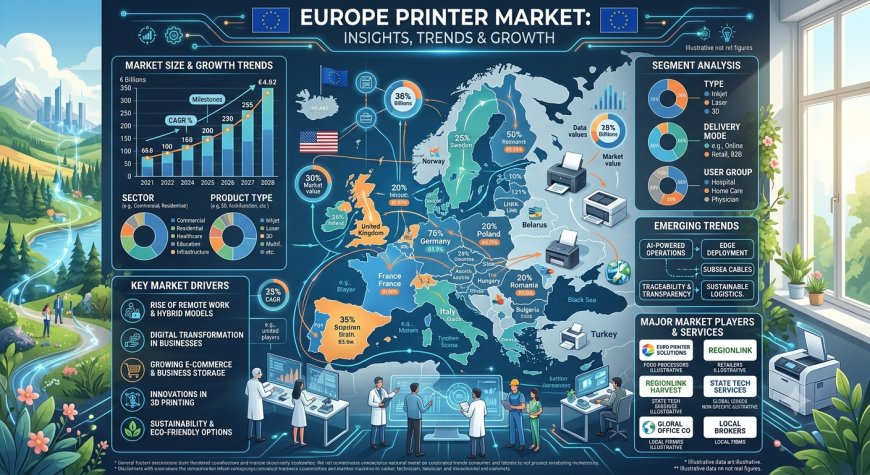
The Europe printer market size was valued at USD 13.7 Billion in 2025. The market is expected to reach USD 19.6 Billion by 2034, exhibiting a CAGR of 3.94% from 2026-2034. The market is experiencing growth driven by advancements in multifunction printing technology and increasing demand for personalized and eco-friendly solutions. Additionally, rising product adoption across industries, such as education, healthcare, and retail is also contributing to the market revenue.
The Europe printer market encompasses multi-functional and standalone printers, spanning dot matrix, inkjet, LED, thermal, and laser technologies, with wired and wireless interfaces, serving residential, commercial, educational institutions, enterprises, government, and other end users across Germany, France, United Kingdom, Italy, Spain, and other European countries.
This market is strategically important to Europe's office productivity, industrial manufacturing, retail operations, and public sector documentation, supporting businesses of all sizes in document production, labeling, and specialty printing across the continent. The market is shaped by continuous advancements in printing technology meeting the rising demand for high-speed, high-resolution printers across various sectors. Businesses are highly adopting multifunction printers that combine printing, scanning, and copying capabilities, reducing operational costs, and improving efficiency. The demand is further amplified by the growing need for customized printing solutions in industries like advertising, packaging, and retail, where branding and personalization play critical roles. Additionally, the shift towards eco-friendly printing solutions driven by stricter environmental regulations has led to raised investments in energy-efficient and sustainable printers. For example, in May 2024, Mutoh's HydrAton 1642 Printer featured innovative water-based UV printing technology, revolutionary print-dry processes, and unique ink film formation emphasizing sustainability and safer printing environments. The propelling digitization across industries has heightened demand for high-quality printers for documentation and record-keeping purposes, with sectors like education, healthcare, and banking requiring reliable and secure printing solutions, especially for sensitive or regulated documents. Moreover, the rise of small and medium-sized enterprises (SMEs) in Europe has boosted the adoption of affordable and compact printing devices tailored to their needs, while improved distribution networks and competitive pricing strategies by key players make these printers highly accessible to businesses of all sizes. The combined innovative leasing models and subscription-based services are creating robust demand for printers across the European market.
The Europe printer market is poised for sustained expansion, underpinned by the shift toward multifunctional and compact printers, rising demand for sustainable and eco-friendly printing, and integration of advanced printing technologies including 3D printing, AI, and IoT. With a projected CAGR of 3.94% through 2034, the market presents significant opportunities for providers focusing on multifunction and compact devices for hybrid work, sustainable and energy-efficient printing solutions, cartridge recycling and extended equipment lifecycles, 3D printing and industrial applications, AI-enabled predictive maintenance and security, wireless and mobile printing capabilities, thermal and label printing for retail and logistics, and subscription and leasing models.
EUROPE PRINTER MARKET SUMMARY
The Europe printer market encompasses the design, manufacture, distribution, and servicing of printing devices for document production, imaging, labeling, and industrial applications across the continent.
The ecosystem spans printer manufacturers (Canon, Ricoh, Fujifilm, Heidelberg, EOS, SATO Holdings, Toshiba, Mutoh), component and consumable suppliers including toner, ink, and cartridge providers, software and connectivity solution providers, distribution channel operators including office equipment dealers, IT resellers, and e-commerce platforms, leasing and managed print service providers, recycling and remanufacturing operators, and end users across residential, commercial, educational, enterprise, government, healthcare, and logistics sectors throughout Europe.
By Printer Type, the market is segmented into Multi-Functional and Standalone.
By Technology Type, the market is segmented into Dot Matrix Printer, Inkjet Printer, LED Printer, Thermal Printer, and Laser Printer.
By Printer Interface, the market is segmented into Wired and Wireless.
By End User, the market is segmented into Residential, Commercial, Educational Institutions, Enterprises, Government, and Others.
By Country, the market serves Germany, France, United Kingdom, Italy, Spain, and Others.
Key trends shaping the market include shift towards multifunctional and compact printers, rising demand for sustainable and eco-friendly printing, integration of advanced printing technologies including 3D printing, AI, and IoT, wireless and mobile printing standardisation, predictive maintenance capabilities, subscription and leasing models, and growth of thermal and label printing for retail and logistics.
PORTER'S FIVE FORCES ANALYSIS – EUROPE PRINTER MARKET
Competitive Rivalry: High. The market features intense competition among global printer manufacturers including Canon, Ricoh, Fujifilm, Heidelberg, EOS, SATO Holdings, and Toshiba, alongside regional players and consumable suppliers. Competition centres on technology innovation, print quality, speed, security features, sustainability credentials, total cost of ownership, and service and support capability. Manufacturers are focusing on sustainability initiatives including eco-friendly inks, energy-efficient processes, and recyclable materials to meet regulatory and consumer expectations. Business implication: Companies must differentiate through technology innovation, sustainability credentials, security capability, and managed service offerings.
Supplier Power (Component and Consumable Providers): Moderate. Printer manufacturers depend on suppliers of print heads, imaging components, toner, ink, and electronic components. Specialised components such as precision print heads and advanced ink formulations are concentrated among limited suppliers, conferring moderate power, while consumables represent recurring revenue with brand-locked compatibility. Business implication: Long-term supply agreements, vertical integration in consumables, and diversified component sourcing can reduce dependency and protect margin streams.
Buyer Power (Businesses and Consumers): High. Business buyers including enterprises, government, and educational institutions negotiate substantial contracts demanding cost efficiency, security compliance, reliability, and managed service support, while SMEs and residential consumers are price-sensitive and increasingly favour multifunction devices that optimize space and cost. The availability of leasing models and subscription-based services shifts purchasing toward total cost of ownership considerations. Business implication: Providers must deliver competitive pricing, multifunction value, security assurance, and flexible acquisition models to win and retain customers.
Threat of Substitutes: Moderate to High. Digital documentation, electronic workflows, cloud storage, and paperless office initiatives substitute for printing in many document applications, particularly in enterprises and government. Within printing, alternative technologies substitute across one another based on application requirements, and digital signage and electronic labeling substitute for printed materials in retail and logistics applications at the margin. Business implication: Demonstrating irreplaceable value in specialty, regulated, and physical documentation applications is essential to defend share against digital substitutes.
Threat of New Entrants: Moderate. Established brand equity, distribution networks, and technology investment create barriers at the hardware manufacturing tier. However, 3D printing innovation, specialty label printing, and consumable remanufacturing have enabled new entrants focused on niche capabilities, while digital-native brands and direct-to-consumer models reduce distribution barriers. Business implication: Incumbents must leverage brand trust, service networks, and technology leadership while monitoring niche and specialty entrants.
KEY ASPECTS REQUIRED FOR THE EUROPE PRINTER MARKET
Market Performance: USD 13.7 Billion in 2025, projected to reach USD 19.6 Billion by 2034, driven by multifunction technology advancement, personalization demand, eco-friendly solutions, and industry adoption across education, healthcare, and retail.
Market Outlook: A 3.94% CAGR through 2034 reflects steady growth led by multifunctional printers, laser and inkjet technologies, wireless interfaces, enterprise and commercial end users, and Germany's regional dominance.
Growth Drivers: Advancements in printing technology meeting demand for high-speed, high-resolution printers; business adoption of multifunction printers combining printing, scanning, and copying to reduce operational costs; growing need for customized printing in advertising, packaging, and retail where branding and personalization are critical; shift toward eco-friendly printing driven by stricter environmental regulations and investment in energy-efficient and sustainable printers (Mutoh's HydrAton 1642 water-based UV printing technology); propelling digitization across industries demanding high-quality printers for documentation and record-keeping in education, healthcare, and banking; rise of SMEs boosting adoption of affordable and compact devices; improved distribution networks and competitive pricing; innovative leasing models and subscription-based services; 3D printing and industrial applications (EOS P3 NEXT offering 50% productivity gains and 30% cost reductions); AI and IoT integration for predictive maintenance and real-time monitoring.
Competitive Landscape: A dynamically evolving market driven by technological influences, industry-specific requirements, and growing attention toward sustainability. Manufacturers are focusing on sustainability initiatives with eco-friendly inks, energy-efficient processes, and recyclable materials, while innovations in digital and offset printing reshape commercial printing, packaging, and publishing segments.
Value Chain Analysis: From component and consumable sourcing through printer manufacturing and assembly, software and connectivity integration, distribution through office equipment dealers and IT resellers, leasing and managed print service provision, consumable supply and recycling, and end use across residential, commercial, educational, enterprise, government, and specialty applications.
Industry Trends: Shift toward multifunctional and compact printers (Fujifilm Apeos series A3 multifunction printers launched April 2024 with superior productivity, security, and sustainability for hybrid work); rising demand for sustainable and eco-friendly printing (energy-efficient devices, recycled cartridges, waterless inks, duplex printing, toner-saving modes, cartridge recycling programs); integration of advanced printing technologies (3D printing, high-speed inkjet, precision laser, EOS P3 NEXT industrial SLS 3D printer with 50% productivity gains; Heidelberg Jetfire uniting offset and digital printing; Canon imageFORCE C7165 with Machine Learning AI for security and predictive maintenance); AI and IoT enabling predictive maintenance and real-time monitoring; wireless and mobile printing standardisation; thermal and label printing growth for retail, logistics, and healthcare (SATO LR4NX series, Toshiba BX410T industrial label printer); subscription and leasing models.
Strategic Recommendations: Invest in multifunction and compact printer development for hybrid work environments; develop sustainable and energy-efficient printing solutions with eco-friendly materials and cartridge recycling programs; expand 3D printing and industrial application capability; integrate AI and IoT for predictive maintenance, security, and real-time monitoring; develop thermal and label printing solutions for retail, logistics, and healthcare; build managed print services and subscription-based offerings; strengthen wireless and mobile printing capability; expand distribution networks and competitive pricing strategies for SME accessibility; pursue industry-specific customization for education, healthcare, and government; invest in security features including AI-based threat detection and environment estimation technology; expand presence in Germany and other leading European markets.
Request for Sample Report: https://www.imarcgroup.com/europe-printer-market/requestsample
MARKET GROWTH DRIVERS
Shift Towards Multifunctional and Compact Printers
The Europe printer market is experiencing a growing trend toward multifunctional and compact printing devices. For example, Fujifilm's Apeos series A3 multifunction printers launched in April 2024 across Europe are offering superior productivity, security, and sustainability, catering to hybrid work needs with advanced digital transformation features. Furthermore, businesses are intensely investing in all-in-one printers that offer printing, scanning, copying, and faxing capabilities in a single unit. This trend is especially prominent among SMEs seeking to optimize office space and reduce equipment costs. Compact designs are also appealing to home office setups, driven by remote work adoption. Manufacturers are responding by offering devices with advanced connectivity options like Wi-Fi and cloud integration, making them suitable for both professional and personal use. Enhanced functionality combined with user-friendly interfaces is making multifunctional printers a preferred choice across various sectors, including retail, healthcare, and education.
Rising Demand for Sustainable and Eco-Friendly Printing
Environmental sustainability is supporting the Europe printer market growth, driven by increasing regulations and consumer awareness. Businesses are prioritizing energy-efficient printers and devices that use eco-friendly materials and consumables, such as recycled cartridges and waterless inks. The growing trend toward reducing carbon footprints has led manufacturers to develop products with lower energy consumption and minimal waste generation. Features like duplex printing and toner-saving modes are gaining traction as they align with sustainability goals. Additionally, programs for cartridge recycling and extended equipment lifecycles are gaining popularity. These innovations are not only addressing regulatory compliance but also enhancing brand image, making eco-conscious printing solutions a critical driver in the market's evolution.
Integration of Advanced Printing Technologies
Technological advancements are transforming the Europe printer market with innovations such as 3D printing, high-speed inkjet, and precision laser technologies. For instance, in November 2024, EOS unveiled the P3 NEXT, a compact, industrial SLS 3D printer offering 50% productivity gains, 30% cost reductions, and advanced materials like PA 2220 and ALM PA 950. Moreover, industries like automotive, healthcare, and packaging are adopting these advanced solutions to meet specific needs, such as prototyping, custom manufacturing, and high-quality imaging. The integration of artificial intelligence (AI) and the Internet of Things (IoT) in printers is enabling predictive maintenance, real-time monitoring, and improved operational efficiency. Additionally, wireless, and mobile printing capabilities are becoming standard, addressing the demand for seamless connectivity in dynamic work environments. This focus on innovation is improving the functional value of printers and widening their application scope which is contributing to the Europe printer market share.
Propelling Digitization Across Industries
The propelling digitization across industries has heightened the demand for high-quality printers for documentation and record-keeping purposes. In sectors like education, healthcare, and banking, the requirement for reliable and secure printing solutions is continuing to grow, especially for sensitive or regulated documents. Secure printing capabilities, including AI-based security environment estimation and threat detection, address compliance requirements in regulated sectors while supporting document workflow integrity.
Rise of Small and Medium-Sized Enterprises
The rise of small and medium-sized enterprises (SMEs) in Europe has boosted the adoption of affordable and compact printing devices tailored to their needs. Improved distribution networks and competitive pricing strategies by key players are making these printers highly accessible to businesses of all sizes. The combined innovative leasing models and subscription-based services are creating a robust demand for printers across the European market. SMEs particularly favour multifunction devices that optimize office space and reduce equipment costs while providing essential printing, scanning, and copying capability.
Customized Printing in Advertising, Packaging, and Retail
The demand is further amplified by the growing need for customized printing solutions in industries like advertising, packaging, and retail, where branding and personalization play critical roles. The demand for high-quality, customized print solutions is growing in e-commerce, retail, and advertising sectors, as precision and adaptability become increasingly important. Commercial printing, packaging, and publishing segments are influenced by the emergence of innovations in digital printing technologies as well as new developments in offset printing, with Heidelberg's Jetfire range uniting offset and digital printing in a single system featuring Canon's inkjet technology and Prinect Touch Free automation.
EUROPE PRINTER MARKET SEGMENTATION
Segmentation analysis provides a detailed view of the Europe printer market by category:
Printer Type Insights: The report has provided a detailed breakup and analysis of the market based on the printer type. This includes multi-functional and standalone printers. Multi-functional printers are widely preferred in Europe due to their ability to combine printing, scanning, copying, and faxing in a single device. They help business users to save costs on equipment and maximise the use of available office space. These machines often feature wireless fidelity (Wi-Fi) and have the ability to work in line with cloud solutions, providing ideal solutions for dynamic, connected workspaces. Standalone printers serve specific needs by offering dedicated high-quality printing without additional features. They are commonly used in applications like photo printing and industrial tasks requiring consistent performance. Their affordability and simplicity make them suitable for households, small businesses, and industries that prioritize straightforward and reliable printing solutions.
Technology Type Insights: A detailed breakup and analysis of the market based on the technology type has also been provided in the report. This includes dot matrix printer, inkjet printer, LED printer, thermal printer, and laser printer. Dot matrix printers employ impact-based printing technology using pins and ribbons, ideal for continuous forms and carbon copies, ensuring durability and reliability for industrial and banking applications requiring multipart document creation. Inkjet printers use nozzles for spraying liquid ink in highly precise manners, making high-resolution outputs of images and text, which is great for creative industries, home users, and small businesses. LED printers use light-emitting diodes to transfer an image onto a drum, resulting in energy efficiency, compact design, and dependable performance for high-speed office printing with minimal moving parts. Thermal printers use heat-sensitive mechanisms to print and are excellent at producing receipts, labels, and barcodes, making them indispensable for retail, logistics, and healthcare sectors that require fast, clear outputs. Laser printers rely on laser technology in projecting images onto a photosensitive drum to produce high-speed, cost-effective, and sharp printing for large-scale office tasks and professional documentation.
Printer Interface Insights: A detailed breakup and analysis of the market based on the printer interface has also been provided in the report. This includes wired and wireless. Wired printers connect to devices via USB, Ethernet, or parallel ports, offering stable and reliable connections. They are ideal for environments requiring secure, uninterrupted printing, such as offices and industrial setups, and are less prone to interference compared to wireless alternatives, ensuring consistent performance for high-volume printing tasks. Wireless printers use technologies like Wi-Fi, Bluetooth, or NFC to connect devices without physical cables. They help in giving flexibility and convenience in dynamic environments that support mobile printing and multiple users. These are ideal for home and office settings as they get rid of cluttered cabling and make it seamless with smart devices.
End User Insights: A detailed breakup and analysis of the market based on the end user has also been provided in the report. This includes residential, commercial, educational institutions, enterprises, government, and others. Residential users prefer compact, affordable printers for personal use, focusing on basic document printing, photo printing, and occasional creative projects, often requiring wireless connectivity for convenience. Commercial users demand robust printers with multifunction capabilities to handle high-volume printing needs in industries like retail, advertising, and hospitality, emphasizing cost-efficiency and reliability. Educational institutions use printers for administrative tasks, student assignments, and teaching materials, prioritizing cost-effectiveness, high-speed output, and durability to meet frequent and varied printing requirements. Enterprises rely on high-performance printers for large-scale document production, emphasizing speed, security, and advanced connectivity features to streamline workflow in dynamic, multi-user office environments. Government offices require secure and reliable printers for critical documentation, including legal, administrative, and identity-related printing, often emphasizing compliance with regulatory standards and long-term cost efficiency. Others category includes healthcare and logistics sectors that demand specialized printers, such as label or barcode printers, to address unique operational requirements like patient records or inventory management.
Country Insights: The report has also provided a comprehensive analysis of all the major regional markets, which include Germany, France, United Kingdom, Italy, Spain, and Others. Germany plays a significant role in the Europe printer market, due to its developed manufacturing base and high demand for industrial and commercial printing solutions, including 3D printing technologies in automotive and healthcare industries. France's printer market has grown on the back of high adoption in education, government, and creative industries with increasing investments in inkjet and multifunction printers. The UK printer market benefits from strong demand from the SME and retail sectors, while interest in cloud-enabled, energy-efficient printers in support of hybrid work and e-commerce growth continues to increase. Italy's printer market remains highly focused on affordability and multifunctionality, with sales largely to small businesses and home offices, and increasing demand for eco-friendly printers that align with national goals on sustainability. The growth in Spanish markets is due to rapidly developing digital transformation initiatives, growing the demand for high-class printing technologies in advertising and design, as well as in logistics. The growth perspective for emerging European markets results from the adoption of advanced technology, growing e-commerce, and increasing demand for efficient solutions for printing in smaller economies, for instance, Poland and the Netherlands.
COMPETITIVE LANDSCAPE
The market research report has also provided a comprehensive analysis of the competitive landscape. Competitive analysis such as market structure, key player positioning, top winning strategies, competitive dashboard, and company evaluation quadrant has been covered in the report. Also, detailed profiles of all major companies have been provided.
The Europe printer market exhibits dynamic evolution, primarily from the basis of technological influences, industry-specific requirements, and growing attention towards sustainability. Market segments like commercial printing, packaging, publishing, as well as specialty applications are influenced by the emergence of innovations in digital printing technologies as well as new developments in offset printing. The demand for high-quality, customized print solutions is growing in e-commerce, retail, and advertising sectors, as precision and adaptability become increasingly important. Manufacturers are focusing on sustainability initiatives that are changing the face of the industry, as businesses embrace eco-friendly inks, energy-efficient processes, and recyclable materials to meet regulatory and consumer expectations. Moreover, the revival of traditional print media and the integration of digital solutions, such as augmented reality in print, clearly show the region's commitment to marrying tradition with innovation.
Major players include Canon, Ricoh Company Ltd., Fujifilm Europe, Heidelberg, EOS, SATO Holdings Corporation, Toshiba, and Mutoh, among others.
Recent Developments:
In April 2024, Fujifilm Europe announced the launch of its Apeos series of multifunction office printers in the European market, marking their debut outside the Asia Pacific region. These printers are built on Fujifilm's extensive expertise in print technology and are aimed at supporting businesses in adapting to the evolving office environment.
In May 2024, Heidelberg introduced the Jetfire range, uniting offset and digital printing in a single system. Featuring Canon's inkjet technology and Prinect Touch Free automation, it enhances efficiency, flexibility, and productivity for commercial print providers.
In October 2024, Canon launched the imageFORCE C7165, a new multifunction printer designed for business environments. This printer utilizes Canon's imageFORCE technology platform, which incorporates Machine Learning AI to improve security, reliability, and print quality. The printer offers a resolution of 4800dpi and utilizes Canon's Security Environment Estimation Technology to recommend optimal security settings and detect network changes in real time, minimizing vulnerabilities. It also employs machine learning for predictive maintenance, allowing it to forecast part lifespans and alert users to potential failures, thus reducing downtime.
In October 2024, Ricoh Company, Ltd. announced the establishment of Ricoh Printing Solutions Europe Limited (RPSE), which will be headquartered in Telford, UK, and is set to begin operations in April 2025. This new company aims to oversee Ricoh's industrial printing business in Europe by consolidating key functions such as sales, engineering support, and evaluation of industrial inkjet printing technologies, including textile printers and inkjet heads.
In October 2024, SATO Holdings Corporation introduced its LR4NX series print and apply labeling machines in Europe, targeting high-volume labeling operations in sectors like food production, manufacturing, and e-commerce. The machines will be available in 38 countries, including key markets such as the UK, France, Germany, and Italy, on a made-to-order basis.
In November 2024, Toshiba introduced the BX410T, an industrial label printer aimed to enhance productivity and facilitate integration in complex business environments. It combines real-time and Linux operating systems for improved performance, along with long-lasting print heads and ribbon-saving technology to reduce total cost of ownership.
In November 2024, EOS unveiled the P3 NEXT, a compact, industrial SLS 3D printer offering 50% productivity gains, 30% cost reductions, and advanced materials like PA 2220 and ALM PA 950.
In May 2024, Mutoh's HydrAton 1642 Printer featured innovative water-based UV printing technology, revolutionary print-dry processes, and unique ink film formation which emphasizes sustainability and safer printing environments.
Investment opportunities exist in multifunction and compact devices for hybrid work, sustainable and energy-efficient printing solutions, cartridge recycling and extended equipment lifecycles, 3D printing and industrial applications, AI-enabled predictive maintenance and security, wireless and mobile printing capabilities, thermal and label printing for retail and logistics, and subscription and leasing models.
REGIONAL ANALYSIS
Germany plays a significant role in the Europe printer market, due to its developed manufacturing base and high demand for industrial and commercial printing solutions, including 3D printing technologies in automotive and healthcare industries. Germany's industrial base supports demand for specialized printing applications, while its manufacturing sector drives adoption of advanced industrial printing solutions including 3D printers for prototyping and custom manufacturing.
France's printer market has grown on the back of high adoption in education, government, and creative industries with increasing investments in inkjet and multifunction printers. The country's strong public sector and educational infrastructure support steady demand for secure and reliable document printing solutions, alongside creative industry demand for high-resolution inkjet capability.
The UK printer market benefits from strong demand from the SME and retail sectors, while interest in cloud-enabled, energy-efficient printers in support of hybrid work and e-commerce growth continues to increase. The UK's e-commerce expansion drives demand for label and thermal printing solutions for logistics and fulfillment operations.
Italy's printer market remains highly focused on affordability and multifunctionality, with sales largely to small businesses and home offices, and increasing demand for eco-friendly printers that align with national goals on sustainability. Italy's SME-dominated business landscape supports demand for compact, cost-effective multifunction devices.
Spain's market growth is due to rapidly developing digital transformation initiatives, growing the demand for high-class printing technologies in advertising and design, as well as in logistics. Spain's expanding logistics sector, driven by e-commerce growth, supports demand for label and barcode printing solutions.
Others include emerging European markets where growth perspectives result from the adoption of advanced technology, growing e-commerce, and increasing demand for efficient solutions for printing in smaller economies, for instance, Poland and the Netherlands.
RECENT INDUSTRY DEVELOPMENTS
2026 Activity: The Europe printer market continued its growth trajectory from USD 13.7 Billion in 2025 toward USD 19.6 Billion by 2034 at a CAGR of 3.94%, driven by multifunction printing technology advancements and demand for personalized and eco-friendly solutions.
November 2024: EOS unveiled the P3 NEXT, a compact, industrial SLS 3D printer offering 50% productivity gains, 30% cost reductions, and advanced materials like PA 2220 and ALM PA 950.
November 2024: Toshiba introduced the BX410T, an industrial label printer combining real-time and Linux operating systems for improved performance, along with long-lasting print heads and ribbon-saving technology to reduce total cost of ownership.
October 2024: Canon launched the imageFORCE C7165, a multifunction printer utilizing Machine Learning AI to improve security, reliability, and print quality, offering 4800dpi resolution and Security Environment Estimation Technology for optimal security settings and real-time network change detection, alongside predictive maintenance forecasting part lifespans.
October 2024: Ricoh announced the establishment of Ricoh Printing Solutions Europe Limited (RPSE), headquartered in Telford, UK, beginning operations in April 2025, consolidating sales, engineering support, and evaluation of industrial inkjet printing technologies including textile printers and inkjet heads.
October 2024: SATO Holdings Corporation introduced its LR4NX series print and apply labeling machines in Europe, targeting high-volume labeling operations in food production, manufacturing, and e-commerce across 38 countries including the UK, France, Germany, and Italy.
May 2024: Heidelberg introduced the Jetfire range, uniting offset and digital printing in a single system featuring Canon's inkjet technology and Prinect Touch Free automation.
May 2024: Mutoh's HydrAton 1642 Printer featured innovative water-based UV printing technology, revolutionary print-dry processes, and unique ink film formation emphasizing sustainability and safer printing environments.
April 2024: Fujifilm Europe announced the launch of its Apeos series of multifunction office printers in the European market, marking their debut outside the Asia Pacific region, aimed at supporting businesses adapting to the evolving office environment.
Market initiatives: Sustainability initiatives with eco-friendly inks, energy-efficient processes, and recyclable materials; revival of traditional print media and integration of digital solutions such as augmented reality in print; growth of subscription and leasing models; AI and IoT integration for predictive maintenance and real-time monitoring; wireless and mobile printing standardisation.
FREQUENTLY ASKED QUESTIONS
Q1: What is the current size of the Europe printer market?
A: The Europe printer market was valued at USD 13.7 Billion in 2025 and is expected to reach USD 19.6 Billion by 2034, exhibiting a CAGR of 3.94% from 2026-2034.
Q2: What are the key drivers of the Europe printer market?
A: The market is driven by: (i) advancements in multifunctional and eco-friendly printers; (ii) rising demand for personalized printing in advertising and packaging; (iii) increasing adoption by SMEs; (iv) technological innovations such as 3D printing, AI, and IoT integration; (v) propelling digitization across education, healthcare, and banking; (vi) stricter environmental regulations driving investment in energy-efficient and sustainable printers; and (vii) innovative leasing models and subscription-based services catering to diverse industries.
Q3: What are the major printer types and technology types in the Europe printer market?
A: Major printer types include Multi-Functional and Standalone, with multi-functional printers widely preferred due to their ability to combine printing, scanning, copying, and faxing in a single device, helping business users save costs on equipment and maximise office space. Major technology types include Dot Matrix, Inkjet, LED, Thermal, and Laser printers. Inkjet printers offer high-resolution image and text output for creative industries, home users, and small businesses, thermal printers serve receipts, labels, and barcodes for retail, logistics, and healthcare, and laser printers provide high-speed, cost-effective printing for large-scale office tasks.
Q4: Which end user and region lead the Europe printer market?
A: Enterprises rely on high-performance printers for large-scale document production, emphasizing speed, security, and advanced connectivity features to streamline workflow in dynamic, multi-user office environments, while commercial users demand robust multifunction printers for high-volume needs in retail, advertising, and hospitality. Germany plays a significant role in the Europe printer market due to its developed manufacturing base and high demand for industrial and commercial printing solutions, including 3D printing technologies in automotive and healthcare industries. France, the UK, Italy, and Spain represent significant markets.
Q5: What are the challenges facing the Europe printer market?
A: Key challenges include the threat of digital substitutes from paperless office initiatives, electronic workflows, and cloud documentation reducing print volumes in enterprises and government; price pressure and intense competition compressing hardware margins; the need to balance sustainability investments with cost competitiveness; consumable revenue pressure from third-party and remanufactured cartridge competition; and the requirement to continuously invest in technology innovation including AI, security, and 3D printing to remain competitive.
Q6: What is the outlook for the Europe printer market?
A: The market is projected to grow at a 3.94% CAGR through 2034, driven by multifunction technology advancement, sustainability requirements, and integration of advanced technologies including 3D printing, AI, and IoT. Opportunities include 3D printing and industrial applications, AI-enabled predictive maintenance and security features, thermal and label printing for retail and logistics growth, sustainable and energy-efficient printing solutions, managed print services and subscription models, and industrial inkjet expansion including textile printing.
Q7: Who are the key players in the Europe printer market?
A: Key players include Canon, Ricoh Company Ltd., Fujifilm Europe, Heidelberg, EOS, SATO Holdings Corporation, Toshiba, and Mutoh, among others.
Note: If you need any specific information that is not covered currently within the scope of the report, we will provide the same as a part of customization.
https://www.imarcgroup.com/request?type=report&id=10018&flag=E
Report Format, Delivery, and Customization Details
Report Format Mode: PDF and Excel (editable PPT/Word version available on special request)
Report Delivery Mode: Online Delivery (Email), Physical Delivery
Report Delivery Time: Report Delivered Over Email within 24 to 48 hours. If requested by the client, a physical copy will be delivered within three to ten days.
Report Confirmation Mode: Yes via Email
Report Customization Mode: Yes via Email / Call (10% free customization included)
Report Table of Content: Yes
Report List of Figures: Yes
Report Methodology Mode: Yes
Post-Sale Analyst Support: 10-12 Weeks
Request For Sample Report: Yes
What's Your Reaction?