




























Australia Used Car Market Projected to Reach USD 217.42 Billion by 2034
Australia used car market size was valued at USD 85.54 Billion in 2025 and is projected to reach USD 217.42 Billion by 2034, exhibiting a CAGR of 10.37% during the forecast period 2026-2034

Market Overview
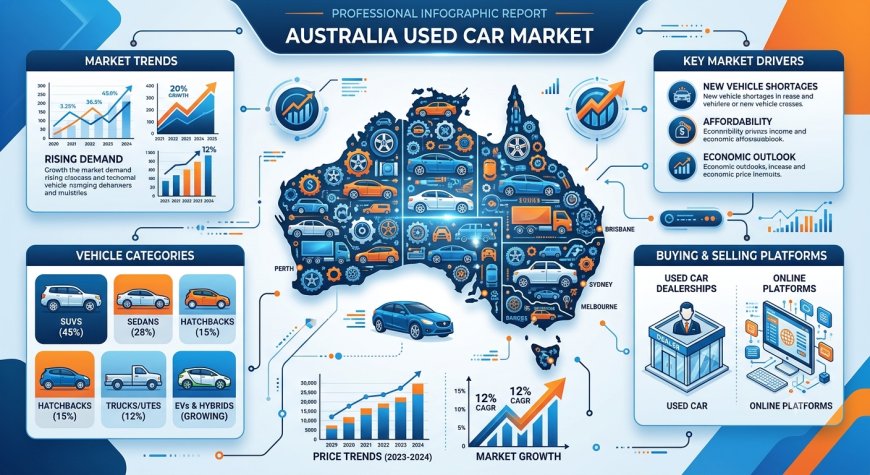
The Australia used car market size was valued at USD 85.54 Billion in 2025 and is projected to reach USD 217.42 Billion by 2034, exhibiting a CAGR of 10.37% during the forecast period 2026-2034. Rising cost-of-living pressures, rapid expansion of digital automotive platforms, and sustained consumer demand for affordable pre-owned vehicles are the primary growth levers.
Australia's used car market encompasses all pre-registered passenger vehicles, light commercial units, SUVs, and specialty automobiles transacted through organised dealers, certified platforms, and private seller channels. The industry spans the full ecosystem from vehicle acquisition and reconditioning through to financing, warranty provision, and digital transaction services. Key segments include fuel type (gasoline, diesel, others), vendor type (organised, unorganised), vehicle type, sales channel, and five regional markets across Australia. The Australia used car market encompasses hatchbacks, sedan, sports utility vehicle, and other vehicle types, organised and unorganised vendor types, gasoline, diesel, and other fuel types, online and offline sales channels across Australia Capital Territory & New South Wales, Victoria & Tasmania, Queensland, Northern Territory & Southern Australia, and Western Australia.
This market is strategically important to Australia's automotive retail sector, consumer mobility, and affordability agenda, supporting the region's transition toward digital-first, transparent, and certified pre-owned vehicle transactions. Macroeconomic drivers—rising new vehicle costs, inflationary pressures, and supply chain disruptions—have structurally redirected consumer demand toward pre-owned alternatives. Digital platforms have fundamentally reshaped the buying experience, improving transparency and accessibility. By 2034, the market will benefit from a maturing supply of pre-owned hybrid and electric vehicles as Australia's EV penetration accelerates. Gasoline-powered vehicles dominate the fuel-type segmentation at 61.4% share in 2025, supported by broad model availability and established refuelling infrastructure. Organised dealers account for 57.2% of transactions, aided by certification programmes, transparent pricing platforms, and structured financing options that build consumer trust. Geographically, the Australian Capital Territory and New South Wales lead with a combined 35.7% share, underpinned by high population density and strong digital platform adoption.
The Australia used car market is poised for sustained expansion, underpinned by affordability and cost-of-living pressures, certified pre-owned programme expansion, digital platform adoption, and growth of the pre-owned EV and hybrid segment. With a projected CAGR of 10.37% through 2034, the market presents significant opportunities for providers focusing on pre-owned EV and hybrid vehicles, digital-first dealerships, certified pre-owned programmes, FinTech integration, and regional and rural market expansion.
AUSTRALIA USED CAR MARKET SUMMARY
The Australia used car market encompasses the sourcing, reconditioning, distribution, financing, and retail of pre-owned vehicles, serving private buyers, suburban families, commercial fleet operators, SMEs, and regional consumers across the country.
The ecosystem spans vehicle sourcing and acquisition channels (trade-ins, auctions, private sellers, lease returns, fleet disposals), inspection and reconditioning specialists, dealer and platform operators (BMW Group, Carma, CARS24, CAR Group Limited, Only Sales Limited, Nine Entertainment Company), technology integrators (AI pricing, PPSR, FinTech), and end users across private, commercial, and regional segments throughout Australia.
By Vehicle Type, the market is segmented into Sports Utility Vehicle (dominating at 38.6%), Hatchbacks, Sedan, and Others.
By Vendor Type, the market serves Organised (dominating at 57.2%) and Unorganised (42.8%).
By Fuel Type, the market serves Gasoline (dominating at 61.4%), Diesel (28.3%), and Others (10.3%, including hybrid, PHEV, and EV).
By Sales Channel, the market serves Offline (dominating at 68.9%) and Online (~13.1% CAGR).
By Region, the market serves Australia Capital Territory & New South Wales (dominating at 35.7%), Victoria & Tasmania (24.6%), Queensland (18.9%), Western Australia (11.0%), and Northern Territory & Southern Australia (9.8%).
Key trends shaping the market include digital-first buying experience and online platform proliferation, accelerating SUV and crossover demand, rise of eco-friendly and fuel-efficient pre-owned vehicles, organised dealer formalisation and certification programmes, and FinTech integration and flexible financing innovation.
PORTER'S FIVE FORCES ANALYSIS – AUSTRALIA USED CAR MARKET
Competitive Rivalry: High. The competitive landscape is moderately fragmented, with established digital marketplaces, OEM-certified platforms, and independent online dealers competing for market share. Leaders compete on inventory transparency, digital experience, and financing integration. Technology differentiation—particularly in pricing algorithms, vehicle history data, and instant valuation tools—is becoming the primary basis for competitive advantage among organised vendors. Business implication: Companies must differentiate through digital innovation, certification credibility, and financing integration.
Supplier Power (Vehicle Sourcing and Auction Providers): Moderate to High. Dealers rely on trade-ins, auctions, private sellers, lease returns, and fleet disposals for vehicle supply. As new car supply normalises post-pandemic, the pipeline of quality three-to-five-year-old trade-in vehicles is tightening. Dealers face increased competition at auctions and from manufacturer buy-back programmes, elevating procurement costs and compressing gross margins on resales. Business implication: Strategic partnerships with fleet operators and diversified sourcing channels can reduce long-term supply risk and procurement costs.
Buyer Power (Private Buyers and Commercial Operators): High. Private buyers, suburban families, commercial fleet operators, and SMEs leverage significant choice across multiple platforms, dealers, and channels. Buyers increasingly demand transparent pricing, vehicle history reports, warranty coverage, and digital convenience. Cost-of-living pressures increase buyer price sensitivity. Business implication: Providers must demonstrate transparency, certification credibility, and value to win buyer trust.
Threat of Substitutes: Moderate. New vehicles, public transport, ride-hailing, and subscription mobility services represent substitutes. However, used cars offer affordability, flexibility, and ownership benefits that alternatives cannot fully replicate, particularly for regional and commercial users. Business implication: Demonstrating affordability, reliability, and ownership value is essential.
Threat of New Entrants: Moderate. Significant capital requirements for inventory, reconditioning, and technology platforms create barriers. However, growth of digital-first platforms, FinTech settlement tools (AutoSettle), and subscription models has enabled new entrants focused on technology-enabled and asset-light models. Business implication: Incumbents must leverage scale, data analytics, and certification programmes while monitoring emerging digital-first competitors.
KEY ASPECTS REQUIRED FOR THE AUSTRALIA USED CAR MARKET
Market Performance: USD 85.54 Billion in 2025, projected to reach USD 217.42 Billion by 2034, driven by cost-of-living pressures, digital platform expansion, and demand for affordable pre-owned vehicles.
Market Outlook: A 10.37% CAGR through 2034 reflects strong growth led by SUVs, organised vendors, gasoline fuel type, offline channels, and ACT and NSW regional dominance.
Growth Drivers: Affordability and cost-of-living pressures; new car supply disruptions; certified pre-owned programme expansion (BMW, Toyota, Hyundai); digital platform adoption (Carsales.com, CARS24, Drive.com.au, AutoSettle); growth of pre-owned EV and hybrid segment; expansion into regional and rural markets; subscription and flexible ownership models; FinTech integration and flexible financing innovation.
Competitive Landscape: A moderately fragmented market with digital marketplaces, OEM-certified platforms, and independent online dealers. Key players invest in AI pricing, vehicle history integration, and FinTech settlement.
Value Chain Analysis: From vehicle sourcing and acquisition through inspection and reconditioning, dealer and platform operations, technology integration, sales channels, to end users across private, commercial, and regional segments.
Industry Trends: Digital-first buying experience and online platform proliferation; accelerating SUV and crossover demand; rise of eco-friendly and fuel-efficient pre-owned vehicles; organised dealer formalisation and certification programmes; FinTech integration and flexible financing; EV battery health assessment technology; PPSR integration.
Strategic Recommendations: Invest in pre-owned EV and hybrid specialist capabilities (battery health checks, CPO programmes); develop digital-first platforms and AI pricing engines; expand certified pre-owned programmes; integrate FinTech settlement and flexible financing; expand into underserved regional and rural markets; target SUV and crossover inventory; strengthen presence in ACT, NSW, and high-growth Western Australia; invest in cybersecurity and data privacy frameworks.
Request for Sample Report: https://www.imarcgroup.com/australia-used-car-market/requestsample
MARKET GROWTH DRIVERS
Affordability and Cost-of-Living Pressures
New vehicle prices in Australia have increased significantly due to supply chain disruptions and currency pressures, making pre-owned vehicles a more attractive alternative. With substantial cost advantages compared to new models, used vehicles are increasingly preferred by first-time buyers, young families, and budget-conscious consumers facing higher living expenses. Rising cost-of-living pressures are among the primary growth levers driving the Australia used car market.
New Car Supply Disruptions
Global semiconductor shortages and logistics disruptions significantly constrained new vehicle supply between 2021 and 2023, tightening availability across key markets. As a result, models like the Land Rover Defender in the two- to four-year age bracket have retained or even exceeded their original value, highlighting a persistent supply-demand imbalance that continues to support strong demand and pricing in the used car market.
Certified Pre-Owned Programme Expansion
Authorised CPO programmes from BMW, Toyota, and Hyundai provide multi-point inspections, warranty extensions, and structured financing. These programmes reduce the traditional risk perception of used car purchases, broadening the addressable buyer base to include risk-averse segments such as suburban families and retirees. Organised vendors held 57.2% of the market in 2025, reflecting ongoing formalisation supported by certified pre-owned programmes, digital inventory management, and structured buyer financing.
Digital Platform Adoption
Online automotive marketplaces led by Carsales.com, CARS24, and Drive.com.au have democratised access to pricing benchmarks, vehicle history, and condition data. FinTech startup AutoSettle launched in March 2024, improving settlement security and instant payment processing—further reinforcing digital confidence. Online platforms accounted for a growing share of used car transactions in Australia by 2024, offering end-to-end digital experiences from vehicle discovery through to financing and home delivery.
Growth of Pre-Owned EV and Hybrid Segment
With EV registrations rising sharply year-on-year, the supply of pre-owned electric and hybrid vehicles is expected to expand significantly from the near term. Organised dealers establishing specialist EV reconditioning and battery health-check capabilities are likely to capture premium margins in this emerging, high-growth sub-segment. The Others fuel-type segment—comprising hybrid, PHEV, and battery electric vehicles—is the highest-growth sub-segment in Australia's used car market, expanding at an estimated CAGR of approximately 14.5% through 2034. As pre-owned electric and hybrid vehicles enter the Australian market in greater numbers from 2026, battery health certification is emerging as a critical technology differentiator for organised dealers.
AUSTRALIA USED CAR MARKET SEGMENTATION
Segmentation analysis provides a detailed view of the Australia used car market by category:
Vehicle Type Insights: Sports Utility Vehicle (SUV) represents a leading segment at 38.6% share in 2025. Pre-owned SUV demand has reached record levels, reflecting a shift in Australian consumer preferences toward versatile, family-oriented vehicles. Organised dealers are increasingly aligning inventory strategies to prioritize SUVs and crossovers, with models such as the Toyota HiLux, Ford Ranger, and Mazda CX-5 consistently ranking among the most traded in the used vehicle market, particularly across Queensland and Western Australia. Hatchbacks represent a significant segment, driven by affordability and urban mobility. Sedan represents a significant segment, driven by demand for comfortable and fuel-efficient passenger vehicles. Other vehicle types, including light commercial units and specialty automobiles, represent growing segments with increasing demand.
Vendor Type Insights: Organised vendors dominate with a 57.2% share in 2025. This segment includes licensed dealerships, certified pre-owned programmes, and technology-enabled platforms such as CARS24, Carsales.com, and HelloCars. The organised segment's growth reflects increasing consumer preference for certified inventory, structured financing, and transparent pricing. Unorganised vendors account for 42.8% and are gradually ceding share as digital tools formalise private transactions. The unorganised segment is highly fragmented, comprising millions of private transactions annually across Gumtree, Facebook Marketplace, and direct seller-to-buyer arrangements.
Fuel Type Insights: Gasoline leads the Australia used car market fuel-type segmentation with a 61.4% share in 2025. Petrol-powered vehicles remain the dominant choice due to their broad model diversity, established maintenance ecosystem, and lower upfront purchase prices relative to diesel or hybrid alternatives. Demand is particularly strong in urban markets where short commutes limit the fuel-efficiency advantage of diesel. Diesel follows at 28.3%, underpinned by strong demand from rural buyers, tradespersons, and fleet operators who value diesel's fuel economy over long distances and towing capacity. The Toyota HiLux, Ford Ranger, and Mitsubishi Triton consistently rank among Australia's most-traded used diesel vehicles. Others at 10.3% (hybrid, PHEV, and EV) represent the fastest-growing segment at approximately 14.5% CAGR through 2034.
Sales Channel Insights: Offline channels dominate at 68.9% share in 2025, driven by dealership showrooms and auction platforms. Online channels represent a fast-growing segment at approximately 13.1% CAGR through 2034, outpacing offline sales as digital-first platforms grow their share of organised vendor transactions. This channel shift favours asset-light, technology-enabled platforms over traditional showroom-centric models, offering superior unit economics at scale.
Regional Insights: Australia Capital Territory & New South Wales lead with a combined 35.7% share in 2025. Sydney—Australia's largest city with a population exceeding 5 million—is the primary driver, supported by a high concentration of organised dealerships, digital platform headquarters, and a financially sophisticated consumer base. The presence of major auction houses and OEM-certified pre-owned centres further consolidates the region's leadership position in both volume and value per transaction. Victoria & Tasmania represent 24.6%, driven by Melbourne dealership networks, state EV incentives, diverse consumer demographics, and urban density. Queensland represents 18.9%, driven by SUV demand, lifestyle vehicles, mining-related commercial fleets, and interstate migration growth. Western Australia represents 11.0% and is identified as the fastest-growing regional market through 2034, driven by resource sector workforce vehicles, remote market expansion, strong diesel demand, and digital expansion. Northern Territory & Southern Australia represent 9.8%, driven by rural and regional demand, LPG and diesel preference, lower new-car penetration, and the Adelaide hub.
COMPETITIVE LANDSCAPE
The competitive landscape is moderately fragmented, with established digital marketplaces, OEM-certified platforms, and independent online dealers competing for market share. Leaders compete on inventory transparency, digital experience, and financing integration. Technology differentiation—particularly in pricing algorithms, vehicle history data, and instant valuation tools—is becoming the primary basis for competitive advantage among organised vendors. The Australia used car market exhibits moderate fragmentation with a clear bifurcation between organised and unorganised channels. Organised vendors collectively hold 57.2% of the market in 2025, but within that segment, the top five platforms—BMW Group, Carma, CARS24, CAR Group Limited, Only Sales Limited—are estimated to account for 30-40% of organised market revenue.
Major players include BMW Group (BMW Premium Certified), Carma (online-first, no-haggle pricing, home delivery), CARS24 (tech-driven, instant cash offers), CAR Group Limited (Carsales, largest marketplace), Only Sales Limited (Only Cars), and Nine Entertainment Company (Drive), among others investing in AI pricing, vehicle history integration, and FinTech settlement.
Recent Developments:
In 2026, BMW Group is strengthening its presence in the pre-owned vehicle market through its BMW Premium Certified Used Cars program, ensuring that every certified vehicle undergoes a rigorous 360-degree technical and safety inspection, along with a verified service history before being approved for sale.
In 2026, CARS24 is accelerating its expansion in Australia as it prepares for a potential IPO in India within the next 6–12 months, increasing investments in logistics infrastructure, including a new operations hub in Sydney.
In 2023, CAR Group Limited announced a strategic acquisition alongside an equity raising to strengthen its global position in digital automotive marketplaces, including expanding its stake in key international platforms.
In March 2024, FinTech startup AutoSettle launched, improving settlement security and instant payment processing for used car transactions.
Investment opportunities exist in pre-owned EV and hybrid specialist capabilities, digital-first platforms, AI pricing engines, certified pre-owned programmes, FinTech settlement, and regional and rural market expansion.
REGIONAL ANALYSIS
Australia Capital Territory & New South Wales command the largest regional share at 35.7% in 2025. Sydney—Australia's largest city with a population exceeding 5 million—is the primary driver, supported by a high concentration of organised dealerships, digital platform headquarters, and a financially sophisticated consumer base. The presence of major auction houses and OEM-certified pre-owned centres further consolidates the region's leadership position in both volume and value per transaction.
Victoria & Tasmania represent 24.6% share in 2025, driven by Melbourne dealership networks, state EV incentives, diverse consumer demographics, and urban density.
Queensland represents 18.9% share in 2025, driven by SUV demand, lifestyle vehicles, mining-related commercial fleets, and interstate migration growth.
Western Australia represents 11.0% share in 2025 and is identified as the fastest-growing regional market through 2034. Growth is driven by resource sector workforce vehicles, remote market expansion, strong diesel demand, and digital expansion. Regional Australia—particularly the Northern Territory, rural Queensland, and inland Western Australia—remains significantly underserved by organised used car dealers, presenting high-growth opportunities as digital platform reach extends and logistics networks improve.
Northern Territory & Southern Australia represent 9.8% share in 2025, driven by rural and regional demand, LPG and diesel preference, lower new-car penetration, and the Adelaide hub.
RECENT INDUSTRY DEVELOPMENTS
2026 Activity: The Australia used car market continued its growth trajectory from USD 85.54 Billion in 2025 toward USD 217.42 Billion by 2034 at a CAGR of 10.37%.
2026: BMW Group is strengthening its presence in the pre-owned vehicle market through its BMW Premium Certified Used Cars program, with rigorous 360-degree technical and safety inspections.
2026: CARS24 is accelerating its expansion in Australia as it prepares for a potential IPO in India, increasing investments in logistics infrastructure, including a new operations hub in Sydney.
March 2024: FinTech startup AutoSettle launched, improving settlement security and instant payment processing for used car transactions.
2023: CAR Group Limited announced a strategic acquisition alongside an equity raising to strengthen its global position in digital automotive marketplaces.
FREQUENTLY ASKED QUESTIONS
Q1: What is the current size of the Australia used car market?
A: The Australia used car market was valued at USD 85.54 Billion in 2025 and is projected to reach USD 217.42 Billion by 2034, exhibiting a CAGR of 10.37% from 2026-2034.
Q2: What are the key drivers of the Australia used car market?
A: The market is driven by: (i) affordability and cost-of-living pressures; (ii) new car supply disruptions; (iii) certified pre-owned programme expansion; (iv) digital platform adoption; (v) growth of pre-owned EV and hybrid segment; (vi) expansion into regional and rural markets; (vii) subscription and flexible ownership models; and (viii) FinTech integration and flexible financing innovation.
Q3: What are the major vehicle types in the Australia used car market?
A: Major vehicle types include Sports Utility Vehicle (dominating at 38.6%), Hatchbacks, Sedan, and Others.
Q4: What are the major vendor types in the Australia used car market?
A: Major vendor types include Organised (dominating at 57.2%) and Unorganised (42.8%).
Q5: What are the major fuel types in the Australia used car market?
A: Major fuel types include Gasoline (dominating at 61.4%), Diesel (28.3%), and Others (10.3%, including hybrid, PHEV, and EV, growing at ~14.5% CAGR).
Q6: What are the major sales channels in the Australia used car market?
A: Major sales channels include Offline (dominating at 68.9%) and Online (~13.1% CAGR).
Q7: Which region leads the Australia used car market?
A: Australia Capital Territory & New South Wales lead with a combined 35.7% share in 2025, driven by high population density, digital platform adoption, and CPO concentration. Victoria & Tasmania (24.6%), Queensland (18.9%), Western Australia (11.0%), and Northern Territory & Southern Australia (9.8%) follow. Western Australia is the fastest-growing regional market.
Q8: What are the challenges facing the Australia used car market?
A: Key challenges include vehicle quality concerns in unorganised channels, credit tightening and rising interest rates, regulatory complexity across states, inventory volatility and vehicle sourcing costs, and cybersecurity and data privacy risks.
Q9: What is the outlook for the Australia used car market?
A: The market is projected to grow at a 10.37% CAGR through 2034, with growth driven by cost-of-living pressures, digital platform expansion, and pre-owned EV adoption. The shift toward digital-first buying, pre-owned EV and hybrid specialist capabilities, organised dealer formalisation, and FinTech integration are expected to shape the market's evolution. The market is projected to reach USD 140.08 Billion by 2030.
Q10: Who are the key players in the Australia used car market?
A: Key players include BMW Group, Carma, CARS24, CAR Group Limited, Only Sales Limited, and Nine Entertainment Company.
Note: If you need any specific information that is not covered currently within the scope of the report, we will provide the same as a part of customization.
https://www.imarcgroup.com/request?type=report&id=21959&flag=E
Report Format, Delivery, and Customization Details
Report Format Mode: PPT, PDF, and Excel
Report Delivery Mode: Online Delivery, Physical Delivery
Report Delivery Time: Report Delivered Over Email within 24 to 48 hours. If requested by the client, a physical copy will be delivered within three to ten days.
Report Confirmation Mode: Yes via Email
Report Customization Mode: Yes via Email / Call
Report Table of Content: Yes
Report List of Figures: Yes
Report Methodology Mode: Yes
Request For Sample Report: Yes
What's Your Reaction?