





























Australia Travel Insurance Market 2026 | Worth USD 463.9 Million by 2034
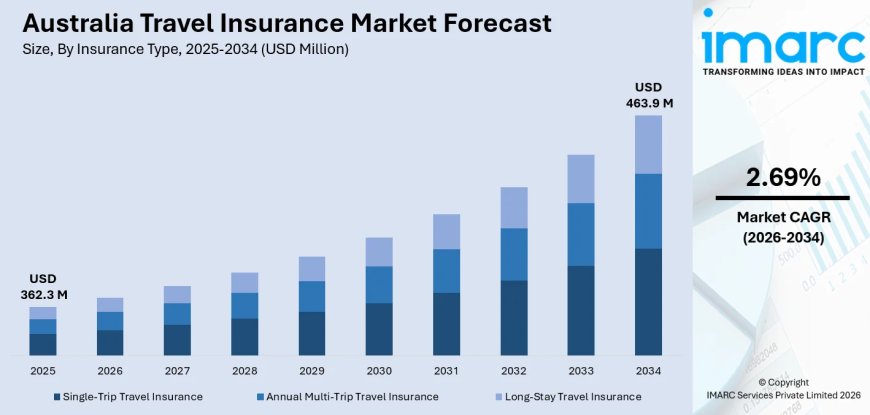
Australia travel insurance market is expected to reach USD 463.9 Million by 2034, exhibiting a growth rate (CAGR) of 2.69% during 2026-2034

Australia Travel Insurance Market Overview
The Australia travel insurance market is experiencing steady expansion, underpinned by a resurgence in international departures, heightened consumer awareness of overseas medical risks, and the accelerating digitisation of insurance distribution. The Australia travel insurance market size reached USD 362.3 Million in 2025, reflecting a robust post-pandemic recovery as Australians return to overseas travel in record numbers. An estimated 11.5 million overseas trips were completed in 2024, reinforcing the structural demand for travel-related risk transfer products across leisure, business, and education segments.
Looking forward, the Australia travel insurance market is expected to reach USD 463.9 Million by 2034, exhibiting a growth rate (CAGR) of 2.69% during 2026-2034. This trajectory is supported by several converging forces, including the rising cost of overseas medical treatment, growing regulatory emphasis on consumer protection under APRA and ASIC oversight, and expanding digital distribution channels that are making policies more accessible. Comprehensive all-inclusive plans accounted for 86% of travel insurance sales in 2025, signalling a decisive consumer shift toward broader coverage rather than bare-minimum protection. Additionally, the growing senior traveler demographic, premium customisation through modular add-ons such as adventure packs, cruise packs, and snow packs, and the increasing integration of embedded insurance at the point of sale are collectively broadening the addressable market. The convergence of insurtech innovation with traditional underwriting expertise is reshaping competitive dynamics, creating opportunities for both established carriers and digital-first entrants to capture incremental share across diversified traveler cohorts.
Request for a sample copy of this report: https://www.imarcgroup.com/australia-travel-insurance-market/requestsample
How AI is Reshaping the Future of the Australia Travel Insurance Market
Artificial intelligence is fundamentally transforming the Australian travel insurance landscape, driving efficiencies across underwriting, claims management, fraud detection, and customer engagement. As insurers move from pilot-stage experimentation to full production deployment, AI is becoming a core operational layer rather than a peripheral innovation. Key developments include:
• AI-Powered Claims Automation: Leading Australian travel insurers are deploying AI-driven claims platforms that have collapsed traditional processing timelines from one to two weeks to mere minutes. Automated data extraction, damage assessment, and fraud screening are delivering 30–40% reductions in per-claim costs and over 95% accuracy in assessments, dramatically improving customer satisfaction and operational throughput.
• Personalised Risk Pricing: Machine learning algorithms are enabling insurers to move beyond static demographic-based pricing toward dynamic, behaviour-driven risk models. By analysing real-time travel patterns, destination risk profiles, and individual health data, AI systems are producing more accurate premium calculations that reward low-risk travellers while maintaining underwriting profitability.
• Parametric Insurance Products: AI and real-time analytics are powering the emergence of parametric travel insurance in Australia, where predefined triggers such as flight delays, weather disruptions, or border closures automatically initiate payouts without the need for manual claims filing, reducing settlement friction and enhancing traveller trust.
• Intelligent Chatbots and Virtual Assistants: AI-enabled customer support platforms are handling policy inquiries, coverage comparisons, and claims initiation around the clock. Multiple Australian insurers expanded digital platforms with AI-assisted onboarding and real-time policy comparisons in 2025, reducing operational costs while improving first-contact resolution rates.
• Fraud Detection and Prevention: Advanced AI models are identifying fraudulent claims patterns with greater precision, cross-referencing claim data against historical databases, social media activity, and external risk feeds. This is reducing claims leakage and protecting premium pools, contributing to more sustainable pricing for legitimate policyholders across the Australian travel insurance market.
Australia Travel Insurance Market Trends
Surge in Comprehensive and All-Inclusive Policy Uptake
The Australian travel insurance market is witnessing a decisive shift toward comprehensive, all-inclusive coverage, with such policies accounting for 86% of all travel insurance sales in 2025. This trend reflects a fundamental change in consumer behaviour driven by post-pandemic risk awareness and high-profile incidents involving uninsured travellers facing catastrophic overseas medical bills. Australian consumers are increasingly prioritising peace of mind over price sensitivity, with 82% of travellers taking out insurance in 2025 despite cost-of-living pressures. The demand for broader coverage extends beyond basic medical expenses to encompass trip cancellation, luggage protection, rental vehicle excess, and personal liability. Insurers are responding by bundling premium features into standard plans and offering modular add-ons such as cruise packs, adventure sports riders, and snow cover that allow policyholders to tailor protection to specific trip profiles. This premiumisation trend is supporting average revenue per policy growth even as unit pricing faces competitive pressure from digital-first disruptors and comparison platforms.
Digital Distribution and Embedded Insurance Expansion
Digital channels are rapidly reshaping how Australians purchase travel insurance, with online aggregators, direct-to-consumer platforms, and embedded insurance solutions at point of sale collectively eroding the dominance of traditional intermediary-led distribution. The Australia insurtech sector reached USD 376.7 Million in 2025, reflecting the scale of investment flowing into technology-enabled insurance models. Embedded insurance is emerging as a particularly disruptive force, with travel booking platforms, airlines, and credit card providers integrating insurance options seamlessly into the purchase journey, reducing friction and capturing customers at the moment of highest intent. This shift is compelling traditional insurers to invest heavily in API-driven distribution partnerships and white-label solutions. Meanwhile, 83% of Australian travellers reported adjusting travel spending due to cost-of-living pressures in 2025, prompting insurers to introduce more affordable entry-tier digital products alongside premium comprehensive plans. The result is a bifurcating market where digital distribution enables both downmarket accessibility and upmarket customisation, expanding the total addressable market across diverse consumer segments.
Australia Travel Insurance Market Summary
• Market Valuation: The Australia travel insurance market reached USD 362.3 Million in 2025 and is forecast to grow to USD 463.9 Million by 2034 at a CAGR of 2.69% during 2026-2034.
• Travel Volume Growth: An estimated 11.5 million overseas trips were completed by Australians in 2024, reinforcing structural demand for travel risk transfer products across leisure, business, and education travel categories.
• Comprehensive Coverage Dominance: All-inclusive policies accounted for 86% of all travel insurance sales in 2025, reflecting a decisive consumer shift toward broader protection over minimum-coverage economy plans.
• Insurance Penetration: Approximately 82% of Australian travellers purchased travel insurance in 2025 despite cost-of-living pressures, demonstrating strong consumer conviction in the value of travel risk mitigation.
• AI-Driven Efficiency Gains: AI-powered claims automation is delivering 30–40% reductions in per-claim costs and over 95% accuracy in damage assessments, transforming operational economics across the value chain.
Australia Travel Insurance Market Growth Drivers
Rising Outbound Travel and Escalating Overseas Medical Costs
The sustained recovery and growth of Australian outbound travel is a primary structural driver of the travel insurance market. With 11.5 million overseas trips recorded in 2024 and seven out of ten Australians planning to travel internationally in 2025, the addressable population for travel insurance products continues to expand. This volume growth is compounded by the escalating cost of overseas medical treatment, which represents the single largest risk exposure for uninsured travellers. Emergency medical evacuations from Southeast Asian and Pacific Island destinations can exceed AUD 100,000, while hospitalisation costs in the United States and Europe routinely reach tens of thousands of dollars per incident. High-profile cases of uninsured Australians facing financial ruin after overseas medical emergencies have significantly elevated public awareness, driving a behavioural shift toward proactive risk transfer. The growing senior traveler demographic further amplifies this driver, as older Australians travel more frequently but face higher medical risk profiles, creating demand for age-inclusive and pre-existing condition-aware policy structures. Regulatory bodies including APRA and ASIC continue to reinforce consumer protection frameworks, bolstering trust in the institutional integrity of travel insurance products.
Expansion of Specialty and Niche Travel Segments
The diversification of Australian travel patterns beyond traditional leisure tourism is creating new demand vectors for specialised insurance products. The cruise segment has emerged as a particularly significant growth category, with operators like Norwegian Cruise Line partnering with Allianz Partners Australia to introduce cruise-specific policies featuring emergency evacuation and shipboard medical coverage. Adventure tourism, including skiing, diving, and trekking, is driving demand for activity-specific riders and modular add-ons. The education travel segment is expanding as more Australians pursue overseas study and exchange programmes, requiring extended-duration policies with unique coverage parameters. Business travel continues to recover, with corporate travel management programmes increasingly mandating comprehensive insurance for duty-of-care compliance. These niche segments command higher average premiums than standard leisure policies, supporting revenue growth even as competitive intensity increases in the mainstream market. Insurers that develop specialised underwriting expertise and distribution partnerships within these segments are positioning themselves for disproportionate share of market growth through 2034.
Australia Travel Insurance Market Segments
The Australia travel insurance market can be segmented across several dimensions, reflecting the diverse risk profiles and coverage preferences of Australian travellers. Key segment breakdowns include:
• By Insurance Type: Single-trip travel insurance holds the largest share at 48% of the market in 2025, reflecting the dominance of one-off holiday and business trips among Australian travellers. Annual multi-trip policies and long-stay travel insurance represent growing segments, driven by frequent travellers and expatriates seeking cost-effective continuous coverage.
• By Coverage Type: Medical expenses coverage leads with 42% market share in 2025, underscoring the primacy of overseas health risk as the core value proposition. Trip cancellation, trip delay, and property damage coverage round out the protection suite, with comprehensive bundled plans increasingly preferred over standalone products.
• By Distribution Channel: Insurance companies dominate distribution with 32% market share in 2025, followed by insurance intermediaries, banks, insurance aggregators, and brokers. Digital aggregators and embedded point-of-sale channels are the fastest-growing distribution modes, disrupting traditional intermediary-led models.
• By End User: Family travelers represent the largest end-user segment at 35% of market share in 2025, reflecting the high propensity of family groups to purchase comprehensive coverage. Senior citizens, education travelers, and business travelers constitute significant secondary segments with distinct coverage requirements and premium profiles.
• By Region: The Australian Capital Territory and New South Wales collectively account for 33% of market share in 2025, driven by Sydney's position as the primary international departure hub. Victoria and Tasmania, Queensland, and Western Australia represent significant secondary markets, with regional growth aligned to state-level outbound travel volumes and demographic profiles.
Australia Travel Insurance Market Competitive Landscape
The Australia travel insurance market features a concentrated competitive landscape dominated by established insurance groups with extensive distribution networks and brand recognition. Allianz Australia Limited commands approximately 25% market share, leveraging its global scale and multi-channel distribution to maintain leadership across retail and corporate segments, with a notable October 2025 acquisition bid for nib Holdings' travel unit signalling further consolidation ambitions. Zurich Financial Services Australia Ltd. (Cover-More) holds approximately 24% market share, distinguished by its worldwide assistance network and deep travel industry partnerships that position it as the preferred provider for travellers prioritising reliability and 24-hour emergency support. Fast Cover Pty Ltd operates as a digital-first disruptor, having launched an AI-powered claims platform partnership in June 2025. nib Travel Services (Australia) Pty Ltd. leverages its health insurance heritage and digital-first approach to attract younger, tech-savvy travellers. Other significant participants include American Express Company (premium card membership bundling), AIG Australia Limited, 1Cover Pty Ltd., and Australia Post Group, collectively contributing to a competitive environment characterised by digital transformation, product innovation, and strategic consolidation.
Australia Travel Insurance Market Latest News & Development
• October 2025: Allianz Australia Limited submitted an acquisition bid for nib Holdings' travel insurance unit, signalling a major consolidation move aimed at expanding Allianz's market leadership in both retail and corporate travel insurance segments across Australia.
• September 2025: Multiple Australian travel insurers expanded digital platforms with AI-assisted onboarding, real-time policy comparisons, and streamlined claims processing, responding to record outbound tourism growth and rising demand for comprehensive coverage plans.
• June 2025: Fast Cover Pty Ltd launched an AI-powered claims platform partnership, deploying automated data extraction and fraud screening capabilities to reduce claims processing times from weeks to minutes while improving assessment accuracy.
• May 2025: Allianz Partners Australia partnered with Norwegian Cruise Line to introduce cruise-specific travel insurance packages featuring emergency evacuation, shipboard medical coverage, and cabin confinement protection, targeting the rapidly expanding Australian cruise travel segment.
• June 2025: Industry reports revealed that 83% of Australian travellers anticipated adjusting travel spending due to cost-of-living pressures, prompting major insurers to introduce more affordable entry-tier travel insurance options alongside premium comprehensive plans to capture price-sensitive segments.
Note: If you require any specific information not currently covered within the scope of the report, IMARC Group will provide it as part of customization.
Speak to an analyst:
https://www.imarcgroup.com/request?type=report&id=21979&flag=E
What's Your Reaction?