































Australia Reverse Logistics Market Projected to Reach USD 20.88 Billion by 2033
Australia reverse logistics market size reached USD 13,576 Million in 2024. Looking forward, IMARC Group expects the market to reach USD 20,881 Million by 2033, exhibiting a CAGR of 4.9% during 2025–2033.

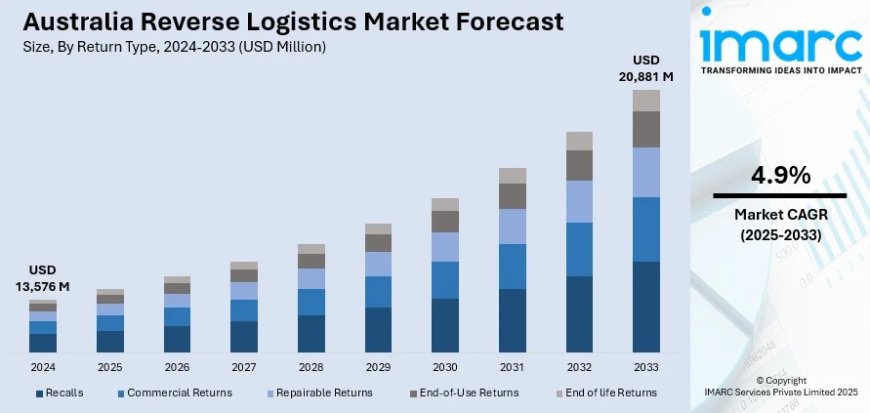
The latest report by IMARC Group, titled "Australia Reverse Logistics Market Report by Return Type (Recalls, Commercial Returns, Repairable Returns, End-of-Use Returns, End of Life Returns), Service (Transportation, Warehousing, Reselling, Replacement Management, Refund Management Authorization, Others), End User (E-Commerce, Automotive, Pharmaceutical, Consumer Electronic, Retail, Luxury Goods, Reusable Packaging), and Region 2025-2033," offers a comprehensive analysis of the Australia reverse logistics market growth. The report includes competitor and regional analysis, along with a detailed breakdown of the market segmentation. The Australia reverse logistics market size reached USD 13,576 Million in 2024. Looking forward, IMARC Group expects the market to reach USD 20,881 Million by 2033, exhibiting a CAGR of 4.9% during 2025–2033.
Base Year: 2024
Forecast Years: 2025–2033
Historical Years: 2019–2024
Market Size in 2024: USD 13,576 Million
Market Forecast in 2033: USD 20,881 Million
Market Growth Rate (2025–2033): 4.9%
Australia Reverse Logistics Market Overview
The growing adoption of e-commerce platforms for managing product returns, evolving focus on sustainability in the product lifecycle for managing end-of-life products and landfill diversion, and the use of advanced technologies for better processing accuracy and visibility are the factors propelling the growth of the Australia reverse logistics market. The growing Australian e-commerce market which is projected to reach USD 1.57 trillion by 2033, government regulations related to the environment such as extended producer responsibility programs, and the integration of artificial intelligence, machine learning, blockchain, and Internet of Things into the reverse supply chain are other factors driving the market. An increased interest in circular economy initiatives and more liberal customer return policies will further increase Australia's reverse logistics market's growth and sophistication.
Characteristics of the Australian reverse logistics environment include strong e-commerce infrastructure, very liberal return policies which result in high volume reverse logistics activities, a mature set of environmental regulations that encourage reverse logistics efforts, as well as advanced logistics capabilities that support the movement of complex reverse flows. Consumer reverse logistics expectations in Australia are growing, especially within fashion, electronics and consumer goods sectors. Circular economy business models, AI logistics services, supply chain and operations management optimization services, and government and corporate sustainability policies are trending in the market, driving the need for technology platforms, automated processing of returns, and sustainable recovery channels. Australia shows an increasing market for new reverse logistics and circular economy business models, driven by sustainability efforts by corporates and e-commerce growth.
Request For Sample Report:
https://www.imarcgroup.com/australia-reverse-logistics-market/requestsample
Australia Reverse Logistics Market Trends
• E-commerce return volume surge: Rapid online retail growth driving increased product returns requiring efficient reverse supply chains for inspection, restocking, refurbishment, and recycling across fashion, electronics, and consumer goods sectors.
• Environmental regulation compliance: Government extended producer responsibility programs and circular economy framework launched in 2025 compelling manufacturers to adopt responsible product take-back and sustainable disposal practices.
• Technology integration advancement: AI, machine learning, blockchain, and IoT adoption improving visibility, traceability, and efficiency in handling reverse logistics with real-time tracking and automated quality assessments.
• Circular economy implementation: Business transition toward circular models promoting material recovery, reuse, and recycling from returned products feeding back into production cycles reducing waste and resource consumption.
• Automated processing expansion: Warehouse robotics and automation systems streamlining labor-intensive handling, sorting, and processing of returned products reducing time and operational expenses.
• Consumer sustainability awareness: Growing environmental consciousness driving demand for responsible product take-back programs and green returns building brand trust and customer loyalty.
Market Drivers
• E-commerce market expansion: Australian online retail projected to reach USD 1.57 trillion by 2033 creating substantial product return volumes requiring sophisticated reverse logistics infrastructure and management capabilities.
• Environmental regulatory pressure: Government extended producer responsibility programs and sustainability initiatives mandating manufacturers take responsibility for end-of-life products driving reverse logistics adoption across industries.
• AI technology advancement: Australian AI market projected to reach USD 7.76 billion by 2033 enabling intelligent reverse logistics optimization through predictive analytics, automated decision-making, and operational efficiency improvements.
• Consumer return expectations: Liberal return policies becoming standard practice in competitive retail environment requiring businesses to invest in efficient product recovery and processing systems.
• Circular economy initiatives: Government circular economy framework promoting resource recovery, waste reduction, and sustainable business models driving demand for comprehensive reverse logistics solutions.
• Brand reputation management: Consumer preference for environmentally responsible companies creating competitive advantage for businesses implementing effective product take-back and sustainable disposal programs.
Challenges and Opportunities
Challenges:
- Processing complexity managing diverse return types including recalls, commercial returns, repairs, and end-of-life products requiring specialized handling, assessment, and disposal procedures
- Quality assessment difficulties determining optimal disposition for returned items across resale, refurbishment, recycling, or disposal categories requiring skilled evaluation and decision-making processes
- Cost management challenges balancing reverse logistics expenses with recovery value while maintaining customer satisfaction and environmental responsibility standards
- Geographic distribution obstacles across Australia's vast territory creating transportation and warehousing complexities for efficient product collection and processing
- Regulatory compliance complexity navigating varying state requirements, environmental standards, and producer responsibility obligations across different product categories and jurisdictions
Opportunities:
- Technology integration expansion leveraging AI-driven analytics, blockchain transparency, and IoT tracking to optimize reverse logistics operations and reduce processing costs
- Circular economy leadership developing comprehensive material recovery programs creating competitive advantage and supporting Australia's sustainability goals and regulatory requirements
- E-commerce partnership growth providing specialized reverse logistics services to online retailers seeking efficient return management and customer satisfaction improvement
- Refurbishment market development creating value-added services for product restoration, warranty management, and secondary market sales maximizing recovery value
- Sustainability consulting expansion offering environmental compliance support, carbon footprint reduction, and circular economy implementation services to businesses seeking competitive differentiation
Australia Reverse Logistics Market Segmentation
By Return Type:
- Recalls
- Commercial Returns
- Repairable Returns
- End-of-Use Returns
- End of Life Returns
By Service:
- Transportation
- Warehousing
- Reselling
- Replacement Management
- Refund Management Authorization
- Others
By End User:
- E-Commerce
- Automotive
- Pharmaceutical
- Consumer Electronic
- Retail
- Luxury Goods
- Reusable Packaging
By Region:
- Australia Capital Territory & New South Wales
- Victoria & Tasmania
- Queensland
- Northern Territory & Southern Australia
- Western Australia
Browse Full Report:
https://www.imarcgroup.com/australia-reverse-logistics-market
Australia Reverse Logistics Market News (2024–2025)
• 2025: Australian government launched ambitious circular economy framework to increase circularity promoting material recovery, waste reduction, and sustainable business models driving demand for reverse logistics solutions.
• 2024: Australian e-commerce market continued expansion trajectory projected to reach USD 1.568 trillion by 2033, creating substantial product return volumes requiring sophisticated reverse supply chain management.
• 2024: AI technology adoption accelerated in logistics operations with Australian AI market projected to reach USD 7.76 billion by 2033, enabling intelligent reverse logistics optimization and automated processing.
• 2024: Extended producer responsibility programs expanded across industries requiring manufacturers to take greater responsibility for end-of-life products driving reverse logistics investment and capability development.
• 2024: Warehouse automation and robotics integration increased streamlining labor-intensive reverse logistics processes including sorting, quality assessment, and product disposition decisions.
Key Highlights of the Report
- Market Performance (2019–2024)
- Market Outlook (2025–2033)
- Industry Catalysts and Challenges
- Segment-wise historical and future forecasts
- Competitive Landscape and Key Player Analysis
- Return Type, Service, and End User Analysis
Ask analyst for your customized sample:
https://www.imarcgroup.com/request?type=report&id=32129&flag=F
Q&A Section
Q1: What drives growth in the Australia reverse logistics market?
A1: Market growth is driven by e-commerce market expansion projected to reach USD 1.57 trillion by 2033, environmental regulatory pressure through extended producer responsibility programs, AI technology advancement with market reaching USD 7.76 billion supporting logistics optimization, consumer return expectations requiring liberal policies, circular economy initiatives promoting resource recovery, and brand reputation management favoring environmentally responsible practices.
Q2: What are the latest trends in this market?
A2: Key trends include e-commerce return volume surge requiring efficient reverse supply chains, environmental regulation compliance through circular economy framework launched in 2025, technology integration advancement using AI and blockchain systems, circular economy implementation promoting material recovery and reuse, automated processing expansion through robotics, and consumer sustainability awareness driving demand for responsible take-back programs.
Q3: What challenges do companies face?
A3: Major challenges include processing complexity managing diverse return types requiring specialized handling procedures, quality assessment difficulties determining optimal product disposition, cost management challenges balancing expenses with recovery value, geographic distribution obstacles across Australia's vast territory, and regulatory compliance complexity navigating varying state requirements and environmental standards.
Q4: What opportunities are emerging?
A4: Emerging opportunities include technology integration expansion leveraging AI analytics and blockchain transparency, circular economy leadership developing comprehensive material recovery programs, e-commerce partnership growth providing specialized return management services, refurbishment market development creating value-added restoration services, and sustainability consulting expansion offering environmental compliance and carbon footprint reduction support.
About Us
IMARC Group is a leading market research company that offers management strategy and market research worldwide. We partner with clients in all sectors and regions to identify their highest-value opportunities, address their most critical challenges, and transform their businesses. IMARC's information products include major market, scientific, economic and technological developments for business leaders in pharmaceutical, industrial, and high technology organizations. Market forecasts and industry analysis for biotechnology, advanced materials, pharmaceuticals, food and beverage, travel and tourism, nanotechnology and novel processing methods are at the top of the company's expertise.
Contact Us
IMARC Group
134 N 4th St. Brooklyn, NY 11249, USA
Email: sales@imarcgroup.com
Tel No: (D) +91-120-433-0800
United States: +1-201-971-6302
What's Your Reaction?