





























Australia Publishing Market Projected to Reach USD 8.0 Billion by 2034
Australia publishing market size reached USD 5.4 Billion in 2025. Looking forward, the market is projected to reach USD 8.0 Billion by 2034, exhibiting a growth rate (CAGR) of 4.32% during 2026-2034.

Market Overview
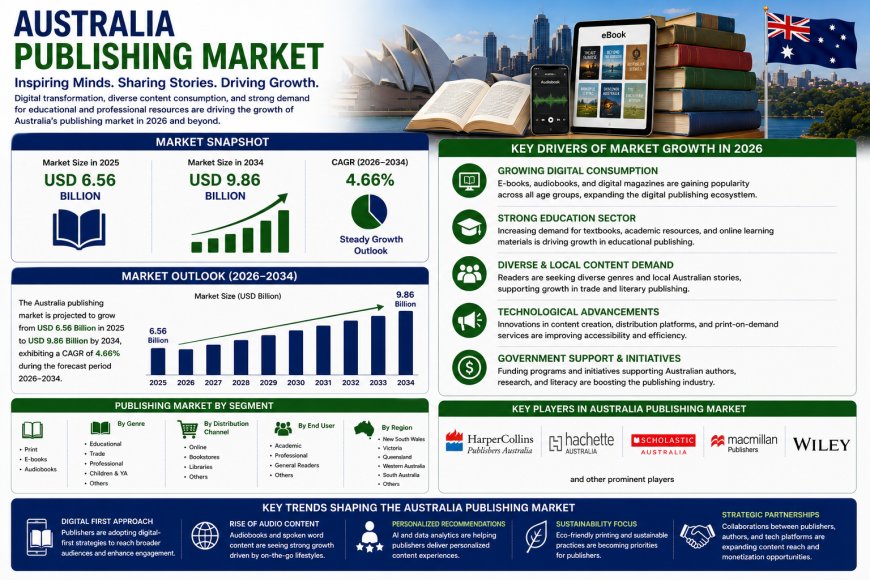
The Australia publishing market size reached USD 5.4 Billion in 2025. Looking forward, the market is projected to reach USD 8.0 Billion by 2034, exhibiting a growth rate (CAGR) of 4.32% during 2026‑2034. The market is propelled by the increasing demand for digital content, such as e‑books and audiobooks, rise of self‑publishing platforms and independent authors, expansion of educational programs, growth of subscription‑based reading services, and social media influence on reading trends and book discovery.
This market is strategically important to Australia's creative and knowledge economy, supporting thousands of authors, publishers, distributors, and retailers while enriching the nation's cultural fabric and educational resources. Publishers are catering to increasing demand for local voices and diversity by vigorously acquiring and promoting works from authors coming from diverse backgrounds while ensuring an ideal depiction of the inclusive population of Australia.
The Australia publishing market is poised for sustained expansion, driven by digital transformation, self-publishing democratisation, and demand for diverse local voices. With a projected CAGR of 4.32% through 2034, the market presents significant opportunities for publishers focusing on digital offerings, audiobooks, and international partnerships.
AUSTRALIA PUBLISHING MARKET SUMMARY
- The Australia publishing market encompasses the full spectrum of content creation and distribution, including books, magazines, newspapers, and digital publications across print, e‑book, and audio formats.
- Major segments identified in the publishing industry include type (book publishing, magazine publishing, newspaper publishing), platform (traditional, digital), and region.
- Key trends shaping the market include digital transformation and the rapid uptake of e‑books and audiobooks, the rise of independent and self‑publishing platforms, increased demand for local and diverse voices, and growing educational and academic publishing.
- According to Dettori Publishing, self‑published books worth of $1.25 Billion are sold each year.
PORTER'S FIVE FORCES ANALYSIS – AUSTRALIA PUBLISHING MARKET
The competitive dynamics of the Australia publishing market can be analysed using Porter's Five Forces framework.
Bargaining Power of Suppliers – Moderate
- Publishers rely on authors, printers, distributors, and digital platform providers. The rise of self‑publishing platforms has given successful authors more leverage, while the proliferation of digital distribution channels provides publishers with multiple sourcing options. However, established authors with strong brand recognition retain moderate negotiating power.
Bargaining Power of Buyers – Moderate to High
- Australian consumers benefit from extensive choice across physical bookstores, online retailers, digital platforms, and subscription services. The ability to compare products, access online reviews, and shop across multiple platforms strengthens buyer negotiating power. Educational institutions and libraries represent concentrated purchasing channels that negotiate volume‑based contracts.
Threat of New Entrants – Moderate
- Significant capital requirements for establishing distribution networks, brand recognition, and author relationships create barriers for traditional publishing entrants. However, self‑publishing platforms such as Amazon's KDP and Smashwords have dramatically lowered barriers, allowing independent authors to publish and circulate works globally. According to Dettori Publishing, self‑published books worth of $1.25 Billion are sold each year.
Threat of Substitutes – Moderate
- Alternative entertainment and information sources, including streaming services, social media, podcasts, and video content, compete for consumer time and attention. However, the enduring appeal of reading for education, entertainment, and personal development provides strong market resilience. Digital content has proven complementary rather than fully disruptive.
Competitive Rivalry – High (Healthy)
- The market features intense competition among traditional publishing houses, self‑publishing platforms, digital subscription services, and independent authors. Publishers catering to local voices and diverse stories are gaining competitive advantage.
Request for Sample Report: https://www.imarcgroup.com/australia-publishing-market/requestsample
MARKET GROWTH DRIVERS
Digital Transformation and E‑Books
The publishers in Australia are rapidly digitizing the industry, particularly with the rapid uptake of e‑books, audiobooks, and other forms of digital content. As the number of e‑readers and mobile devices increase significantly, demand for physical copies of books is witnessing a decline. Publishing houses are monetizing this trend by expanding their offerings digitally for a wider reach and eliminating the constraints of printing and distribution. Digital platforms are offering opportunities for self‑publishing, which allows independent authors to maintain control over their work and bypass traditional gatekeepers. This trend is further accelerated by subscription‑based models offered by services such as Kindle Unlimited and Audible, making digital books increasingly accessible to more readers.
Rise of Independent and Self‑Publishing
Among the major driving forces of the Australia publishing market are various emerging independent and self‑publishing platforms. Authors no longer need to depend on conventional publishing houses to bring their works before a reading audience. The arrival of Amazon's KDP and Smashwords, amongst many others, has opened avenues for independent authors to publish and circulate their manuscripts to every corner of the world. According to Dettori Publishing, self‑published books worth of $1.25 Billion are sold each year. This democratizes the publishing process and allows more creative control to the author, while increasing the percentage of royalties.
Increased Demand for Local and Diverse Voices
Another major driving force behind the publishing market of Australia is the increasing demand for local voices and diversity. The readers increasingly demand relatable books through which they can identify themselves and come across the multicultural society of modern Australia. This has contributed to the demand for stories from indigenous authors and other books addressing themes about the immigrant communities of Australia. Publishers are catering to this demand by vigorously acquiring and promoting works from authors coming from diverse backgrounds while ensuring an ideal depiction of the inclusive population of Australia.
AUSTRALIA PUBLISHING MARKET SEGMENTATION
Segmentation analysis provides a detailed view of the Australia publishing market by category:
- Type Insights: Book Publishing, Magazine Publishing, Newspaper Publishing.
- Platform Insights: Traditional, Digital.
- Regional Insights: Australia Capital Territory & New South Wales, Victoria & Tasmania, Queensland, Northern Territory & Southern Australia, Western Australia.
COMPETITIVE LANDSCAPE
The competitive landscape of the Australia publishing market is dynamic, featuring traditional publishing houses, self‑publishing platforms, digital subscription services, and independent authors. Traditional publishers are increasingly acquiring and promoting works from diverse backgrounds. The market research report provides a comprehensive analysis of the competitive landscape, including market structure, key player positioning, top winning strategies, competitive dashboard, and company evaluation quadrant, with detailed profiles of all major companies provided in the full report. Investment opportunities exist in digital content expansion, audiobook production, educational publishing, and international rights acquisitions.
REGIONAL ANALYSIS
- Australia Capital Territory & New South Wales represents a critical demand centre, anchored by Sydney's large population, concentration of publishing houses, and strong retail infrastructure supporting bookstores and distribution networks.
- Victoria & Tasmania benefits from Melbourne's reputation as Australia's literary capital, with a thriving independent bookstore scene and literary festivals.
- Queensland experiences steady publishing market growth driven by Brisbane's expanding population and increasing demand for educational and children's publishing.
- Western Australia sees demand from Perth's growing reading community and focus on supporting local authors.
- Northern Territory & Southern Australia, though smaller in market share, contribute to the national publishing market through unique regional voices and Indigenous publishing initiatives.
RECENT INDUSTRY DEVELOPMENTS
- 2025 Activity: The Australia publishing market continued its growth trajectory, driven by increasing demand for digital content and the rise of self‑publishing platforms.
- 2025 Activity: Self‑publishing platforms including Amazon's KDP and Smashwords continued to empower independent authors, with self‑published books worth $1.25 billion sold each year.
- 2025 Activity: Publishers continued to acquire and promote works from Indigenous authors and diverse backgrounds, responding to reader demand for relatable books reflecting Australia's multicultural society.
Note: If you need any specific information that is not covered currently within the scope of the report, we will provide the same as a part of customization.
https://www.imarcgroup.com/request?type=report&id=24789&flag=C
Report Format, Delivery, and Customization Details
Report Format Mode: PPT, PDF, and Excel
Report Delivery Mode: Online Delivery, Physical Delivery
Report Delivery Time: Report Delivered Over Email within 24 to 48 hours. If requested by the client, a physical copy will be delivered within three to ten days.
Report Confirmation Mode: Yes via Email
Report Customization Mode: Yes via Email / Call
Report Table of Content: Yes
Report List of Figures: Yes
Report Methodology Mode: Yes
Request For Sample Report: Yes
What's Your Reaction?