






























Australia Lactic Acid Market Size, Share, Report 2026–2034
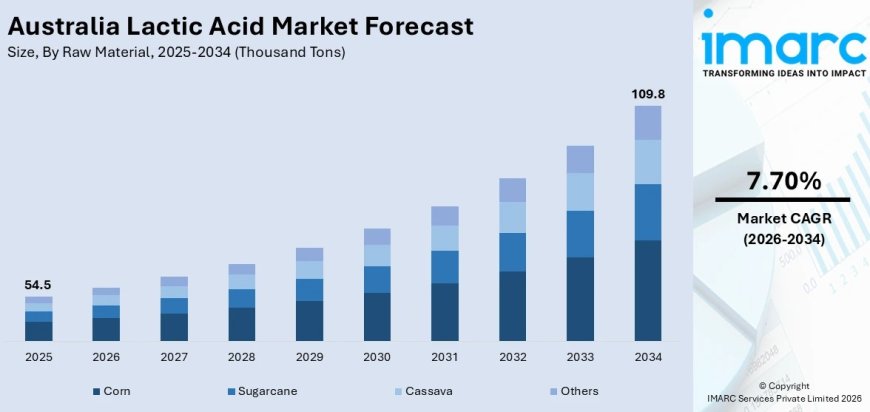
The Australia Lactic Acid Market reached a size of 54.5 Thousand Tons in 2025 and is projected to reach 109.8 Thousand Tons by 2034, growing at a CAGR of 7.70% during the forecast period of 2026–2034

Market Overview
The Australia Lactic Acid Market reached a size of 54.5 Thousand Tons in 2025 and is projected to reach 109.8 Thousand Tons by 2034, growing at a CAGR of 7.70% during the forecast period of 2026–2034. The market is expanding steadily, supported by rising demand for bio-based materials, advancements in sustainable packaging driven by Australia's single-use plastics legislation, and broader applications of lactic acid across food preservation, personal care formulations, pharmaceuticals, and industrial chemical processes. Lactic acid — produced predominantly through the bacterial fermentation of renewable carbohydrate feedstocks including corn starch, sugarcane, and cassava — occupies a structurally important position in Australia's ongoing transition away from petroleum-derived chemicals and plastics. Its primary derivative, polylactic acid (PLA), is the most commercially mature bioplastic in food packaging globally — accounting for approximately 31% of total bioplastic production worldwide — and is gaining significant adoption among Australian food manufacturers, foodservice operators, and retail packaging suppliers seeking certified compostable alternatives to conventional PET and polystyrene packaging. Regulatory drivers including state and territory single-use plastics bans progressively enacted from 2021 to 2023 and Australia's National Packaging Targets — which commit industry to 100% reusable, recyclable, or compostable packaging by 2025 — are compressing timelines for PLA adoption and directly expanding addressable demand for lactic acid as the foundational feedstock. Simultaneously, the food and beverage industry's accelerating shift toward clean-label, naturally derived preservatives and pH regulators, and the personal care industry's growing use of lactic acid in AHA exfoliants and anti-aging formulations, are broadening the application base supporting market growth. New South Wales and Victoria are the dominant regional markets, anchored by food processing and pharmaceutical manufacturing concentration.
How AI is Reshaping the Future of the Australia Lactic Acid Market:
- AI-powered fermentation optimization platforms are being deployed by lactic acid producers to continuously monitor and dynamically adjust fermentation parameters — including temperature, pH, nutrient feed rates, and microbial strain performance — using machine learning models trained on large-scale batch data, achieving measurable improvements in lactic acid yield, purity, and production cycle time that reduce per-unit manufacturing costs and improve supply reliability for Australian downstream processors.
- In April 2025, researchers at DTU and Novonesis demonstrated that AI-guided lactic acid bacteria fermentation protocols — optimizing strain selection, culture conditions, and fermentation sequencing — significantly enhanced flavor compound development and nutritional profile in plant-based dairy alternative products, a finding directly relevant to Australian food manufacturers accelerating their plant-based product development programs and requiring high-purity food-grade lactic acid inputs.
- Digital twin modeling of lactic acid fermentation and purification processes is enabling process engineers at global producers supplying the Australian market to simulate process modifications, scale-up scenarios, and raw material substitutions in virtual environments before physical implementation — reducing optimization costs, accelerating capacity expansion timelines, and improving process consistency across production batches.
- AI-driven quality control systems using near-infrared spectroscopy and machine learning models are enabling real-time, non-destructive purity verification of lactic acid streams at Australian food and pharmaceutical manufacturing sites — replacing slower laboratory assay methods and enabling continuous-flow production monitoring that maintains the stringent purity specifications required for pharmaceutical-grade and food-grade applications without production interruption.
- Predictive demand analytics platforms used by Australian lactic acid distributors and downstream processors are applying machine learning to forecast seasonal demand patterns, manage inventory optimization, and plan procurement from global suppliers — improving supply chain resilience for an import-dependent market where supply disruptions from major producing regions in Europe and Asia-Pacific directly affect manufacturing continuity for Australian food and personal care manufacturers.
Request Industry-Focused Sample with Insights & Forecasts
https://www.imarcgroup.com/australia-lactic-acid-market/requestsample
Market Trends and Insights
- Single-Use Plastics Legislation Accelerating PLA Demand: Australia's progressive state and territory single-use plastics bans — fully enacted across all mainland states and territories by late 2023, prohibiting single-use plastic plates, cutlery, straws, and expanded polystyrene food containers — are directly compelling foodservice operators, food manufacturers, and packaging suppliers to adopt PLA-based certified compostable alternatives certified to AS4736, creating a structurally expanding demand pull for lactic acid as the foundational PLA feedstock throughout the forecast period.
- Clean-Label Preservation Driving Food and Beverage Adoption: Growing Australian consumer preference for clean-label, naturally derived food ingredients is accelerating lactic acid adoption as a food preservative, pH regulator, and flavor enhancer across meat processing, dairy, bakery, and ready-meal manufacturing — with lactic acid's GRAS designation and transparent natural origin from fermentation providing a significant labeling and consumer perception advantage over synthetic acidulants and preservatives.
- Personal Care AHA Demand Expanding Formulation Applications: Australia's premium skincare and dermocosmetics market is generating strong and growing demand for cosmetic-grade lactic acid — with its well-documented efficacy as an alpha-hydroxy acid (AHA) exfoliant, moisturizer, and anti-aging active ingredient, compatibility with sensitive skin, and increasing incorporation into dermatologically approved skincare lines driving consistent volume growth in the personal care application segment throughout the forecast period.
- Pharmaceutical Biopolymer Applications Emerging as High-Value Segment: In January 2025, Mondeal Pty Ltd launched Lenisna (Juvelook) — a PDLLA-based injectable poly-D-L-lactic acid aesthetic biofiller — in Australia, marking a significant commercial development in lactic acid-derived biocompatible materials for collagen-stimulating aesthetic medicine and exemplifying the high-value pharmaceutical and aesthetic medicine applications of lactic acid derivatives that command significantly higher per-kilogram values than commodity food or industrial applications.
- Global PLA Capacity Expansion Supporting Supply and Technology Transfer: The global PLA production capacity pipeline — including Emirates Biotech's collaboration with Sulzer to establish what will be the world's largest PLA production facility — signals sustained capital investment in lactic acid-to-PLA manufacturing infrastructure at a scale that will progressively reduce PLA input costs, support Australian packaging converters in accessing competitively priced certified compostable materials, and accelerate the economic viability of PLA as a mainstream alternative to petroleum-based packaging resins in the Australian market.
By raw material, corn is the dominant feedstock for lactic acid production globally and for material supplied to the Australian market — offering high sugar content, established fermentation technology, and consistent year-round availability from major producing regions in North America, Europe, and Southeast Asia. Sugarcane is the second-largest raw material source, with particular relevance for Australian lactic acid applications given domestic sugarcane production in Queensland — with Queensland's sugar industry producing approximately 4.5 million tonnes of raw sugar annually, representing a potential future domestic feedstock advantage for Australian lactic acid production or bio-based chemical precursor supply. Cassava is a growing feedstock source for Asian-origin lactic acid suppliers serving the Australian import market. By form, liquid lactic acid is the dominant form across food, beverage, and industrial applications, offering ease of incorporation into wet processing environments. Solid lactic acid is used primarily in pharmaceutical and specialty personal care formulations where precise dosing and extended shelf stability are required.
By application, PLA is the fastest-growing segment — driven by the single-use plastics legislative environment and national packaging targets — and is projected to account for the largest incremental volume growth through 2034. Food and beverages is the largest application segment by current volume, encompassing lactic acid's roles as a natural preservative, acidulant, flavor enhancer, and emulsifier across meat processing, dairy, bakery, sauces, and ready-meal manufacturing. Pharmaceuticals is a high-value segment encompassing both controlled drug release biopolymers and injectable aesthetic medicine applications including PDLLA and PLLA-based collagen stimulators. Personal care is a steadily growing segment anchored by AHA skincare formulations. Industrial applications — including lactic acid's use as a green solvent substitute, cleaning agent, and metal surface treatment chemical — represent a smaller but commercially meaningful segment benefiting from broader industrial decarbonization and green chemistry transitions. Regionally, New South Wales leads market volume on the strength of its food processing and pharmaceutical manufacturing base, with Victoria a close second. Queensland is the fastest-growing region given both food manufacturing activity and the long-term potential of domestic sugarcane feedstock proximity.
Market Growth Drivers
Sustained Demand for Biopolymer Applications
The increasing emphasis on sustainability across industrial and consumer segments has positioned lactic acid as a strategically essential feedstock in Australia's transition toward biodegradable materials and circular economy packaging models. Australia's National Packaging Targets — committing industry to 100% reusable, recyclable, or compostable packaging by 2025 — combined with state and territory single-use plastics bans enacted across all mainland jurisdictions by late 2023 are creating a compliance-driven demand floor for PLA-based certified compostable packaging that directly expands lactic acid consumption at scale. BioPak — one of Australia's leading compostable packaging suppliers — reports that PLA certified to the Australian industrial compostability standard AS4736 is the preferred material for certified-compostable cups, clamshells, cutlery, and films across Australian foodservice and retail channels. The food processing and packaging industries are actively integrating PLA-based solutions to align with circular economy goals and corporate sustainability benchmarks — with major Australian retailers including Coles and Woolworths each having published packaging sustainability roadmaps that are driving supplier reformulation toward certified compostable materials. The global scale-up of PLA production capacity — including Emirates Biotech's Sulzer-licensed facility — will progressively improve supply security and reduce PLA input costs for Australian packaging converters, accelerating mainstream adoption across the forecast period.
Natural Ingredient Focus in Formulations
In Australia's personal care and pharmaceutical sectors, strong and growing consumer and regulatory preference for naturally derived, biocompatible, and environmentally safe ingredients is significantly driving lactic acid adoption across a broadening range of high-value formulation applications. With a well-documented safety profile, GRAS designation for food applications, and clinically established efficacy as an alpha-hydroxy acid in skin renewal applications, lactic acid is increasingly incorporated into premium Australian skincare products — including exfoliants, AHA toners, moisturizers, and anti-aging serums — where its mild nature and suitability for sensitive skin types provide a meaningful commercial advantage over synthetic alternatives. The Australian cosmetic market's growing premiumization — with consumers increasingly willing to pay a premium for dermatologically validated, naturally derived active ingredients — is sustaining consistent volume and value growth in the personal care lactic acid segment. In the pharmaceutical sector, the development of biodegradable polymer systems for controlled drug release, resorbable sutures, and implantable devices — using lactic acid-derived PLLA and PDLLA polymers — is creating a high-value, regulatory-supported growth segment. In January 2025, Mondeal Pty Ltd's launch of PDLLA-based injectable Lenisna (Juvelook) in Australia exemplified the expanding commercial footprint of lactic acid-derived biocompatible materials within Australia's aesthetic medicine market, reinforcing the pharmaceutical segment's contribution to overall lactic acid demand growth throughout the forecast period.
Regulatory Support and Clean-Label Consumer Preferences
Regulatory frameworks and evolving Australian consumer preferences are providing dual and mutually reinforcing structural support for lactic acid market growth across food, beverage, and industrial applications. Australia's Food Standards Code — administered by Food Standards Australia New Zealand (FSANZ) — approves lactic acid as a food additive (INS 270) with broad permission for use across food categories as a preservative, acidulant, and flavor enhancer, providing food manufacturers with a clear, established regulatory pathway for incorporation into product formulations. Growing consumer demand for clean-label food products — with transparent, minimal, and naturally recognizable ingredient lists — is compelling Australian food manufacturers to substitute synthetic acidulants and preservatives with lactic acid, which consumers recognize and respond favorably to as a product of natural fermentation. In April 2025, research from DTU and Novonesis highlighted how lactic acid bacteria fermentation enhanced both flavor profile and nutritional quality in plant-based dairy alternatives — a finding with direct relevance to the rapidly expanding Australian plant-based food market — reinforcing lactic acid's dual role as both a processing aid and a functional ingredient in next-generation clean-label food innovation. Government incentives for circular economy investment, bio-based chemical production, and sustainable packaging infrastructure further create a favorable policy environment that supports continued market development through the forecast period.
Market Segmentation
Raw Material Insights:
- Corn
- Sugarcane
- Cassava
- Others
Form Insights:
- Liquid
- Solid
Application Insights:
- Industrial
- Food and Beverages
- Pharmaceuticals
- Personal Care
- Polylactic Acid (PLA)
- Others
Regional Insights:
- Australia Capital Territory & New South Wales
- Victoria & Tasmania
- Queensland
- Northern Territory & Southern Australia
- Western Australia
Recent News and Developments
- April 2025: Researchers at DTU and Novonesis published findings demonstrating that advanced lactic acid bacteria fermentation protocols significantly enhanced flavor compound development and nutritional profile in plant-based dairy alternative products — reinforcing the application of food-grade lactic acid and lactic acid bacteria as key functional ingredients in Australia's rapidly expanding plant-based food and beverage manufacturing sector.
- January 2025: Mondeal Pty Ltd launched Lenisna (Juvelook) — a PDLLA-based injectable poly-D-L-lactic acid aesthetic biofiller — in Australia, marking a significant commercial milestone in lactic acid-derived biocompatible aesthetic medicine materials and expanding the addressable pharmaceutical and aesthetic medicine application segment for high-purity lactic acid derivatives within the Australian market.
- 2025: Emirates Biotech's collaboration with Sulzer to establish the world's largest PLA production facility — utilizing Sulzer's licensed fermentation-to-polymerization technology — progressed through engineering and development phases, with the facility's eventual commissioning expected to expand global lactic acid-to-PLA supply capacity, improve feedstock economics for Australian packaging converters, and accelerate the cost competitiveness of certified compostable PLA packaging relative to conventional petrochemical alternatives.
- 2024: BioPak Australia — one of the country's leading certified compostable packaging suppliers — expanded its PLA product range certified to AS4736 industrial compostability standards, reflecting growing commercial adoption of lactic acid-derived bioplastic packaging across Australian foodservice, retail, and institutional catering channels driven by progressive single-use plastics legislation and national packaging sustainability commitments.
- 2024: Australia's state and territory single-use plastics bans reached full national coverage across all mainland jurisdictions — prohibiting single-use plastic plates, cutlery, straws, stirrers, and expanded polystyrene food containers and cups — directly compelling the foodservice industry, food manufacturers, and packaging suppliers to accelerate adoption of PLA-certified compostable alternatives and creating a structurally durable regulatory demand floor for lactic acid as the foundational PLA feedstock.
- 2023: Food Standards Australia New Zealand (FSANZ) continued its progressive review of food additive permissions under Standard 1.3.1, maintaining and reconfirming lactic acid (INS 270) permissions across a broad range of food categories — providing Australian food manufacturers with ongoing regulatory certainty for lactic acid's use as a natural preservative, acidulant, and pH regulator in clean-label food and beverage formulation programs.
Note: If you need specific information that is not currently within the scope of the report, we can provide it to you as a part of the customization.
Ask analyst for your customized sample:
https://www.imarcgroup.com/request?type=report&id=32275&flag=F
About Us
IMARC Group is a global management consulting firm that helps the world's most ambitious changemakers to create a lasting impact. The company provides a comprehensive suite of market entry and expansion services. IMARC's offerings include thorough market assessment, feasibility studies, company incorporation assistance, factory setup support, regulatory approvals and licensing navigation, branding, marketing and sales strategies, competitive landscape and benchmarking analyses, pricing and cost research, and procurement research.
Contact Us
IMARC Group,
134 N 4th St. Brooklyn, NY 11249, USA,
Email: sales@imarcgroup.com,
Tel No: (D) +91 120 433 0800,
United States: +1-201971-6302
What's Your Reaction?