





























Australia Biochar Market to Reach USD 168.7 Million by 2033
The Australia biochar market size reached USD 61.6 Million in 2024. Looking forward, IMARC Group expects the market to reach USD 168.7 Million by 2033, exhibiting a CAGR of 10.60% during 2025–2033.

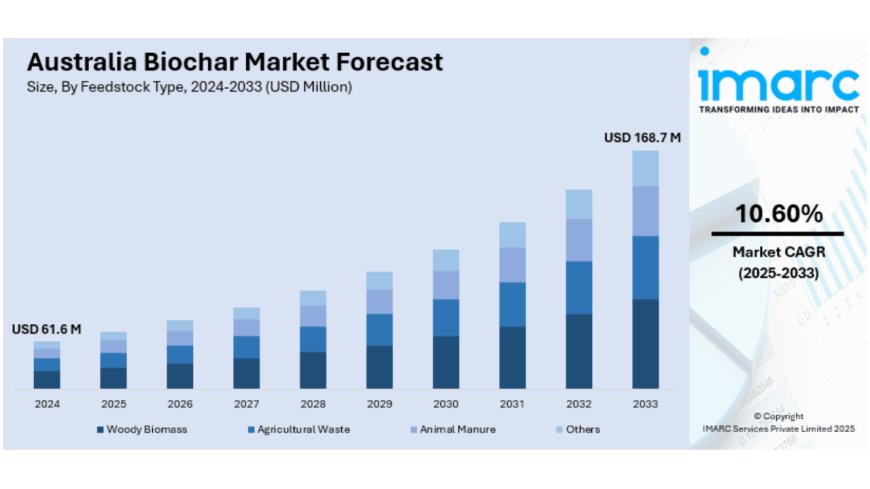
The latest report by IMARC Group, titled "Australia Biochar Market Report by Feedstock Type (Woody Biomass, Agricultural Waste, Animal Manure, Others), Technology Type (Slow Pyrolysis, Fast Pyrolysis, Gasification, Hydrothermal Carbonization, Others), Product Form (Coarse and Fine Chips, Fine Powder, Pellets, Granules and Prills, Liquid Suspension), Application (Farming, Gardening, Livestock Feed, Soil, Water and Air Treatment, Others), and Region 2025-2033," offers a comprehensive analysis of the Australia biochar market growth. The report includes competitor and regional analysis, along with a detailed breakdown of the market segmentation. The Australia biochar market size reached USD 61.6 Million in 2024. Looking forward, IMARC Group expects the market to reach USD 168.7 Million by 2033, exhibiting a CAGR of 10.60% during 2025–2033.
Base Year: 2024
Forecast Years: 2025–2033
Historical Years: 2019–2024
Market Size in 2024: USD 61.6 Million
Market Forecast in 2033: USD 168.7 Million
Market Growth Rate (2025–2033): 10.60%
Australia Biochar Market Overview
Australia’s biochar market is witnessing strong expansion, supported by the increasing adoption of sustainable agriculture, climate action initiatives, opportunities for carbon capture, and government incentives promoting regenerative farming. Technological advancements in pyrolysis methods, growth in waste-to-energy projects, carbon credit schemes, and recognition of biochar’s soil improvement properties are key drivers. Biochar innovations are transforming Australia’s agriculture by boosting soil fertility, enhancing moisture retention, lowering fertilizer reliance, and providing long-term carbon storage, establishing the nation as a pioneer in eco-friendly farming practices.
The foundation of Australia’s biochar industry lies in its robust agricultural sector and diverse applications, including crop cultivation, soil health restoration, waste recycling, water treatment, and carbon farming. With abundant biomass resources and a strong environmental commitment, demand for biochar solutions that improve yields while addressing climate concerns is rising. The expansion of regenerative agriculture, circular economy frameworks, government-backed carbon credit initiatives, and sustainable waste solutions create a conducive environment for growth, driving investments in pyrolysis technologies, manufacturing infrastructure, and research activities. Australia’s push for agricultural transformation, supported by rigorous environmental standards and ambitious net-zero emission targets, makes it a fertile market for innovative biochar development and commercialization.
Request For Sample Report:
https://www.imarcgroup.com/australia-biochar-market/requestsample
Australia Biochar Market Trends
• Sustainable agriculture integration: Growing adoption of biochar as soil amendment enhancing fertility, water retention capacity, and crop yields while reducing chemical fertilizer dependency and supporting regenerative farming practices across Australian agricultural operations.
• Carbon sequestration expansion: Increasing implementation of biochar for long-term carbon storage in soils, supporting Australia's net-zero emission targets and providing farmers with carbon credit revenue opportunities through environmental stewardship programs.
• Waste-to-energy conversion: Rising utilization of pyrolysis technology converting agricultural waste, forestry residues, and municipal organic waste into biochar and bioenergy, creating circular economy solutions and sustainable waste management practices.
• Advanced pyrolysis technologies: Growing deployment of sophisticated production systems including slow pyrolysis, fast pyrolysis, and hydrothermal carbonization methods optimizing biochar quality, yield, and cost-effectiveness for diverse applications.
• Research and development acceleration: Expanding scientific research investigating biochar applications in water treatment, air purification, livestock feed additives, and specialized industrial uses broadening market opportunities and commercial potential.
• Government policy support: Strengthening regulatory frameworks, incentive programs, and funding initiatives promoting biochar adoption through carbon farming schemes, renewable energy projects, and sustainable agriculture development programs.
Market Drivers
• Climate change mitigation pressure: Growing urgency to reduce greenhouse gas emissions and enhance carbon sequestration driving biochar adoption as a natural climate solution supporting Australia's international climate commitments and environmental targets.
• Soil degradation challenges: Increasing recognition of soil health deterioration, erosion problems, and fertility decline across Australian agricultural lands creating demand for biochar solutions that restore soil productivity and long-term sustainability.
• Agricultural productivity demands: Rising pressure to increase crop yields, improve drought resilience, and optimize resource efficiency while maintaining environmental stewardship driving adoption of biochar soil amendments and farming practices.
• Government carbon incentives: Implementation of carbon credit programs, carbon farming initiatives, and environmental payment schemes providing financial incentives for biochar adoption and sustainable land management practices.
• Waste management solutions: Growing need for sustainable disposal methods for agricultural residues, forestry waste, and organic municipal waste creating opportunities for biochar production through waste-to-energy conversion technologies.
• Water scarcity management: Increasing focus on water conservation, improved irrigation efficiency, and drought resilience driving adoption of biochar amendments that enhance soil water retention and reduce agricultural water consumption.
Challenges and Opportunities
Challenges:
- High production costs and capital investment requirements for pyrolysis equipment and biochar processing facilities creating financial barriers particularly for small-scale producers and limiting market accessibility for cost-sensitive applications
- Limited market awareness and education regarding biochar benefits requiring comprehensive outreach programs, demonstration projects, and technical support to encourage adoption among traditional farming communities and industrial users
- Quality standardization and certification challenges lacking comprehensive standards for biochar specifications, testing protocols, and performance metrics creating uncertainty for buyers and hindering market development
- Supply chain infrastructure limitations requiring development of collection networks, processing facilities, and distribution systems to efficiently handle diverse feedstock materials and deliver products to end users
- Regulatory complexity and approval processes for biochar applications in specific sectors requiring extensive testing, documentation, and compliance procedures particularly for livestock feed and water treatment applications
Opportunities:
- Carbon credit market expansion through verified carbon sequestration programs providing additional revenue streams for biochar producers and users while supporting climate change mitigation objectives
- Export market potential for Australian biochar expertise and technology serving international markets seeking sustainable agriculture solutions and carbon management strategies in similar climatic conditions
- Industrial application diversification including water treatment systems, air purification technologies, and specialized chemical processes creating new market segments beyond traditional agricultural uses
- Research collaboration expansion between universities, government agencies, and private companies advancing biochar science, optimizing production methods, and developing innovative applications
- Circular economy integration combining biochar production with renewable energy generation, waste management services, and agricultural productivity enhancement creating comprehensive sustainability solutions
Australia Biochar Market Segmentation
By Feedstock Type:
- Woody Biomass
- Forest Residues
- Wood Chips
- Sawdust
- Tree Prunings
- Agricultural Waste
- Crop Residues
- Rice Husks
- Wheat Straw
- Sugarcane Bagasse
- Animal Manure
- Cattle Manure
- Poultry Litter
- Pig Manure
- Others
- Municipal Organic Waste
- Food Processing Waste
- Paper Mill Sludge
By Technology Type:
- Slow Pyrolysis
- Traditional Kilns
- Retort Systems
- Batch Reactors
- Fast Pyrolysis
- Fluidized Bed Reactors
- Circulating Fluid Bed
- Rotating Cone Reactors
- Gasification
- Fixed Bed Gasifiers
- Fluidized Bed Gasifiers
- Downdraft Gasifiers
- Hydrothermal Carbonization
- High Pressure Systems
- Continuous Process
- Batch Process
- Others
- Microwave Pyrolysis
- Flash Pyrolysis
By Product Form:
- Coarse and Fine Chips
- Fine Powder
- Pellets
- Granules and Prills
- Liquid Suspension
By Application:
- Farming
- Soil Amendment
- Crop Production
- Organic Farming
- Carbon Farming
- Gardening
- Home Gardens
- Landscaping
- Nursery Applications
- Livestock Feed
- Feed Additives
- Ruminant Feed
- Poultry Feed
- Soil, Water and Air Treatment
- Soil Remediation
- Water Filtration
- Air Purification
- Wastewater Treatment
- Others
- Industrial Applications
- Energy Storage
- Construction Materials
By Region:
- Australia Capital Territory & New South Wales
- Victoria & Tasmania
- Queensland
- Northern Territory & Southern Australia
- Western Australia
Browse Full Report:
https://www.imarcgroup.com/australia-biochar-market
Australia Biochar Market News (2024–2025)
• February 2025: Australian government committed $10.4 million to sugarcane waste-to-fuel projects, including $8 million for Licella's proposed biorefinery in Queensland expected to produce 60 million litres of low-carbon fuel annually.
• 2024: ARENA funding supported biochar and bioenergy sector development through $33.5 million national initiative to decarbonize aviation sector using sustainable waste-to-energy technologies and biochar production systems.
• 2024: Sustainable agriculture market in Australia reached $7.47 billion with projected growth to $25.08 billion by 2033, driving increased biochar adoption for soil enhancement and carbon sequestration applications.
• 2024: Carbon farming initiatives expanded across Australia with enhanced government support for biochar-based carbon credit programs providing farmers additional revenue streams through environmental stewardship practices.
• 2024: Research and development activities accelerated with collaborations between universities and private enterprises optimizing pyrolysis technology, production methods, and cost-effectiveness for commercial biochar applications.
• 2024: Waste management sector integration increased with forestry, municipal waste management, and biomass energy industries investing in pyrolysis technology for circular economy biochar production models.
Key Highlights of the Report
- Market Performance (2019–2024)
- Market Outlook (2025–2033)
- Industry Catalysts and Challenges
- Segment-wise historical and future forecasts
- Competitive Landscape and Key Player Analysis
- Feedstock Type, Technology Type, Product Form, and Application Analysis
Ask analyst for your customized sample:
https://www.imarcgroup.com/request?type=report&id=32355&flag=F
Q&A Section
Q1: What drives growth in the Australia biochar market?
A1: Market growth is driven by climate change mitigation pressure requiring carbon sequestration solutions, soil degradation challenges demanding fertility restoration methods, agricultural productivity demands for sustainable yield enhancement, government carbon incentives through farming schemes and credit programs, waste management solutions converting organic waste to valuable products, and water scarcity management improving soil water retention and irrigation efficiency.
Q2: What are the latest trends in this market?
A2: Key trends include sustainable agriculture integration enhancing soil fertility and reducing chemical inputs, carbon sequestration expansion supporting net-zero emission targets, waste-to-energy conversion creating circular economy solutions, advanced pyrolysis technologies optimizing production efficiency and quality, research and development acceleration exploring new applications and markets, and government policy support through incentive programs and regulatory frameworks.
Q3: What challenges do companies face?
A3: Major challenges include high production costs and capital investment requirements for processing equipment, limited market awareness requiring comprehensive education and demonstration programs, quality standardization and certification challenges lacking comprehensive industry standards, supply chain infrastructure limitations requiring collection and distribution network development, and regulatory complexity with approval processes for specific sector applications.
Q4: What opportunities are emerging?
A4: Emerging opportunities include carbon credit market expansion providing additional revenue streams through verified sequestration programs, export market potential leveraging Australian expertise for international sustainable agriculture markets, industrial application diversification in water treatment and air purification technologies, research collaboration expansion advancing biochar science and innovative applications, and circular economy integration combining production with renewable energy and comprehensive sustainability solutions.
About Us
IMARC Group is a leading market research company that offers management strategy and market research worldwide. We partner with clients in all sectors and regions to identify their highest-value opportunities, address their most critical challenges, and transform their businesses. IMARC's information products include major market, scientific, economic and technological developments for business leaders in pharmaceutical, industrial, and high technology organizations. Market forecasts and industry analysis for biotechnology, advanced materials, pharmaceuticals, food and beverage, travel and tourism, nanotechnology and novel processing methods are at the top of the company's expertise.
Contact Us
IMARC Group
134 N 4th St. Brooklyn, NY 11249, USA
Email: sales@imarcgroup.com
Tel No: (D) +91-120-433-0800
United States: +1-201-971-6302
What's Your Reaction?