





























Philippines CT Scanners Market 2026: Trends, Share, Size, Growth & Forecast till 2034
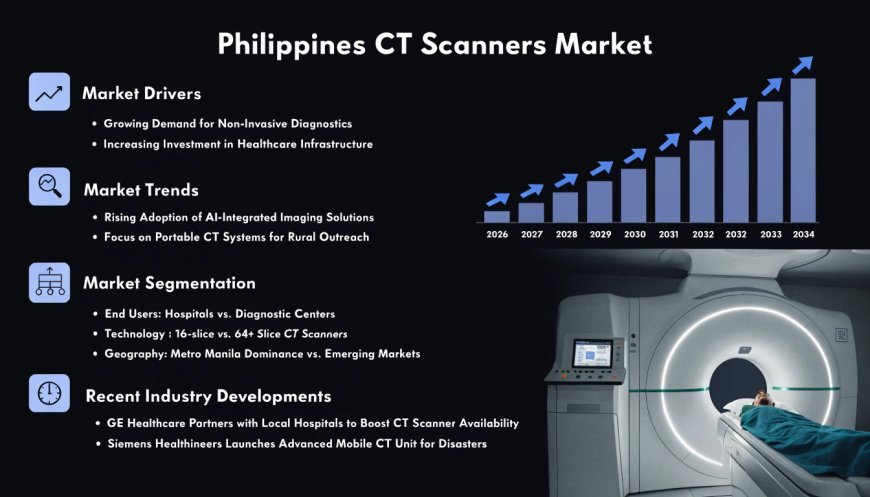
The Philippines CT scanners market size reached USD 196.65 Million in 2025. Looking forward, the market is expected to reach USD 355.98 Million by 2034, exhibiting a growth rate (CAGR) of 6.82% during 2026-2034.

Philippines CT Scanners Market Overview:
The Philippines CT scanners market size reached USD 196.65 Million in 2025. Looking forward, the market is expected to reach USD 355.98 Million by 2034, exhibiting a growth rate (CAGR) of 6.82% during 2026-2034. The market encompasses diverse technologies, modalities, device architectures, applications, and end-user segments tailored to the Philippines’ expanding diagnostic imaging landscape, covering 16-slice, 32-slice, 64-slice, 128 and above slice, 8-slice, and less than 8 slices configurations across fixed and mobile modalities in O-arm and C-arm device architectures, serving cardiology, oncology, neurology, and other applications across hospitals, diagnostic centers, and other healthcare facilities. Government healthcare infrastructure investment through the HEAL Project and HFEP, rising prevalence of chronic diseases including cancer and cardiovascular conditions, integration of artificial intelligence and cutting-edge imaging technologies, expansion of diagnostic capacity in underserved areas, and increased healthcare expenditure are some of the key factors driving market growth throughout the forecast period.
Request for a sample report PDF: https://www.imarcgroup.com/philippines-ct-scanners-market/requestsample
Philippines CT Scanners Market Summary:
• The HEAL Project — a USD 59 million collaboration between UNOPS, the Department of Health, and the Asian Development Bank — delivered over 45 CT scanners to more than 100 public health facilities across the Philippines by its completion in February 2025. Before these installations, patients in rural areas had to travel two to three hours for CT services, and for cerebrovascular cases such delays could mean the difference between life and death.
• Ischaemic heart diseases are the leading cause of death in the Philippines, accounting for 85,868 deaths or 19.4% of total mortality from January to October 2024. Cardiovascular disease caused 58% of total mortality in the country, with particularly high rates of stroke. Cancer is the second leading cause of death at 13.5% of all fatalities — all conditions where CT scanning plays a critical role in early detection, treatment planning, and monitoring.
• PhilHealth has expanded diagnostic imaging coverage through its outpatient emergency care benefit package, which now includes CT scans alongside electrocardiograms, X-rays, and laboratory tests. However, CT and MRI scans remain covered primarily as inpatient services, creating ongoing advocacy for broader outpatient coverage that would further drive diagnostic imaging demand.
• Approximately 35% of newly installed CT scanners globally now feature AI capabilities, with AI-powered systems demonstrating a 30–40% reduction in radiologist reading time and improved detection accuracy. Leading Philippine hospital groups are upgrading their CT imaging suites with multi-slice scanners featuring enhanced dose-reduction features and AI-assisted analysis tools.
• The DOH’s PHP 35.37 billion budget for 2025 and the HFEP’s PHP 14.47 billion allocation for 2026 continue to fund healthcare facility construction and medical equipment procurement. With 1,823 health facilities identified for completion at PHP 32.4 billion estimated cost, the pipeline for CT scanner installations at new and upgraded facilities remains substantial.
• There is significant regional disparity in diagnostic imaging access. Luzon, home to three-quarters of tertiary care facilities, has 41.6 imaging units per million population, compared to 28.7 in Visayas and 26.0 in Mindanao — highlighting the untapped demand in regions outside Metro Manila that government programs are specifically targeting.
• CT scanners delivered through the HEAL Project are serving an average of five to ten patients daily at participating hospitals since January 2024. Diagnoses are faster, treatment plans are more efficient, and patient outcomes have significantly improved — particularly for cerebrovascular and trauma cases in previously underserved provincial facilities.
• Market segmentation covers 16-slice through 128+ slice technologies across fixed and mobile modalities, O-arm and C-arm architectures, serving cardiology, oncology, neurology, and other applications at hospitals, diagnostic centers, and other end-user facilities throughout the Philippines.
Key Trends Shaping the Philippines CT Scanners Market:
• Government-driven diagnostic capacity expansion: The HEAL Project’s delivery of 45+ CT scanners to 100+ public facilities, combined with the DOH’s PHP 35.37 billion budget and HFEP’s PHP 14.47 billion allocation for facility construction, is systematically closing the diagnostic imaging gap in underserved regions. With 1,823 health facilities still requiring completion, the government infrastructure pipeline represents a sustained, multi-year demand channel for CT scanner procurement.
• AI integration transforming diagnostic workflows: Roughly 35% of new CT installations globally now include AI capabilities, and Philippine hospitals are adopting these systems to reduce radiologist reading time by 30–40% while improving detection accuracy. AI-powered features including automated lesion detection, quantitative analysis, and workflow optimization are becoming competitive differentiators for hospitals and diagnostic centers seeking to attract patients and improve clinical outcomes.
• Rising chronic disease burden driving imaging demand: Cardiovascular disease causes 58% of mortality in the Philippines, with ischaemic heart disease alone accounting for 19.4% of all deaths. Cancer is the second leading cause of death at 13.5%. The growing prevalence of these conditions — fueled by high blood pressure, unhealthy diets, smoking, and obesity — is creating sustained demand for CT-based screening, diagnosis, and treatment monitoring across cardiology, oncology, and neurology.
• Multi-slice technology advancement and dose reduction: Leading hospital groups are upgrading to 64-slice, 128-slice, and 256-slice CT scanners that produce sharper images faster while reducing radiation exposure. These advanced systems shorten scan times, improve patient throughput, and expand the range of clinical applications — making them essential for hospitals handling growing patient volumes and increasingly complex diagnostic cases.
• Closing the regional diagnostic imaging gap: With Luzon at 41.6 imaging units per million population versus 28.7 in Visayas and 26.0 in Mindanao, there is a clear structural imbalance that government programs and private investment are working to address. Mobile CT units and cost-effective mid-range scanners are emerging as solutions for bringing diagnostic imaging to geographically isolated and disadvantaged areas across the archipelago.
Browse the full report with TOC and list of figures: https://www.imarcgroup.com/philippines-ct-scanners-market
Market Growth Drivers:
Government Healthcare Investment and Diagnostic Infrastructure Expansion
The Philippine government’s commitment to healthcare infrastructure is creating a powerful demand engine for CT scanners. The HEAL Project’s USD 59 million investment delivered over 45 CT scanners and 5,000 units of medical equipment to more than 100 public health facilities by February 2025, directly addressing critical diagnostic gaps in rural and underserved regions. The DOH’s PHP 35.37 billion budget for 2025 — up PHP 6.78 billion from 2024 — targets facility upgrades and medical equipment procurement nationwide. The HFEP’s PHP 14.47 billion allocation for 2026 funds construction and rehabilitation of rural health units (PHP 3.96 billion), local government hospitals (PHP 6.90 billion), and other health facilities (PHP 3.59 billion). With 1,823 facilities still requiring completion at an estimated PHP 32.4 billion, the multi-year pipeline for CT scanner installations is substantial. PhilHealth’s expanded outpatient emergency care coverage now includes CT scans, further driving utilization at newly equipped facilities.
Chronic Disease Burden, Cancer Screening, and Cardiovascular Diagnostics
The Philippines faces an escalating chronic disease crisis that is structurally driving CT scanner demand. Ischaemic heart diseases led all causes of death in 2024 with 85,868 fatalities (19.4% of total mortality), while cardiovascular disease collectively caused 58% of all deaths — with particularly devastating stroke rates. Cancer is the second leading cause of death at 13.5% of fatalities. Major risk factors including high blood pressure, unhealthy diets high in sodium and trans-fats, smoking, physical inactivity, and obesity are worsening these trends. CT scanning is indispensable across this disease landscape: cardiac CT for coronary artery assessment, CT angiography for stroke diagnosis, chest CT for lung cancer screening, and whole-body CT for oncology staging and monitoring. PhilHealth’s launch of outpatient cancer screening benefit packages in August 2025 and expanded Z-Benefit packages for heart disease further institutionalize CT imaging as a standard component of chronic disease management.
AI Technology Integration, Private Hospital Investment, and Medical Tourism
Technology innovation is reshaping the Philippines CT scanner market. Approximately 35% of new CT installations globally now feature AI capabilities that demonstrate 30–40% reduction in radiologist reading time while improving detection accuracy for lesions, hemorrhages, and other pathologies. Philippine hospital groups are investing in multi-slice scanners (64-slice through 256-slice) with enhanced dose-reduction features and AI-assisted analysis tools. The advanced imaging modalities market reached approximately PHP 15 billion, reflecting a 10% year-on-year increase. The medical tourism market — USD 1.7 billion in 2025 — creates additional demand for world-class diagnostic imaging at facilities competing for international patients. Major global manufacturers including Siemens Healthineers, GE HealthCare, Philips Healthcare, and Canon Medical Systems (distributed locally through Philippine Medical Systems Inc.) are actively expanding their presence, bringing the latest scanner technology and service infrastructure to support the market’s modernization trajectory.
Market Segmentation:
IMARC Group provides an analysis of the key trends in each segment of the Philippines CT scanners market, along with forecasts at the country and regional levels from 2026-2034. The market has been categorized based on technology, modality, device architecture, application, and end user.
By Technology:
• 16-Slice
• 32-Slice
• 64-Slice
• 128 and Above Slice
• 8-Slice
• Less Than 8 Slices
By Modality:
• Fixed
• Mobile
By Device Architecture:
• O-Arm
• C-Arm
By Application:
• Cardiology
• Oncology
• Neurology
• Others
By End User:
• Hospitals
• Diagnostic Centers
• Others
Key Players:
The Philippines CT scanners market features competition among global medical imaging multinationals, regional distributors, and local service providers. Major players active in the market include Siemens Healthineers, GE HealthCare, Philips Healthcare, Canon Medical Systems (distributed by Philippine Medical Systems Inc.), Fujifilm, Hitachi Healthcare, Carestream Health, Mindray Medical, and other global and regional medical device companies. The market research report provides a comprehensive analysis of the competitive landscape including key player positioning, market structure, top winning strategies, competitive dashboards, and detailed company profiles.
Key Aspects Required for the Philippines CT Scanners Market:
• Demand structure spans public tertiary hospitals, private hospital networks, standalone diagnostic centers, ambulatory imaging facilities, and government health programs. The HEAL Project’s 45+ CT installations and HFEP’s 1,823-facility pipeline create institutional demand, while private hospitals invest in premium scanners to serve growing patient volumes and attract medical tourists.
• Hospitals dominate end-user demand, driven by their extensive patient base, broad clinical case mix, and the critical role of CT imaging in emergency care, surgery planning, and chronic disease management. Public hospitals equipped through the HEAL Project are now processing five to ten CT patients daily — volumes expected to grow as awareness increases and referral pathways strengthen.
• Cardiology and oncology lead application segments, reflecting the Philippines’ disease burden where cardiovascular disease causes 58% of mortality and cancer accounts for 13.5% of deaths. CT angiography, coronary calcium scoring, lung cancer screening, and whole-body staging scans are standard clinical workflows driving recurring equipment utilization and consumable demand.
• Regional imaging disparity creates targeted growth opportunities. Luzon has 41.6 imaging units per million population versus 28.7 in Visayas and 26.0 in Mindanao. Government programs specifically target these underserved regions, and mobile CT units offer a cost-effective solution for geographically isolated and disadvantaged areas across the 7,000+ island archipelago.
• Buyers prioritize image quality, scan speed, radiation dose management, AI capabilities, total cost of ownership, service and maintenance support, and compatibility with hospital information systems. The shift toward multi-slice scanners (64-slice through 256-slice) with AI-assisted analysis reflects growing sophistication in procurement decisions.
• Competitive landscape includes global leaders Siemens Healthineers, GE HealthCare, Philips Healthcare, and Canon Medical Systems alongside Fujifilm, Hitachi, Carestream, and Mindray. Philippine Medical Systems Inc. has served as Canon’s official distributor for over 25 years, illustrating the importance of established local distribution networks in the market.
• Distribution channels include direct procurement by large hospital groups, government tender processes through the DOH and HFEP, authorized medical equipment distributors, public-private partnership procurement models, and international development project channels like the HEAL Project. The mix of public and private funding sources creates diverse entry points for equipment manufacturers.
• PhilHealth’s coverage policies significantly influence CT scanner utilization. CT scans are covered as inpatient services and through the outpatient emergency care benefit package, while the August 2025 launch of outpatient cancer screening benefit packages is expanding access to preventive CT imaging. Ongoing advocacy for broader outpatient CT coverage, if realized, would substantially increase scanning volumes.
Recent News and Developments:
August 2025: PhilHealth launched outpatient cancer screening benefit packages, expanding insurance coverage for preventive diagnostic imaging including CT scans. This move is expected to increase CT utilization rates as more Filipinos gain access to covered cancer screening services.
February 2025: The HEAL Project — a USD 59 million collaboration between UNOPS, the Department of Health, and the Asian Development Bank — completed after four years, having delivered over 45 CT scanners and 5,000 units of medical equipment to more than 100 public health facilities across the Philippines.
January 2025: The Department of Health received a PHP 35.37 billion budget for 2025, a PHP 6.78 billion increase from 2024, earmarked for upgrading healthcare facilities and procuring modern medical equipment including diagnostic imaging systems across underserved regions.
2025: The Philippine Children’s Medical Center (PCMC) installed new MRI and CT scanners to boost diagnostic health services for Filipino children, enhancing pediatric imaging capabilities at one of the country’s leading children’s hospitals.
2025: Leading Philippine hospital groups announced upgrades to their CT imaging suites, incorporating multi-slice scanners with enhanced dose-reduction features and AI-assisted analysis tools to improve diagnostic precision and shorten patient throughput times.
2025: The advanced imaging modalities market in the Philippines reached approximately PHP 15 billion, reflecting a 10% year-on-year increase, driven by investments in cutting-edge CT and MRI technologies across both public and private healthcare facilities.
2025: PhilHealth expanded its outpatient emergency care benefit package to include diagnostic imaging services such as CT scans, ECGs, and X-rays, reducing financial barriers to emergency diagnostic care at accredited facilities nationwide.
2025: The Philippines CT scanners market reached approximately USD 196.65 Million, driven by the HEAL Project’s rural facility upgrades, rising chronic disease prevalence, AI-powered imaging technology adoption, and sustained government healthcare infrastructure investment.
About Us
IMARC Group is a global management consulting firm that helps the world’s most ambitious changemakers to create a lasting impact. The company provides a comprehensive suite of market entry and expansion services. IMARC offerings include thorough market assessment, feasibility studies, company incorporation assistance, factory setup support, regulatory approvals and licensing navigation, branding, marketing and sales strategies, competitive landscape and benchmarking analyses, pricing and cost research, and procurement research.
Contact Us
IMARC Group
134 N 4th St., Brooklyn, NY 11249, USA
Email: sales@imarcgroup.com
Tel. No.: (D) +91 120 433 0800
United States: +1-201-971-6302
What's Your Reaction?