




























Philippines Active Pharmaceutical Ingredients (APIs) Market | Size, Growth, Trends and Analysis 2026-2034
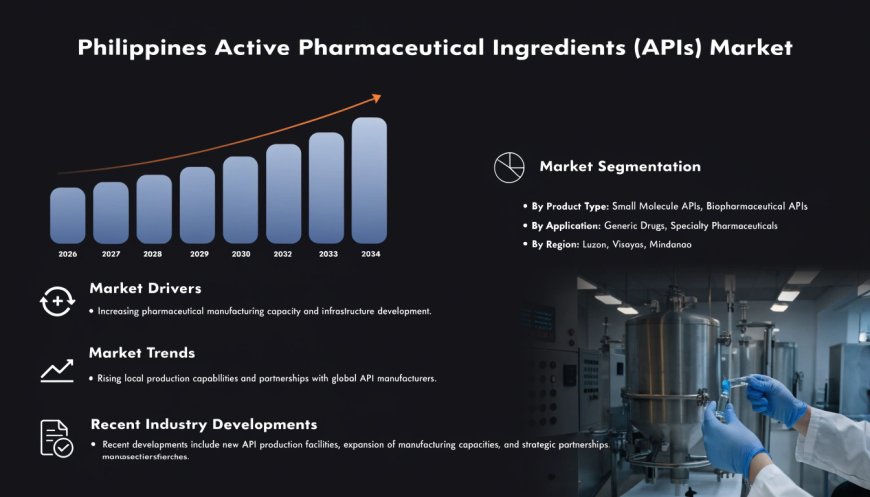
The Philippines active pharmaceutical ingredients (APIs) market size reached USD 5,115.50 Million in 2025. The market is projected to reach USD 7,374.23 Million by 2034, growing at a CAGR of 4.15% during 2026-2034.

Market Overview
The Philippines active pharmaceutical ingredients (APIs) market is steadily advancing, driven by the government’s strategic push to onshore drug manufacturing, the sustained high prevalence of chronic diseases, and the establishment of dedicated pharmaceutical economic zones that provide tax incentives and streamlined regulatory processes. According to IMARC Group, the market size reached USD 5,115.50 Million in 2025 and is projected to reach USD 7,374.23 Million by 2034, exhibiting a compound annual growth rate (CAGR) of 4.15% during 2026‑2034.
The Philippines continues to post a significant pharmaceutical trade deficit, reflecting its heavy dependence on imported medicines and APIs. More than 90 percent of pharmaceuticals in the country are imported, exposing the sector to external supply disruptions and cost fluctuations. This reliance on external sources represents a major vulnerability in the local pharmaceutical supply chain, prompting the government to actively promote self-sufficiency and import substitution through the development of pharma zones, fiscal incentives, and targeted foreign direct investment (FDI) attraction. The market is strategically important to the Philippines’ economy as it enhances healthcare security, reduces external supply chain vulnerabilities, creates high‑value employment, and positions the nation as a competitive player in the regional pharmaceutical landscape.
The Philippines active pharmaceutical ingredients (APIs) market is poised for sustained expansion, driven by escalating government support through pharmaceutical ecozones and regulatory improvements, and the rising burden of chronic diseases. With generic medicines projected to account for a significant share of pharmaceutical sales by 2030 and landmark FDI commitments strengthening the local value chain, the market presents significant opportunities for domestic and international manufacturers focused on cost‑effective, high‑quality, and innovative API production.
Philippines Active Pharmaceutical Ingredients (APIs) Market Summary
The Philippines active pharmaceutical ingredients (APIs) market encompasses the production and distribution of chemical or biological substances used as the active component in finished pharmaceutical products. APIs are essential for drug efficacy and are categorised by drug type, manufacturer type, synthesis method, and therapeutic application. The ecosystem includes captive manufacturers producing APIs for their own finished drug products, merchant API manufacturers supplying third‑party pharmaceutical companies, and a growing number of biotech innovators leveraging synthetic and biological synthesis methods.
Segmentation Insights
-
By Drug Type: Innovative Active Pharmaceutical Ingredients (API), Generic Active Pharmaceutical Ingredients (API)
-
By Type of Manufacturer: Captive Manufacturers, Merchant API Manufacturers (Innovative Merchant API Manufacturers, Generic Merchant API Manufacturers)
-
By Type of Synthesis: Synthetic Active Pharmaceutical Ingredients (API) (Innovative Synthetic APIs, Generic Synthetic APIs); Biotech Active Pharmaceutical Ingredients (API) (Innovative Biotech APIs, Biosimilars, Monoclonal Antibodies, Vaccines, Cytokines, Fusion Proteins, Therapeutic Enzymes, Blood Factors, Mammalian Expression Systems, Microbial Expression Systems, Yeast Expression Systems, Transgenic Animal Systems, Others)
-
By Therapeutic Application: Oncology, Cardiovascular and Respiratory, Diabetes, Central Nervous System Disorders, Neurological Disorders, Others
The generic API segment is expected to see strong growth, supported by government policies promoting affordable medicines and the Universal Health Care (UHC) Act. Biotech APIs represent an emerging segment as the country builds capabilities in advanced biological synthesis. The expanding share of generic medicines is creating consistent and growing demand for domestically produced APIs.
Porter's Five Forces Analysis – Philippines Active Pharmaceutical Ingredients (APIs) Market
The competitive dynamics of the Philippines active pharmaceutical ingredients (APIs) market can be analysed using Porter's Five Forces framework.
Bargaining Power of Suppliers – Moderate
The Philippines relies heavily on imported APIs, particularly from China and India, which gives international suppliers significant influence over pricing and availability. However, government initiatives to attract foreign direct investment and develop local manufacturing capabilities through pharmaceutical economic zones (pharmazones) offering tax incentives and streamlined regulatory processes are gradually reducing this dependency.
Bargaining Power of Buyers – High
Buyers include pharmaceutical manufacturers, government procurement agencies, and healthcare providers. The government’s commitment to lowering medicine costs through centralised procurement gives institutional buyers significant negotiating leverage. The generics market, where cost‑effectiveness is paramount, further amplifies buyer power as pharmaceutical companies seek competitive pricing from API suppliers.
Threat of New Entrants – Moderate
Capital requirements for API manufacturing are substantial, and navigating regulatory approval processes can be complex. However, government support through pharmazones, which provide tax incentives and streamlined registration, is lowering barriers. The growing demand for generic APIs and the push for local production are attracting new players, particularly in the generic API segment.
Threat of Substitutes – Low
There is a low threat of substitutes. APIs are essential components of pharmaceutical products, and alternative treatment modalities (e.g., biologics, gene therapy) still require their own specific active ingredients. While some plant‑based or synthetic alternatives exist for certain molecules, they are not direct substitutes for the vast majority of APIs.
Competitive Rivalry – Moderate
The market is moderately competitive, characterised by a blend of multinational pharmaceutical corporations establishing manufacturing operations within Philippine Economic Zone Authority-designated pharmaceutical parks and local companies gradually building API production capabilities. International API manufacturers, particularly from India and China, dominate imports, while a growing number of local producers are establishing themselves, supported by government incentives. Competition centres on regulatory compliance, product quality consistency, supply reliability, pricing competitiveness, and technical service support.
Request for Sample Report: https://www.imarcgroup.com/philippines-active-pharmaceutical-ingredients-market/requestsample
Market Growth Drivers
Government Support and Establishment of Pharmaceutical Ecozones
Government support and the creation of pharmaceutical ecozones are major drivers of the market growth in the Philippines. The government’s focus on reducing import dependency and enhancing local drug manufacturing is encouraging investments in API production facilities. Pharmaceutical ecozones provide tax incentives, simplified regulatory processes, and improved infrastructure, attracting both domestic and international players. These zones foster research collaborations and technology transfer, improving production efficiency and product quality. The government’s industrial policies promote innovations in life sciences and support startups focusing on biopharmaceuticals and synthetic chemistry.
The first pharma zone, the Victoria Industrial Park, a 30-hectare facility in Victoria, Tarlac, was officially launched, poised to become a dynamic hub for investment, innovation, medical research, and inclusive progress. PEZA is also looking to proclaim a second pharmaceutical economic zone within the year, indicating strong momentum in establishing a specialised pharmaceutical manufacturing ecosystem.
Rising Prevalence of Chronic Diseases and Healthcare Access Expansion
The rising burden of chronic ailments, such as diabetes, cardiovascular disorders, cancer, and respiratory illnesses, is significantly fueling the Philippines active pharmaceutical ingredients (APIs) market growth. Increased diagnosis and long-term treatment needs have accelerated the demand for essential and high-quality medicines, boosting API consumption. Local manufacturers and multinational pharmaceutical firms are investing in large-scale production of therapeutic APIs to meet the healthcare system’s evolving requirements. The rise in lifestyle-related diseases also promotes research into complex APIs, including biologics and specialty formulations. This growing disease burden directly supports sustained API demand, enabling capacity expansion and innovations across the pharmaceutical sector.
Expansion of Centralized Government Procurement Initiatives
The expansion of universal healthcare coverage and centralized government procurement systems is a key factor driving the market in the Philippines. With the government’s aim to provide affordable and accessible healthcare to all citizens, the demand for generic medicines and essential drugs has surged. Centralized procurement initiatives streamline drug purchasing, ensuring consistent quality standards and bulk API sourcing at lower costs. This system supports local API manufacturers by guaranteeing stable, large-volume contracts and encouraging investments in domestic production. The alignment of healthcare reforms with industrial policy fosters a sustainable ecosystem that strengthens pharmaceutical manufacturing, supports local innovation, and reduces dependence on imported active ingredients.
Technological Advancements and AI Integration in API Manufacturing
Artificial intelligence is progressively transforming the Philippines API manufacturing landscape. AI-powered solutions enable predictive maintenance systems that reduce unplanned downtime, implement computer vision-driven quality inspection processes that enhance product consistency, and deploy machine learning algorithms for production optimization and process control. As pharmaceutical manufacturers in the Philippines are adopting Industry 4.0 technologies and digital factory platforms, AI-powered solutions are improving operational efficiency, reducing manufacturing costs, and ensuring regulatory compliance. These technological advancements are making local API production more competitive and efficient, supporting the government's push for import substitution.
Philippines Active Pharmaceutical Ingredients (APIs) Market Segmentation
Segmentation analysis provides a detailed view of the Philippines active pharmaceutical ingredients (APIs) market by category:
-
Drug Type Insights: Innovative Active Pharmaceutical Ingredients (API), Generic Active Pharmaceutical Ingredients (API)
-
Type of Manufacturer Insights: Captive Manufacturers, Merchant API Manufacturers (Innovative Merchant API Manufacturers, Generic Merchant API Manufacturers)
-
Type of Synthesis Insights: Synthetic Active Pharmaceutical Ingredients (API) (Innovative Synthetic APIs, Generic Synthetic APIs); Biotech Active Pharmaceutical Ingredients (API) (Innovative Biotech APIs, Biosimilars, Monoclonal Antibodies, Vaccines, Cytokines, Fusion Proteins, Therapeutic Enzymes, Blood Factors, Mammalian Expression Systems, Microbial Expression Systems, Yeast Expression Systems, Transgenic Animal Systems, Others)
-
Therapeutic Application Insights: Oncology, Cardiovascular and Respiratory, Diabetes, Central Nervous System Disorders, Neurological Disorders, Others
Competitive Landscape
The competitive landscape of the Philippines active pharmaceutical ingredients (APIs) market is characterised by a mix of international suppliers and a growing number of local manufacturers supported by government incentives. International API suppliers, particularly from India and China, dominate imports, while local producers are focusing on generic APIs and, increasingly, biotech APIs with government support.
Key players drive the market by expanding product portfolios, investing in advanced manufacturing technologies, and strengthening partnerships with domestic formulators. Major players are employing vertical integration strategies to secure raw material supplies and control quality throughout the manufacturing process, while simultaneously investing in facility modernisation to meet stringent requirements imposed by the Food and Drug Administration and international regulatory authorities.
The market landscape features collaborations between domestic manufacturers and foreign technology partners aimed at knowledge transfer, capacity building, and accessing advanced manufacturing processes, positioning the Philippines to gradually reduce import dependency and develop specialized capabilities in both synthetic and biotechnology-derived APIs across multiple therapeutic categories. The market research report has also provided a comprehensive analysis of the competitive landscape, including market structure, key player positioning, top winning strategies, competitive dashboard, and company evaluation quadrant.
Regional Analysis
Regional dynamics within the Philippines active pharmaceutical ingredients (APIs) market are shaped by the concentration of industrial zones, manufacturing facilities, and research institutions.
-
Luzon is the largest market region, hosting the Victoria Industrial Park (the country’s first pharma zone) and the Zen Industrial Pharma Ecozone in Tarlac. The region has the highest concentration of pharmaceutical manufacturing plants, extensive research institutions, and is the primary destination for FDI in the pharmaceutical sector. PEZA is in talks with Japanese and Chinese‑American companies to locate in Victoria Industrial Park, further strengthening Luzon’s position as the centre of API manufacturing.
-
Visayas is an emerging market, with potential for pharmaceutical logistics and distribution hubs, supported by improving infrastructure and connectivity. The region benefits from its strategic location for inter‑island distribution of finished pharmaceutical products.
-
Mindanao is a growing market, with rising interest in pharmaceutical investment and increasing awareness of the importance of local drug manufacturing for healthcare security. The region’s growing population and expanding healthcare access are creating new opportunities for API consumption and distribution.
Recent Industry Developments
-
March 2025: PEZA Director General Tereso O. Panga graced the groundbreaking ceremony of the Zen Industrial Pharma Ecozone (ZIPZ) in Luisita, Tarlac, with initial investments of US$20 million. The ecozone is poised to host the Philippines’ first US FDA‑certified manufacturing facility, specialising in the production of sterile injectables and biopharmaceuticals for regulated markets.
-
January 2026: PEZA announced that Zen LifeSciences Inc. is investing ₱1.2 billion to manufacture health products for the export market, with commercial operations expected to start in January 2027 and creating over 90 jobs. The facility is located at Luisita Industrial Park‑Special Economic Zone in Tarlac.
-
2025 (Throughout): PEZA officially launched the Victoria Industrial Park in Tarlac, the country’s first pharma zone. During the event, 13 memoranda of agreement and understanding were signed with investors including Lifestrong Marketing, Greenstone Pharmaceutical, Goodfield, and Ethosperic, among others. A satellite FDA laboratory has commenced construction on‑site.
-
March 2026: BMI, a unit of Fitch Solutions, reported that generic medicines are projected to command a significant share of the Philippines’ total pharmaceutical sales by 2030, with the segment growing at a compound annual rate, reaching ₱409 billion.
-
2025 (Throughout): The Bureau of Internal Revenue expanded the list of VAT‑exempt medicines to include more medications for cancer, diabetes, and other critical illnesses, reducing patient costs and encouraging higher demand for essential drugs.
Browse Full Report with TOC & List of Figures for In‑Depth Market Insights: https://www.imarcgroup.com/philippines-active-pharmaceutical-ingredients-market
Note: If you need any specific information that is not covered currently within the scope of the report, we will provide the same as a part of customisation.
About Us
IMARC Group is a global management consulting firm that helps the world's most ambitious changemakers to create a lasting impact. The company provides a comprehensive suite of market entry and expansion services. IMARC offerings include thorough market assessment, feasibility studies, company incorporation assistance, factory setup support, regulatory approvals and licensing navigation, branding, marketing and sales strategies, competitive landscape and benchmarking analyses, pricing and cost research, and procurement research.
Contact Us
IMARC Group
134 N 4th St., Brooklyn, NY 11249, USA
Email: sales@imarcgroup.com
Tel No.: (D) +91 120 433 0800
United States: +1-201-971-6302
What's Your Reaction?