



























Netherlands E Invoicing Market Share, Trends & Industrial Report 2034
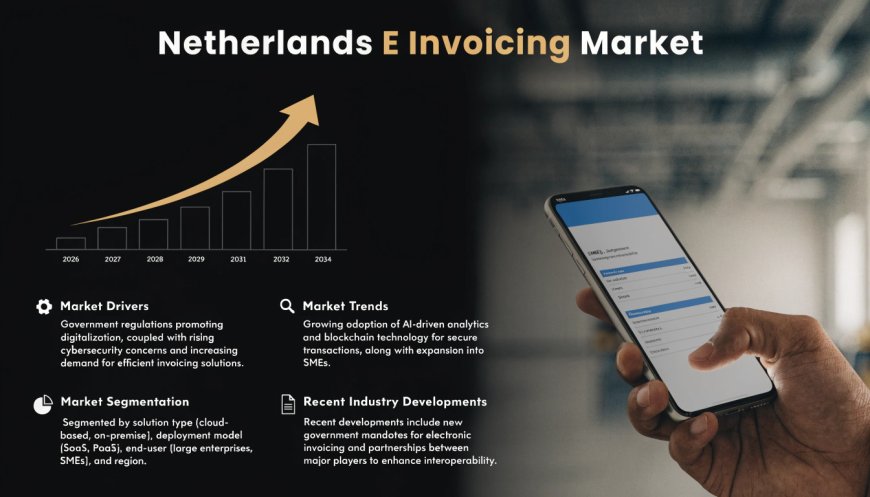
The market size reached USD 195.2 Million in 2025 and is expected to reach USD 744.0 Million by 2034, exhibiting a compound annual growth rate (CAGR) of 15.55% during 2026 2034.

Market Overview
The Netherlands e‑invoicing market is experiencing strong momentum, driven by growing digital adoption, forward‑looking regulatory mandates, and the need for streamlined financial operations. According to IMARC Group, the market size reached USD 195.2 Million in 2025 and is expected to reach USD 744.0 Million by 2034, exhibiting a compound annual growth rate (CAGR) of 15.55% during 2026‑2034. This robust growth reflects the country’s proactive embrace of digital financial tools, with businesses increasingly adopting electronic invoicing to enhance efficiency, reduce errors, and ensure seamless compliance. The market is strategically important to the Dutch economy as it reinforces the Netherlands’ position as a leading digital hub within Europe, fostering a more agile, sustainable, and internationally connected business environment.
The Netherlands e‑invoicing market is poised for transformative expansion, propelled by strong regulatory backing, the widespread adoption of the Peppol framework, and the upcoming EU ViDA initiative. With a projected CAGR of 15.55% through 2034, the market offers significant opportunities for technology providers, enterprises, and public institutions to capitalize on the shift toward automated, secure, and interoperable invoicing solutions.
Netherlands E‑Invoicing Market Summary
- The Netherlands e‑invoicing market encompasses the electronic exchange of structured invoice data between businesses, consumers, and government entities. It leverages standardized formats (e.g., UBL, Peppol BIS) and secure networks to streamline the entire invoice lifecycle, from creation and delivery to validation and archiving.
- The ecosystem includes certified Peppol Access Point providers, software vendors, ERP integrators, public sector platforms (e.g., Digipoort), and end‑users across B2B, B2C, and B2G segments.
- Major segments identified in the market include channel (B2B, B2C, and others), deployment type (cloud‑based and on‑premises), application (energy and utilities, FMCG, e‑commerce, BFSI, government, and others), and province (Noord‑Holland, Zuid‑Holland, Noord‑Brabant, Gelderland, Utrecht, and others).
- The market is driven by strong regulatory mandates for public procurement, the operational benefits of efficiency and cost reduction, and the accelerating adoption of standardized frameworks like Peppol and NLCIUS.
- The Dutch government has set a clear roadmap toward full implementation of the EU’s VAT in the Digital Age (ViDA) rules, with mandatory digital reporting for cross‑border B2B transactions expected by 2030, offering a clear growth horizon for the sector.
PORTER’S FIVE FORCES ANALYSIS – NETHERLANDS E‑INVOICING MARKET
Bargaining Power of Suppliers – Moderate to High
- The market is characterized by a mix of established global software providers and specialized local e‑invoicing platforms. Key players such as eConnect, WeFact, and Basware hold significant influence due to their technological expertise and deep integration with the Peppol network.
- However, the presence of multiple certified Peppol Access Points and the rise of open standards (e.g., Peppol BIS, UBL) give buyers a degree of choice, preventing any single supplier from dominating the market entirely.
Bargaining Power of Buyers – Moderate
- Buyers range from large enterprises and government bodies to SMEs and individual consumers. The availability of diverse e‑invoicing solutions across different price points and deployment models (cloud vs. on‑premises) provides buyers with considerable flexibility.
- While large procurement contracts give major buyers leverage, the high switching costs associated with ERP integrations and network‑specific compliance create some customer loyalty, balancing the overall bargaining power.
Threat of New Entrants – Moderate
- The technical and regulatory complexity of becoming a certified Peppol Access Point, along with the need for robust security measures (e.g., ISO 27001), creates moderate entry barriers.
- Nevertheless, the growing market size and the proliferation of cloud‑based API solutions have lowered initial capital requirements, encouraging innovative startups and international players to enter the Dutch market.
Threat of Substitutes – Low
- E‑invoicing delivers unique benefits in speed, accuracy, and interoperability that traditional paper or PDF‑based invoicing cannot match. As the EU moves toward mandatory digital reporting, the use of non‑electronic invoice formats is becoming obsolete for cross‑border and public procurement transactions.
- Alternative data exchange methods lack the standardized framework and legal acceptance of e‑invoicing networks, making substitution a very limited threat.
Competitive Rivalry – Moderate
- The market is moderately competitive, featuring a mix of international tech giants and agile local specialists. Competition revolves around service reliability, compliance expertise, ease of integration with existing ERP systems, and value‑added features like OCR+ and automated matching.
- Recent consolidations, such as the acquisition of WeFact by Visma, indicate a trend toward integration across the accounting and e‑invoicing value chain, fostering a healthy yet competitive landscape.
Request for Sample Report: https://www.imarcgroup.com/netherlands-e-invoicing-market/requestsample
MARKET GROWTH DRIVERS
Standardization Through Peppol and NLCIUS Frameworks
The Netherlands e‑invoicing market is benefiting from the adoption of standardized frameworks like Peppol and the Dutch‑specific NLCIUS, which have created a reliable and interoperable infrastructure. These frameworks ensure consistent data formats, security protocols, and delivery mechanisms, making it easier for businesses and government entities to exchange invoices efficiently. The Netherlands Peppol Authority oversees compliance and ensures seamless connectivity among access point providers. This has fostered trust in digital invoicing systems and simplified cross‑border transactions, especially within the EU. With formats such as Peppol BIS and SI‑UBL widely supported, businesses can integrate e‑invoicing into their ERP systems with minimal friction. This high level of standardization not only reduces onboarding time but also drives adoption by offering a dependable, scalable solution across the market.
Digital Transformation, ViDA, and Technological Advancements
The impending EU‑wide mandatory digital reporting for cross‑border B2B transactions, set for 2030 under the ViDA initiative, is accelerating investment in compliant e‑invoicing systems. This long‑term visibility encourages both service providers and businesses to upgrade their infrastructure. Moreover, the integration of artificial intelligence and machine learning is revolutionizing e‑invoicing platforms. Advanced features like OCR+ for accurate document conversion, automated data validation, fraud pattern detection, and predictive analytics are making the systems smarter and more valuable to end‑users. These technological enhancements, combined with the growth of cloud‑based SaaS models, are democratizing access for smaller enterprises and ensuring the market remains at the forefront of digital innovation.
Netherlands E‑Invoicing Market Segmentation
Segmentation analysis provides a detailed view of the Netherlands e‑invoicing market by category:
- Channel Insights: B2B, B2C, Others.
- Deployment Type Insights: Cloud‑based, On‑premises.
- Application Insights: Energy and Utilities, FMCG, E‑Commerce, BFSI, Government, Others.
- Province Insights: Noord‑Holland, Zuid‑Holland, Noord‑Brabant, Gelderland, Utrecht, Others.
Competitive Landscape
The competitive landscape of the Netherlands e‑invoicing market features a mix of international tech corporations, specialized local providers, and emerging fintech startups. The market is moderately concentrated, with several key players holding significant market share due to their strong technological capabilities, certified Peppol Access Point status, and extensive integration networks. Companies are increasingly focusing on value‑added services such as document automation, procurement service buses, and AI‑driven analytics to differentiate themselves. Recent strategic moves include the acquisition of leading Dutch e‑invoicing platform WeFact by Visma, consolidating a robust pre‑accounting ecosystem for SMEs. Key players operating in the market include eConnect (a Dutch specialist and market leader in e‑invoicing, holding approximately 40% of all Dutch Peppol transactions), WeFact (a leading SaaS pre‑accounting platform for entrepreneurs and SMEs), Basware, KPN (a major ICT supplier processing a high volume of invoices annually), Centric (a partner for Peppol e‑invoicing), and Storecove, among others.
Regional Analysis
Regional dynamics within the Netherlands e‑invoicing market are shaped by the concentration of economic activity, government presence, and industrial clusters.
- Noord‑Holland and Zuid‑Holland represent the largest demand centers, driven by the presence of major corporate headquarters (including Rotterdam and Amsterdam), a high density of SMEs, and the central government’s administrative hubs. These provinces are early adopters of digital financial technologies and benefit from a dense network of IT service providers.
- Noord‑Brabant and Gelderland are key industrial and logistics regions, with a strong presence of manufacturing, automotive, and logistics companies. The high volume of B2B transactions in these sectors creates substantial demand for efficient e‑invoicing solutions.
- Utrecht serves as a central connectivity hub and is home to many financial and tech service providers, making it a significant market for B2B and B2G e‑invoicing.
- Other provinces are steadily catching up, supported by nationwide digitalization programs and the expanding reach of cloud‑based e‑invoicing services.
Recent Industry Developments
- December 2025: Main Capital Partners announced the strategic sale of WeFact, a leading Dutch e‑invoicing and pre‑accounting platform, to global software group Visma. Under Main’s ownership, WeFact tripled its ARR, expanded to over 45,000 customers, and strengthened its position in the Benelux market.
- December 2025: The EU approved the VAT in the Digital Age (ViDA) bill, which includes mandatory real‑time digital reporting and e‑invoicing for cross‑border B2B transactions. The Dutch government, as a Peppol authority, is actively promoting Peppol as the compliance framework, launching pilots to demonstrate its suitability.
- July 2025: The Netherlands announced a public consultation on a potential B2B e‑invoicing mandate, publishing a four‑phase plan to align with the EU’s ViDA requirements. The plan includes policy research, stakeholder consultations, legislative finalization, and system setup leading to full implementation by 2030.
- June 2025: The Dutch Ministry of Finance published a parliamentary letter outlining the roadmap for implementing e‑invoicing and digital reporting obligations, signaling a proactive stance toward mandatory B2B e‑invoicing in the coming years.
- April 2025: Sligro Food Group was awarded the Storecove E‑Invoicing Growth Award 2025, recognizing its significant progress in scaling electronic invoicing as part of a broader digital strategy, highlighting how large organizations successfully leverage e‑invoicing for operational gains.
- February 2025: It was reported that 56% of Dutch accounting firms had already taken measures to transition to e‑invoicing, demonstrating significant momentum among professional service providers despite the lack of a legal B2B mandate.
Browse Full Report with TOC & List of Figures for In‑Depth Market Insights: https://www.imarcgroup.com/netherlands-e-invoicing-market
Note: If you need any specific information that is not covered currently within the scope of the report, we will provide the same as a part of customization.
About Us
IMARC Group is a global management consulting firm that helps the world’s most ambitious changemakers to create a lasting impact. The company provides a comprehensive suite of market entry and expansion services. IMARC offerings include thorough market assessment, feasibility studies, company incorporation assistance, factory setup support, regulatory approvals and licensing navigation, branding, marketing and sales strategies, competitive landscape and benchmarking analyses, pricing and cost research, and procurement research.
Contact Us
IMARC Group
134 N 4th St., Brooklyn, NY 11249, USA
Email: sales@imarcgroup.com
Tel No.: (D) +91 120 433 0800
United States: +1-201-971-6302
What's Your Reaction?