































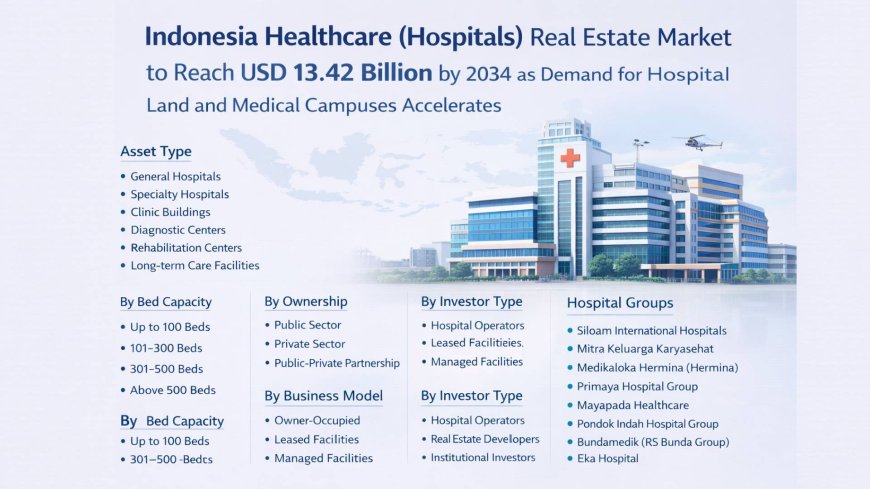
Indonesia Healthcare (Hospitals) Real Estate Market to Reach USD 13.42 Billion by 2034 as Demand for Hospital Land and Medical Campuses Accelerates
For real estate developers and healthcare investors, hospital land development is emerging as one of the most promising opportunities in Indonesia’s evolving property landscape.

Expanding Healthcare Infrastructure Driving Real Estate Development
Indonesia’s healthcare sector is entering a new phase of real estate expansion as the country works to strengthen medical infrastructure and improve healthcare accessibility. Rising patient demand, government healthcare reforms, and increasing private investment are driving the need for new hospital construction across the country. As a result, land acquisition for hospitals, medical campuses, and specialty healthcare facilities is becoming a key focus within Indonesia’s property sector.
Recent industry insights by The Report Cube – leading market research firm in UAE, show that the Indonesia Healthcare (Hospitals) Real Estate Market was valued at USD 5.6 billion in 2025 and is projected to reach USD 13.42 billion by 2034, registering a compound annual growth rate (CAGR) of 10.2% between 2026 and 2034. This strong growth reflects the rising demand for modern hospital infrastructure and strategically located plots for healthcare facility development.
For real estate developers and healthcare investors, hospital land development is emerging as one of the most promising opportunities in Indonesia’s evolving property landscape.
Population Growth Creating Long-Term Healthcare Demand
Indonesia is home to more than 280 million people, making it one of the most populous countries in the world. With continued population growth and rapid urbanization, the demand for accessible and high-quality healthcare facilities is increasing steadily.
One of the key factors influencing hospital real estate demand is the country’s limited healthcare capacity. Indonesia currently maintains approximately 1.4 hospital beds per 1,000 people, which remains significantly below the World Health Organization’s recommended ratio of 3 beds per 1,000 population. This gap highlights the need for new hospitals, expanded healthcare networks, and upgraded medical facilities across both urban and regional areas.
To address this infrastructure gap, developers and hospital operators are increasingly investing in land parcels suitable for large-scale healthcare developments. These projects often involve building new hospitals or expanding existing facilities to accommodate growing patient volumes.
Access the PDF Brochure of the Report - https://www.thereportcubes.com/request-sample/healthcare-real-estate-market-indonesia
Government Policies Supporting Healthcare Expansion
Government policies are playing an important role in encouraging healthcare infrastructure development across Indonesia. The Indonesia Health Transformation Program (2022–2027), along with its updated 2025 roadmap, focuses on strengthening hospital capacity, improving referral systems, and integrating digital healthcare technologies.
The program aims to modernize medical infrastructure nationwide by upgrading referral hospitals, expanding specialist centers, and increasing access to quality healthcare services. These initiatives are encouraging both public and private stakeholders to invest in hospital development projects.
In addition, reforms introduced under the National Health Insurance (JKN) Strengthening Policy 2025 are expanding healthcare coverage through BPJS Kesehatan. With more Indonesians gaining access to healthcare services, hospitals are seeing increased patient volumes. This shift is prompting private hospital operators to expand their networks and acquire land in areas where healthcare infrastructure is still limited.
As healthcare demand rises, property developers are collaborating with hospital groups to secure suitable land locations for new healthcare facilities.
Rising Demand for Integrated Medical Campuses
Modern hospital development is evolving beyond standalone facilities. Across Indonesia, developers are increasingly focusing on integrated medical campuses built on larger land plots. These healthcare hubs combine multiple services within a single property development.
Integrated campuses typically include:
- General hospitals
- Specialty treatment centers
- Diagnostic laboratories
- Outpatient clinics
- Rehabilitation facilities
- Healthcare retail and pharmacy outlets
This approach improves patient convenience while also creating efficient healthcare ecosystems. By offering multiple services in one location, medical campuses help hospitals optimize operational efficiency and enhance patient care.
These developments also present attractive opportunities for property developers, as healthcare facilities often maintain long-term occupancy and stable operational demand.
Changing Disease Patterns Increasing Healthcare Facility Needs
Another major factor influencing hospital real estate development is the rising prevalence of non-communicable diseases across Indonesia. Over the past decade, conditions such as cardiovascular disease, cancer, and metabolic disorders have increased significantly.
Healthcare experts estimate that these diseases have grown by nearly 25% in recent years, increasing the demand for specialized medical services. As a result, hospitals are expanding their infrastructure to accommodate advanced treatment facilities such as:
- Oncology treatment centers
- Cardiac care units
- Advanced diagnostic imaging facilities
- Robotic surgery suites
- Intensive care units
These specialized medical services require purpose-built infrastructure, which is driving demand for new hospital buildings and larger healthcare campuses.
Increasing Investor Interest in Healthcare Real Estate
Healthcare real estate is becoming an increasingly attractive asset class for investors in Indonesia. The sector offers long-term stability due to the consistent demand for healthcare services.
Institutional investors, real estate developers, and private equity groups are gradually increasing their participation in healthcare infrastructure projects. Long-term lease agreements between developers and hospital operators are also becoming more common, helping provide predictable rental income and stable property yields.
In many cases, developers use build-to-suit models, where hospital facilities are constructed according to the specific operational requirements of healthcare providers. This model allows hospital operators to expand their networks without carrying the full burden of property ownership.
As the healthcare system continues to expand, hospital real estate is expected to become one of the most resilient segments within Indonesia’s commercial property market.
Development Challenges in Hospital Real Estate
Despite its strong growth potential, hospital real estate development involves complex planning and significant capital investment. Building a mid-to-large-scale hospital typically requires investment ranging between USD 50 million and USD 150 million, depending on the size and specialization of the facility.
Construction timelines can also be lengthy, often taking 24 to 36 months from land acquisition to operational launch. Developers must comply with detailed zoning regulations, medical safety standards, and healthcare licensing procedures before construction can proceed.
Hospitals must also meet strict structural requirements to support specialized equipment, infection control systems, and emergency safety protocols. These requirements add complexity to hospital development compared to other types of commercial property.
However, developers and healthcare operators continue to pursue new projects due to the strong and sustained demand for healthcare infrastructure.
Secondary Cities Emerging as New Healthcare Hubs
While major cities such as Jakarta, Surabaya, and Bandung remain central to Indonesia’s healthcare infrastructure, significant growth opportunities are emerging in secondary cities.
Regions across Sumatra, Kalimantan, and Sulawesi are witnessing increasing healthcare demand due to economic development, industrial growth, and population migration. Many of these areas still face limited access to advanced healthcare facilities, creating opportunities for new hospital projects.
Special economic zones are also attracting healthcare investments. For instance, in 2025, Mayapada Healthcare began developing an 11-story, 250-bed international hospital in Batam, with an investment exceeding IDR 1 trillion. The project aims to strengthen Indonesia’s position in regional medical tourism while expanding high-quality healthcare infrastructure.
Such developments demonstrate how hospital land development is expanding beyond traditional urban centers.
Technology Integration Shaping Future Hospital Designs
Technology is also transforming hospital real estate planning. Modern healthcare facilities now require specialized building layouts to support advanced medical technologies.
Hospitals are increasingly investing in:
- robotic surgical systems
- AI-powered diagnostics
- digital patient record systems
- smart monitoring infrastructure
These technologies require reinforced structural designs, specialized data infrastructure, and energy-efficient systems. As a result, new hospital buildings are being designed with greater flexibility to support future medical innovations.
Green building practices are also gaining popularity within healthcare construction projects. Energy-efficient hospital buildings can reduce operating costs while supporting environmental sustainability.
Regional Market Trends Across Indonesia
Within Indonesia’s healthcare real estate market, Java currently holds the largest share, accounting for approximately 58% of the market. The island hosts many of the country’s major hospitals and healthcare networks due to its dense population and developed infrastructure.
Cities such as Jakarta, Surabaya, and Bandung remain key centers for hospital investment and development. However, as healthcare demand spreads across the country, regions such as Sumatra and Kalimantan are expected to witness increased hospital construction activity in the coming years.
Eastern regions including Papua and Maluku also present long-term potential as infrastructure investment improves healthcare access.
Outlook for Indonesia’s Healthcare Real Estate Sector
Indonesia’s healthcare system is undergoing a significant transformation, supported by expanding insurance coverage, rising healthcare awareness, and growing private investment. These factors are creating sustained demand for new hospital facilities and healthcare infrastructure across the country.
As healthcare providers expand their networks and modernize their services, the need for well-located land parcels and integrated medical campuses will continue to grow. For property developers, investors, and healthcare operators, hospital real estate development represents a strategic opportunity within Indonesia’s rapidly evolving property market.
With strong policy support, increasing patient demand, and ongoing healthcare modernization, Indonesia’s healthcare real estate sector is expected to remain one of the most dynamic segments of the property industry over the next decade.
Additional Real Estate Market Study:
US Real Estate Market Size & Analysis: Companies, Share, Growth & Value
Saudi Arabia Commercial Real Estate Market Size & Analysis: Companies, Share, Growth & Value
Thailand Luxury Residential Real Estate Market Size & Analysis: Companies, Share, Growth & Value
Switzerland Real Estate Market Size & Analysis: Companies, Share, Growth & Value
Singapore Real Estate Market Size & Analysis: Companies, Share, Growth & Value
Israel Real Estate Market Size & Analysis: Companies, Share, Growth & Value
New Zealand Real Estate Market Size & Analysis: Companies, Share, Growth & Value
China Real Estate Market Size & Analysis: Companies, Share, Growth & Value
Saudi Arabia Real Estate Market Size & Analysis: Companies, Share, Growth & Value
UAE Real Estate Market Size & Analysis: Companies, Share, Growth & Value
Canada Real Estate Market Size & Analysis: Companies, Share, Growth & Value
Australia Real Estate Market Size & Analysis: Companies, Share, Growth & Value
South Korea Real Estate Market Size & Analysis: Companies, Share, Growth & Value
Philippines Real Estate Market Size & Analysis: Companies, Share, Growth & Value
India Real Estate Market Size & Analysis: Companies, Share, Growth & Value
Nigeria Real Estate Market Size & Analysis: Companies, Share, Growth & Value
Vietnam Real Estate Market Size & Analysis: Companies, Share, Growth & Value
Egypt Real Estate Market Size & Analysis: Companies, Share, Growth & Value
Europe Real Estate Market Size & Analysis: Companies, Share, Growth & Value
Bahrain Luxury Residential Real Estate Market Size & Analysis: Companies, Share, Growth & Value
Indonesia Data Center Real Estate Valuation Market Size & Analysis: Companies, Share, Growth & Value
Kuwait Real Estate Market Size & Analysis: Companies, Share, Growth & Value
Philippines Residential Real Estate Market Size & Analysis: Companies, Share, Growth & Value
What's Your Reaction?