


























Indonesia Data Center Market: Digital Sovereignty and the Hyperscale Surge
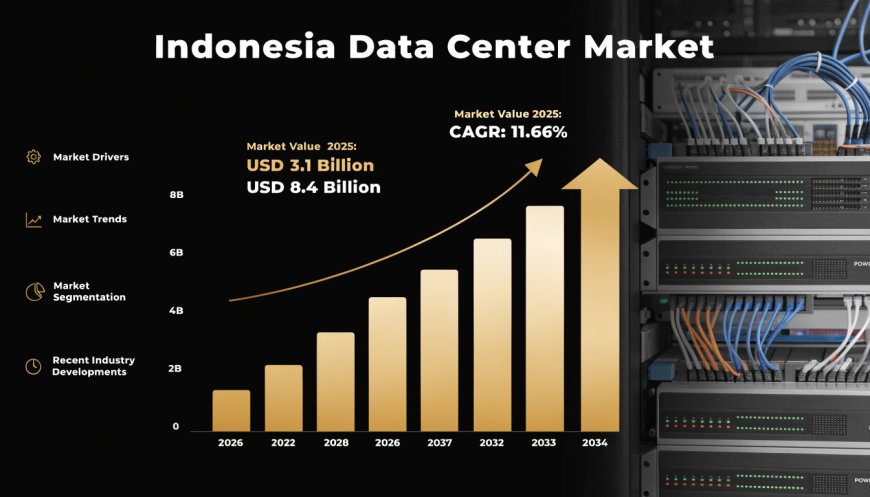
Indonesia data center market size reached USD 3.1 Billion in 2025. The market is expected to reach USD 8.4 Billion by 2034, exhibiting a growth rate (CAGR) of 11.66% during 2026-2034.
Market Overview
Indonesia is rapidly positioning itself as a dominant digital hub in Southeast Asia, driven by its massive population and the explosive growth of its digital economy. As the archipelago undergoes a structural shift toward cloud-based services and 5G connectivity, the demand for localized data storage and high-speed processing has reached an all-time high. According to the latest analysis by IMARC Group, the Indonesia Data Center Market reached a valuation of USD 3.1 Billion in 2025. Propelled by a national digital transformation mandate and increasing internet penetration, the market is projected to reach USD 8.4 Billion by 2034, expanding at a robust CAGR of 11.66% during the forecast period.
Why Invest in the Indonesia Data Center Market
Indonesia's data sovereignty law and hyperscaler entries (Google, AWS, and Microsoft have all recently announced major expansions) are creating a high-urgency window for investors and operators to buy validated market entry reports. Government Regulation No. 71 (PSTE), which mandates that public sector data and specific private financial data be stored within Indonesian borders, has effectively guaranteed a massive, permanent demand for local capacity. Investors entering the market now can capitalize on this "sovereignty-driven" growth before the primary clusters in Jakarta and West Java reach saturation, securing a strategic foothold in the largest digital market in the ASEAN region.
Core Market Drivers: The 12.56% Growth Trajectory
The expansion of Indonesia's data center ecosystem is anchored by several macroeconomic and regulatory catalysts:
-
Hyperscale Influx and Cloud Adoption: The entry of global cloud giants (CSPs) has transformed the landscape from small, enterprise-level facilities to massive hyperscale campuses. These providers are not just leasing space but are acting as anchor tenants that drive the development of high-availability, multi-megawatt sites.
-
Mandatory Data Localization: Strict regulatory frameworks regarding personal data protection (PDP) and data residency are forcing international firms operating in Indonesia to migrate their data from regional hubs like Singapore to local Indonesian facilities.
-
The E-Commerce and Fintech Explosion: Indonesia hosts some of the world's most active digital consumers. The rapid scaling of local "unicorns" in the logistics, ride-hailing, and digital banking sectors requires a high-performance backend infrastructure that only modern, high-density data centers can provide.
-
Edge Computing and 5G Rollout: As 5G networks expand across Java, Sumatra, and beyond, there is a rising need for "Edge" data centers to reduce latency for real-time applications, such as autonomous systems and high-frequency digital payments.
Strategic Market Segmentation
The Indonesian market is analyzed through several critical lenses:
-
By Type: Colocation Data Centers currently hold the largest market share, as both local and international firms prefer the cost-efficiency of leasing space over building proprietary facilities. Hyperscale facilities are the fastest-growing sub-segment.
-
By Component: IT Infrastructure (Servers, Storage, and Networking) accounts for the largest share of capital expenditure, followed by Power and Cooling systems, which are increasingly focusing on energy efficiency due to rising operational costs.
-
By End User: BFSI (Banking, Financial Services, and Insurance) and IT & Telecom are the primary consumers, followed by a rapidly growing Retail and E-commerce segment.
-
By Region: Greater Jakarta (Jabodetabek) remains the undisputed leader, accounting for over 70% of the total market capacity due to its stable power grid and proximity to the nation’s primary commercial exchanges.
➤ Request Sample Report - Access Key Market Statistics and Actionable Insights
Recent Developments & News (2025-2026)
The market has witnessed transformative developments in the last 12 months:
-
Batam-Singapore Digital Bridge: Recent developments in Batam’s special economic zones (Kabil and Nongsa Digital Park) are positioning the island as a "spillover" hub for Singapore, attracting significant investment from operators looking to bridge the two markets.
-
Renewable Energy Integration: Several new data center projects in West Java have announced partnerships with local utility providers to secure "Green Energy" certificates, aiming to attract global hyperscalers with strict carbon-neutrality mandates.
-
Subsea Cable Expansion: The landing of new high-capacity subsea cables, such as the Bifrost and Echo cable systems, has significantly increased Indonesia's international bandwidth, making it more attractive for regional data transit.
Future Outlook
Looking toward 2034, the Indonesia data center market is set to transition from a localized storage hub to a regional digital powerhouse. As the government continues to simplify licensing through "Special Economic Zones" for data centers, the focus will shift toward sustainability and PUE (Power Usage Effectiveness) optimization. For stakeholders, the combination of regulatory tailwinds and a digital-native population ensures that Indonesia will remain the most dynamic data center market in Southeast Asia for the foreseeable future.
Strategic Assessment FAQ
What is the projected size of the Indonesia Data Center Market by 2034?
The market is projected to reach approximately USD 8.4 Billion by 2034, growing from its current billion-dollar valuation.
How is the Data Sovereignty Law affecting the market?
The law mandates that certain types of data must be stored locally, which has triggered a massive migration of data from overseas servers to Indonesian soil, driving an urgent need for new facility construction.
Which region in Indonesia is best for investment?
While Jakarta is the current hub, Batam and West Java are emerging as high-growth alternatives due to their proximity to subsea cables and available land for hyperscale expansion.
Note: If you require specific details, data, or insights that are not currently included in the scope of this report, we are happy to accommodate your request. As part of our customization service, we will gather and provide the additional information you need, tailored to your specific requirements. Please let us know your exact needs, and we will ensure the report is updated accordingly to meet your expectations.
➤ Request Customization - Align the Report Insights with Your Strategic Goals
Strategic Insight & Verdict
Strategic Insight & Verdict Having analyzed hyperscale investments and digital economy expansion, we observe Indonesia’s data center market transitioning toward high-density, energy-efficient, and strategically interconnected infrastructure. Operators investing in renewable energy sourcing, advanced cooling technologies, and robust interconnection ecosystems will gain competitive advantage. We at IMARC Group anticipate accelerated growth driven by data localization mandates, cloud adoption, and increasing demand from enterprises and digital platforms.
— Pragati Bharadwaj, Digital Market Research Strategist at IMARC Group https://www.linkedin.com/in/pragati-bharadwaj/
Verified Data Source : IMARC Group
About Us
IMARC Group is a leading market research company offering strategic insights and data-driven solutions across industries. The firm specializes in market forecasting, competitive analysis, and industry intelligence to support informed business decisions.
Contact Details
IMARC Group
134 N 4th St, Brooklyn, NY 11249, USA
Email: sales@imarcgroup.com
Tel No: (D) +91 120 433 0800
United States: +1-201-971-6302
What's Your Reaction?