
































India Fintech Market Research Growth Analysis 2026-2034: Forecast Growth with 16.70% CAGR
The India fintech market valued at USD 142.5 Billion in 2025, is projected to reach USD 642.9 Billion by 2034, growing at a CAGR of 16.70% from 2026-2034.

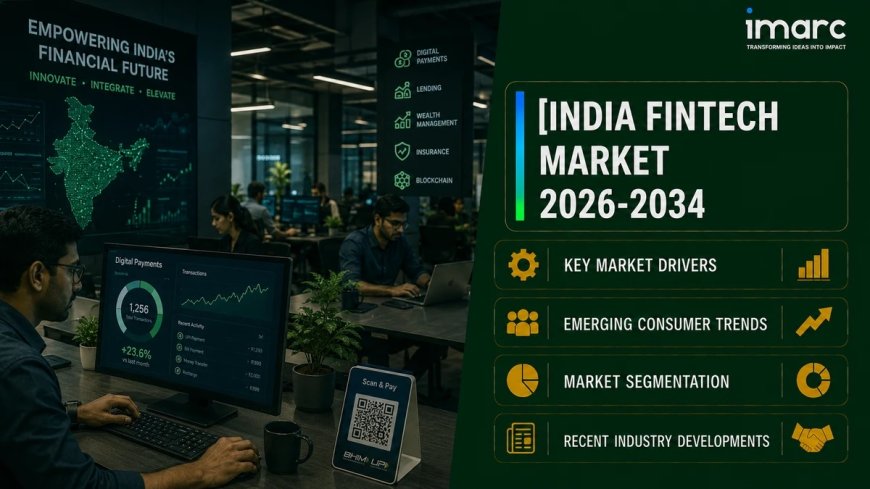
According to IMARC Group's report titled "India Fintech Market Size, Share, Trends and Forecast by Deployment Mode, Technology, Application, End User, and Region, 2026-2034", The report offers a comprehensive analysis of the industry, including market share, trends, forecast, growth and regional insights.
The India fintech market valued at USD 142.5 Billion in 2025, is projected to reach USD 642.9 Billion by 2034, growing at a CAGR of 16.70% from 2026-2034.
- Payment Integration Premium: Allocating deployment capital into transaction networks taps into the dominant payment and fund transfer application segment, which commands a decisive 46.5% market share.
- Enterprise Infrastructure Capture: Partnering with established banking institutions unlocks the largest single end-user cluster, which controls a 41.8% volume share as traditional entities aggressively digitize core infrastructure.
- Geographical Expansion Arbitrage: Expanding commercial deployment footprints into West and Central India targets the country's primary regional fintech hub, which anchors a leading 34.6% market share.
The Strategic Market Challenge: Navigating the Fintech Market in India A critical operational challenge confronting enterprise leaders within the technology and media sector is managing accelerating regulatory compliance overhead while maintaining processing agility. Because the domestic financial ecosystem undergoes frequent policy adjustments regarding digital lending, data localization, and partner-bank verification protocols, operators face substantial friction in maintaining frictionless customer onboarding. This shifting regulatory structure strains engineering resources and directly increases corporate compliance outlays, penalizing capital allocators who fail to embed highly adaptable regulatory architecture into their primary software layers.
➤ Access Key Market Statistics and Actionable Insights - Request Sample Report
India's Strategic Vision for the Fintech Market:
-
Macro-Financial Inclusivity Targets: The central government is systematically driving financial formalization through the Digital India framework, aiming to bring 100% of unbanked small businesses and rural households into the structured banking fold.
-
Open Banking Proliferation Blueprint: Institutional roadmaps focus on expanding API-driven open banking infrastructure, actively mandating secure, real-time data exchange via the nationwide Account Aggregator framework to dismantle institutional data monopolies.
-
Sovereign Retail Payment Dominance: Public policy targets the cross-border expansion and technical optimization of the Unified Payments Interface (UPI) to establish it as a primary global framework for real-time retail settlements.
Why Invest in the India Fintech Market: Key Growth Drivers & ROI
-
Digital Public Infrastructure Support: Massive state-backed investments in the "India Stack"—composed of Aadhaar identity verification, UPI rails, and digital lockers—provide corporate operators with pre-built verification and payment architectures, lowering user acquisition costs by over 80%.
-
Evolving Mass Consumption Trends: Rapid smartphone penetration combined with affordable data access has moved transaction preferences toward digital channels, with UPI processing over 185.8 billion transactions in FY2025 alone and accounting for 83.4% of total digital retail payments.
-
Advanced Architecture Upgrades: The enterprise integration of cloud-based deployment models, which command a 64.7% market share, combined with real-time AI fraud-telemetry systems, minimizes operational risk while yielding excellent gross margins.
India Fintech Market Trends & Future Outlook:
-
Predictable Value Compounding: The domestic market value is structurally positioned to expand at a steady compound annual growth rate (CAGR) of 16.70% between 2026 and 2034, ensuring long-term volume stability for capital allocations.
-
Dominance of API-Driven Technology: Application Programming Interfaces (APIs) represent the leading technology vector, capturing a 27.9% market share in 2025 as embedded finance transforms non-financial digital platforms.
-
Transition to Biometric Authentication: Digital payment systems are rapidly evolving beyond static PIN architectures, standardizing fingerprint and facial recognition technologies to secure high-frequency merchant transactions.
-
Deep Tier-2 and Tier-3 Penetration: Market growth is rapidly shifting from saturated metropolitan zones toward semi-urban regions, turning small merchant acquisition into the primary growth frontier for consumer applications.
-
Expansion of Alternative Credit Models: Proprietary machine learning algorithms are increasingly displacing legacy credit-bureau scoring, enabling cash-flow-based underwriting for cash-starved micro-enterprises.
Regulatory Landscape & Policy Catalysts in India
-
Reserve Bank of India (RBI) Digital Lending Guidelines: According to the Reserve Bank of India, strict regulatory guardrails mandate that all loan servicing, disbursements, and repayments occur directly between regulated banking entities and borrower accounts, neutralizing unauthorized third-party pools.
-
Pradhan Mantri Jan Dhan Yojana (PMJDY): According to the Ministry of Finance, this flagship financial inclusion program has institutionalized millions of low-income bank accounts, forming the baseline transactional layer for downstream digital financial products.
-
Zero MDR Policies for Small Merchants: According to the Ministry of Finance, the strategic mandate eliminating Merchant Discount Rates (MDR) on UPI transactions ensures that micro-merchants receive digital capital without extra charges, driving corporate B2B retail distribution.
-
RBI Regulatory Sandbox Frameworks: According to the Reserve Bank of India, live testing cohorts provide fintech developers with structured exemptions to safely trial innovative cross-border payments and mitigation models under controlled supervision.
➤ Explore the Exact Chapters and Data Scope - Get Full Brochure
By the IMARC Group, the Top Competitive Landscape & their Positioning:
- PhonePe (Walmart Inc.)
- Google Pay (Alphabet Inc.)
- Paytm (One97 Communications Ltd.)
- Razorpay
India Fintech Market Segmentation:
The market report offers a comprehensive analysis of the segments, highlighting those with the largest India fintech market share. It includes forecasts for the period 2026-2034 and historical data from 2020-2025 for the following segments.
Deployment Mode Insights
- Cloud-Based (64.7% market share in 2025)
- On Premises
Technology Insights
- Application Programming Interface (27.9% majority share in 2025)
- Artificial Intelligence
- Blockchain
- Robotic Process Automation
- Data Analytics
- Others
Application Insights
- Payment and Fund Transfer (46.5% share in 2025)
- Loans
- Insurance and Personal Finance
- Wealth Management
- Others
End User Insights
- Banking (41.8% market share in 2025)
- Insurance
- Securities
- Others
Regional Insights
- West and Central India (34.6% market share in 2025)
- North India
- South India
- East India
Note: If you need specific information that is not currently within the scope of the report, we can provide it to you as a part of the customization.
➤ Shape the Data to Answer Your Specific Questions - Request Customization
Frequently Asked Questions (FAQs)
Q1: What is the current value and projected growth of the India Fintech Market?
According to IMARC Group, the India fintech market was valued at USD 142.5 Billion in 2025 and is projected to reach USD 642.9 Billion by 2034, exhibiting a CAGR of 16.70% during the 2026–2034 forecast period.
Q2: Which deployment mode commands the highest market share?
The cloud-based deployment model holds the primary market share at 64.7% in 2025, driven by the operational necessity for fintech platforms to leverage auto-scaling, reduce server downtime, and host agile API connections.
Q3: How is the integration of APIs shaping the domestic technology layer?
Application Programming Interfaces (APIs) represent the leading technology segment with a 27.9% market share, acting as the primary digital conduit that enables independent fintech systems to link seamlessly with legacy commercial bank ledgers.
Q4: What specific application sector drives absolute transaction velocity?
The payment and fund transfer vertical commands the leading application share at 46.5%, anchored heavily by the mass institutionalization of UPI and real-time electronic ledger settlements across both retail and corporate business networks.
Q5: What represents the largest growth segment for alternative capital providers?
Digital lending tech is currently the highest-margin investment segment, targeting the significant USD 300 Billion credit gap present within the underbanked MSME sector through the deployment of short-term supply chain financing.
Strategic Insight & Verdict:
India’s financial technology environment is executing a clear migration from a payment facilitation utility to a heavily formalized credit, wealth, and embedded banking infrastructure. Analyzing this maturation across the technological matrix, we at IMARC Group have observed that long-term asset growth relies strictly on optimizing API-driven co-lending platforms and establishing deep regulatory compliance. For global investors and corporate strategists, the optimal path requires immediate capital allocation toward data-compliant micro-lending and B2B enterprise software platforms to lock in premium margins within this expanding USD 642.9 Billion market.
Verified Data Source: India Fintech Market Report by IMARC Group
Written by: Gourav (Digital Market Research Strategist @ IMARC Group)
View my full professional profile and connect with me at [https://www.linkedin.com/in/gourav-shah-005425345] for exclusive market research insights and B2B growth strategies.
What's Your Reaction?