




























Australia Wood Plastic Composites Market Projected to Reach USD 273.7 Million by 2034
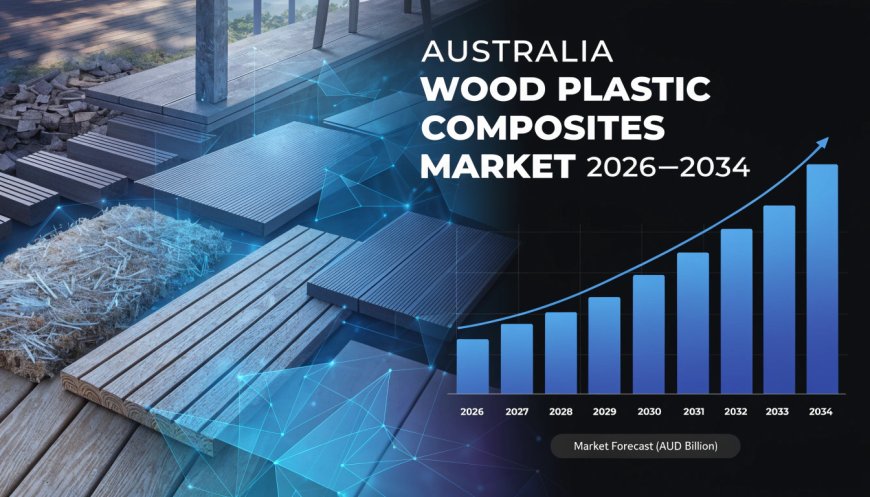
Australia wood plastic composites market size reached USD 132.8 Million in 2025 and is projected to reach USD 273.7 Million by 2034, growing at a CAGR of 8.37% during 2026-2034.

Market Overview
The Australia wood plastic composites market size reached USD 132.8 Million in 2025 and is projected to reach USD 273.7 Million by 2034, growing at a CAGR of 8.37% during 2026-2034. The market is gaining extraordinary momentum on the back of growing demand for sustainable building materials and the rising focus on eco-friendly construction practices, as builders and consumers increasingly seek durable, low-maintenance, and environmentally responsible alternatives to traditional timber and plastic products across residential, commercial, and infrastructure development projects.
Government policies and programs, including the Green Star rating system and state-specific requirements encouraging green materials in building and infrastructure projects, have augmented the drive for WPC implementation. The National Plastics Plan includes legislative pressure to decrease the use of virgin plastic and boost recycled content, while the Recycling Modernization Fund supports schemes to create infrastructure for plastic remanufacturing. WPCs provide superior fire-resistance compared to untreated timber, an essential benefit in high-risk bushfire areas throughout states such as Victoria, New South Wales, and Western Australia. With building codes becoming more stringent in bushfire-prone zones and Australia's fast urban growth creating demand for modular construction techniques, the Australia wood plastic composites market is positioned for sustainable, innovation-driven expansion over the forecast horizon.
How AI is Reshaping the Future of the Australia Wood Plastic Composites Market
Artificial intelligence is rapidly reshaping how Australian WPC manufacturers optimize material formulations, predict product performance, and streamline production processes for building and construction applications. Key applications include:
- AI-powered material formulation platforms analyzing polymer-wood fiber ratios and additive combinations, accelerating development of fire-resistant WPC grades for bushfire-prone regions.
- Machine learning algorithms optimizing extrusion parameters and cooling profiles, reducing material waste and improving dimensional consistency for decking and cladding profiles.
- AI-driven quality control systems using computer vision to detect surface defects and color inconsistencies, ensuring aesthetic quality for residential renovation and remodeling applications.
- Intelligent predictive maintenance models monitoring extrusion line equipment performance, reducing unplanned downtime for WPC manufacturing facilities.
- Natural language processing tools analyzing building code updates and fire safety standards, guiding product development for compliance with Australian Standards AS 1530 series.
Australia Wood Plastic Composites Market Trends
Growing Focus on Sustainable and Eco-Friendly Construction Practices
Among the foremost drivers for the Australia wood plastic composites industry is the country's rising attention to green and environmentally friendly building. As climate change commitments come under increased scrutiny and the environmental impact of building activities becomes higher on Australia's agenda, pressure mounts on reducing the building sector's ecological footprints. Australia's growing desire for green construction materials has intensified, driven heavily by wood plastic composites since they fit this sustainability picture absolutely. They provide a long-lasting alternative to conventional wood without adding to deforestation or excessive plastic build-up. Government policies and programs, including the Green Star rating system and state-specific requirements encouraging green materials in building and infrastructure projects, have also augmented the drive for WPC implementation. Developers, builders, and even residential homeowners are now extensively focusing on materials offering extended service life, lower maintenance expenses, and smaller carbon footprint, all of which WPCs naturally offer. The federal government's National Plastics Plan and Recycling Modernization Fund promote supply chains that can feed recycled polyethylene, polypropylene, or other polymers into products with recycled wood fibers.
Rising Demand from the Residential Renovation and Remodeling Sector
Another driver of the Australia wood plastic composites market share is the expanding residential renovation and remodeling market. Over the past few years, stimulated by trends including shifting lifestyle patterns, higher disposable incomes, and government promotions for home upgrades, Australians have been pouring money into refurbishing their homes. WPCs are increasingly popular with homeowners seeking to add decks, patios, fencing, and outdoor furniture with materials that are both beautiful and extremely durable. Compared to traditional wood, WPC products provide increased resistance to moisture, rot, termites, and UV degradation, which are concerns that are especially pertinent in Australia's harsh and unpredictable climate. Moreover, the low-maintenance aspect of WPCs, which needs no periodic painting, sealing, or staining, makes them highly desirable for homeowners who want beauty without the cost of extensive maintenance. The wide range of textures, colors, and finishes available has also rendered WPCs highly sought after by architects and designers who want to achieve current design trends. In December 2024, European construction group STRABAG expanded into Australia by acquiring Georgiou Group, aiming to deliver large-scale infrastructure projects with potential opportunities to integrate WPCs.
Request a Business Sample Report for Procurement & Investment Evaluation:
https://www.imarcgroup.com/australia-wood-plastic-composites-market/requestsample
Australia Wood Plastic Composites Market Summary
- Market Size in 2025: USD 132.8 Million, supported by growing demand for sustainable building materials and eco-friendly construction practices.
- Forecast Value by 2034: USD 273.7 Million, driven by rising focus on circular economy initiatives and fire-resistant building products.
- CAGR (2026-2034): 8.37%, reflecting strong demand from residential renovation sector and modular construction techniques.
- Leading Type: Polyethylene-based WPC, dominating due to widespread availability of recycled polyethylene feedstock and excellent moisture resistance.
- Leading Application: Building and Construction, representing the largest segment for decking, cladding, fencing, and facade panels.
Australia Wood Plastic Composites Market Growth Drivers
Transition to Fire-Resistant and Resilient Building Products
Australia's heightened susceptibility to catastrophic weather events, specifically bushfires, has made a notable impact on the uptake of fire-resistant building materials and further intensified the Australia wood plastic composites market demand. Timber has been the traditional product of choice for Australian building for some time now, yet with the ever-expanding threat of fire-related damage, most acutely in bushland-fringing suburbs, residents and builders alike have begun to question safer options. WPCs provide superior fire-resistance compared to untreated timber, and this is an essential benefit in high-risk areas throughout states such as Victoria, New South Wales, and Western Australia. Besides fire resistance, WPCs also stand up to warping and degradation through changes in weather patterns, which makes them conducive to Australia's varied climate zones. This trend in material choice is consistent with government guidelines and insurance inducements promoting fire-safe construction. The National Construction Code contains requirements for fire-resisting construction, and Australian Standards AS 1530 series assess combustibility, smoke emission, and spread of flame that apply to composite products used in decking, cladding, or facades. With more areas being declared bushfire-prone and building codes becoming stringent, WPCs are increasingly a popular choice in residential as well as commercial construction for compliance and security.
Urban Development and Modular Construction
Australia's fast urban growth and desire for modular, prefabricated building techniques are generating fresh demand for lightweight yet flexible materials such as wood plastic composites. As population increases in urban cities like Sydney, Melbourne, and Brisbane, developers are looking for space-saving and time-reducing construction alternatives. WPCs best fit the bill here because they can be easily handled, require minimal maintenance, and can be molded around modular designs. Their consistency and suitability with CNC as well as automated production techniques render them a choice for applications in factory-made wall panels, decking modules, and facade systems. Moreover, the increasing prevalence of vertical dwelling and outdoor areas on rooftops in urban skyscrapers has generated new applications for WPC decking and railing systems. In September 2024, Sumitomo Forestry acquired a 51% stake in homebuilder Metricon, positioning Sumitomo as the leading builder group in Australia with over 7,000 annual housing starts, presenting potential opportunities for integrating sustainable materials like WPCs into construction projects. With Australia further investing in sustainable urban development and high-density housing, WPCs present a balance of performance, aesthetics, and eco-value.
Market Segments
By Type:
- Polyethylene
- Polyvinylchloride
- Polypropylene
- Others
By Application:
- Building and Construction
- Automotive
- Industrial and Consumer Goods
- Others
By Region:
- Australia Capital Territory & New South Wales
- Victoria & Tasmania
- Queensland
- Northern Territory & Southern Australia
- Western Australia
Competitive Landscape
The Australia wood plastic composites market features participation from global construction groups, domestic WPC manufacturers, and building material suppliers competing across types (polyethylene, polyvinylchloride, polypropylene) and applications (building and construction, automotive, industrial and consumer goods). Key players include STRABAG (acquired Georgiou Group in December 2024), Sumitomo Forestry (acquired 51% stake in Metricon in September 2024), and various local WPC producers serving residential renovation and infrastructure development sectors. Market participants are pursuing strategic acquisitions and partnerships to expand market reach and integrate sustainable materials into large-scale projects. In December 2024, European construction group STRABAG expanded into Australia by acquiring Georgiou Group, aiming to deliver large-scale infrastructure projects with potential opportunities to integrate WPCs into future projects, aligning with STRABAG's commitment to innovative, resource-efficient construction solutions. In September 2024, Sumitomo Forestry acquired a 51% stake in homebuilder Metricon, positioning Sumitomo as the leading builder group in Australia with over 7,000 annual housing starts, presenting potential opportunities for integrating sustainable materials like WPCs into construction projects, aligning with Sumitomo Forestry's commitment to eco-friendly building practices. The competitive landscape is also supported by government research grants and innovation funding through programs such as the Cooperative Research Centres Projects (CRC-P), which have funded projects to create lightweight prefabricated building elements from recycled plastics.
Latest News & Developments
- December 2024: European construction group STRABAG expanded into Australia by acquiring Georgiou Group, aiming to deliver large-scale infrastructure projects, with Australia's growing adoption of WPCs in construction presenting potential opportunities for STRABAG to integrate these materials into future projects.
- September 2024: Sumitomo Forestry acquired a 51% stake in homebuilder Metricon, positioning Sumitomo as the leading builder group in Australia with over 7,000 annual housing starts, presenting potential opportunities for integrating sustainable materials like WPCs into construction projects.
Note: If you require any specific information not currently covered within the scope of the report, IMARC Group will provide it as part of customization.
Speak to an analyst:
https://www.imarcgroup.com/request?type=report&id=36012&flag=E
About Us
IMARC Group is a global management consulting firm that helps the world's most ambitious changemakers to create a lasting impact. The company provides a comprehensive suite of market entry and expansion services. IMARC offerings include thorough market assessment, feasibility studies, company incorporation assistance, factory setup support, regulatory approvals and licensing navigation, branding, marketing and sales strategies, competitive landscape and benchmarking analyses, pricing and cost research, and procurement research.
Contact Us
IMARC Group
134 N 4th St., Brooklyn, NY 11249, USA
Email: sales@imarcgroup.com
Tel. No.: (D) +91 120 433 0800
United States: +1-201-971-6302
What's Your Reaction?