





























Australia Paper Cups and Paper Plates Market Size, Share, Report 2026-2034
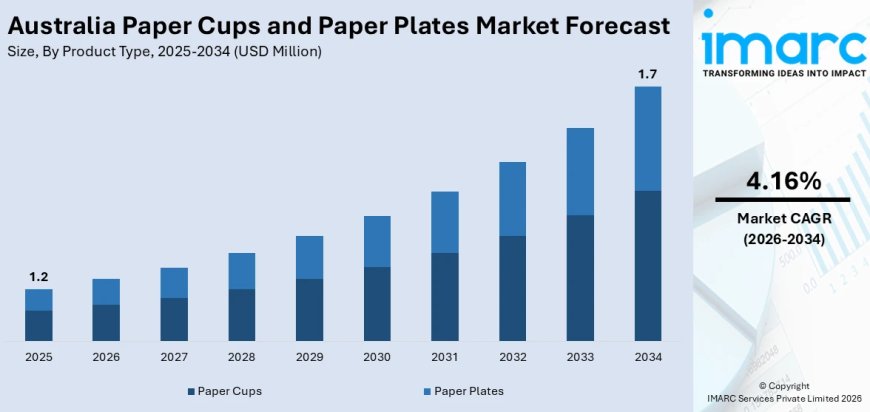
Australia paper cups and paper plates market size was valued at USD 1.2 Million in 2025. Looking forward, IMARC Group estimates the market to reach USD 1.7 Million by 2034, exhibiting a CAGR of 4.16% from 2026-2034.

Australia Paper Cups and Paper Plates Market Overview
The Australia paper cups and paper plates market encompasses a growing range of disposable and sustainable paper-based tableware products including hot and cold beverage cups, heavy-duty and medium-duty plates, and complementary food packaging solutions manufactured from responsibly sourced paper pulp, sugarcane bagasse, bamboo fiber, and other renewable materials. The market serves a diverse customer base spanning household consumers, quick-service restaurants, cafes, catering companies, event organizers, and institutional foodservice providers. As Australia intensifies its commitment to eliminating single-use plastics and transitioning toward a circular economy, paper-based cups and plates have emerged as the primary sustainable alternative, combining functional convenience with environmental responsibility.
The Australia paper cups and paper plates market size was valued at USD 1.2 Million in 2025. Looking forward, IMARC Group estimates the market to reach USD 1.7 Million by 2034, exhibiting a CAGR of 4.16% from 2026-2034. The market is being driven by rising consumer demand for sustainable, biodegradable alternatives due to environmental concerns and government regulations restricting plastic use, the expanding foodservice and takeaway industry fueled by on-the-go consumption trends and online food delivery, corporate sustainability initiatives promoting eco-friendly dining solutions, and continuous innovations in biodegradable coatings and material technologies that enhance product performance.
Australia's regulatory landscape has become a powerful catalyst for market growth, with national and state-level bans on single-use plastic cutlery and tableware compelling foodservice operators and retail businesses to transition toward paper-based alternatives. The National Packaging Targets, which aim for all packaging to be reusable, recyclable, or compostable by 2026, are creating a structured regulatory framework that incentivizes investment in sustainable paper cup and plate solutions. Simultaneously, the country's vibrant cafe culture, thriving quick-service restaurant sector valued at approximately AUD 25.3 billion, and rapidly expanding food delivery ecosystem are generating sustained demand for convenient, high-performance disposable tableware that aligns with both consumer convenience expectations and environmental sustainability mandates.
Read More About Australia Paper Cups and Paper Plates Market
How AI is Reshaping the Future of the Australia Paper Cups and Paper Plates Market
Artificial intelligence is introducing transformative capabilities across the paper cups and plates value chain, from sustainable material innovation and manufacturing optimization to intelligent recycling systems and consumer engagement platforms that are accelerating the industry's transition toward a fully circular economy:
- AI-Powered Sustainable Material Discovery and Coating Innovation: Machine learning platforms are accelerating the discovery and optimization of biodegradable coatings and barrier materials that replace conventional polyethylene linings in paper cups and plates. AI algorithms simulate molecular interactions, predict biodegradation timelines, and optimize formulations of plant-based coatings such as polylactic acid (PLA) and polybutylene succinate (PBS), enabling manufacturers to develop products that maintain leak-proof performance while achieving full compostability under Australian standards. Nestlé and IBM's generative AI tool, launched in 2025, exemplifies this trend by suggesting novel sustainable materials that improve packaging performance and food safety.
- Intelligent Manufacturing and Quality Control Systems: AI-driven computer vision and sensor systems are revolutionizing paper cup and plate manufacturing by detecting defects in real time, monitoring coating uniformity, and ensuring dimensional consistency at production speeds that far exceed human inspection capabilities. These intelligent quality control platforms reduce waste rates, minimize production errors, and ensure that every product meets the stringent performance and compostability standards required by Australian regulations, delivering significant cost savings while maintaining premium product quality across high-volume production runs.
- AI-Enhanced Recycling and Circular Economy Optimization: Artificial intelligence is transforming paper cup and plate recycling through advanced sorting systems that use computer vision and machine learning to identify, separate, and process paper-based packaging materials with up to 60% greater efficiency than conventional recycling methods. These AI-enabled recycling platforms can distinguish between different coating types, contamination levels, and material compositions, enabling more effective recovery of paper fibers and supporting Australia's ambitious National Packaging Targets for circular economy transition.
- Predictive Demand Forecasting and Supply Chain Intelligence: AI forecasting models are enabling paper cup and plate manufacturers and distributors to predict demand fluctuations driven by seasonal events, festival calendars, weather patterns, and foodservice industry trends with unprecedented accuracy. These systems optimize production scheduling, raw material procurement, and inventory allocation across distribution networks, reducing overproduction waste and ensuring product availability during peak demand periods such as summer outdoor events, holiday seasons, and major sporting occasions.
- AI-Optimized Packaging Design and Material Efficiency: Generative AI design platforms are enabling manufacturers to optimize paper cup and plate structures by analyzing data on material stress, thermal insulation requirements, and structural integrity to minimize material usage while maintaining product performance. These computational design tools can reduce paper and coating material consumption by up to 15% per unit without compromising functionality, delivering both cost savings and environmental benefits by reducing the raw material footprint of every cup and plate produced.
Request a Business Sample Report for Procurement & Investment Evaluation:
https://www.imarcgroup.com/australia-paper-cups-paper-plates-market/requestsample
Australia Paper Cups and Paper Plates Market Trends
Compostable and Home-Compostable Product Innovation
The shift toward compostable and biodegradable paper cups and plates represents the dominant trend in Australia's market, driven by growing consumer environmental consciousness, corporate sustainability commitments, and strengthening regulatory frameworks. Manufacturers are investing heavily in plant-based coating technologies, with polylactic acid (PLA), polybutylene succinate (PBS), and polyhydroxyalkanoate (PHA) emerging as leading alternatives to conventional polyethylene linings. BioPak's FSC-certified home compostable PHA cups, featuring leak-proof linings made through fermentation using renewable resources and certified to Australian standards AS5810 for backyard composting, exemplify the industry's push toward products that decompose in household compost environments rather than requiring industrial composting facilities. This innovation trajectory is supported by Detpak's introduction of over 20 commercially compostable and recyclable PBS-lined cartons, trays, and lunchboxes, reflecting the broader industry commitment to sustainable materials.
On-the-Go Consumption Culture and Foodservice Expansion
Australia's deeply embedded cafe culture, expanding quick-service restaurant sector, and rapidly growing food delivery ecosystem are generating sustained demand for high-performance paper cups and plates that combine convenience with sustainability. The fast-paced urban lifestyles of Australian consumers, particularly in metropolitan centers like Sydney, Melbourne, and Brisbane, have intensified reliance on takeaway meals and portable beverages, necessitating disposable packaging that delivers spill-proof performance, effective thermal insulation, and grease resistance. Online food delivery platforms have amplified this demand by requiring sturdy, eco-friendly packaging solutions that maintain food quality during transit while meeting the sustainability expectations of environmentally conscious consumers. The growing outdoor dining and festival scene, combined with post-pandemic recovery in tourism and hospitality, is further expanding the addressable market for disposable paper tableware across catering, events, and large-scale gathering applications.
Australia Paper Cups and Paper Plates Market Summary
- Market Size (2025): USD 1.2 Million
- Market Forecast (2034): USD 1.7 Million
- Market Growth Rate (CAGR 2026-2034): 4.16%
- Base Year: 2025
- Forecast Period: 2026-2034
Australia Paper Cups and Paper Plates Market Growth Drivers
Regulatory Push Against Single-Use Plastics and Circular Economy Mandates
Australia's comprehensive regulatory framework targeting single-use plastics is serving as the primary structural growth driver for the paper cups and plates market. Progressive state-level bans on plastic tableware, combined with the National Packaging Targets mandating that all packaging be reusable, recyclable, or compostable by 2026, are creating a compulsory transition pathway from plastic disposables to paper-based alternatives. National Packaging Regulations expected in 2026 will make compliance mandatory for businesses, further accelerating adoption across foodservice, retail, and institutional channels. These regulatory developments are complemented by deposit return systems launched in Victoria in 2023 and Tasmania in 2025, reflecting Australia's deepening commitment to circular economy principles that support the long-term growth of sustainable paper packaging solutions.
Corporate Sustainability Initiatives and Eco-Conscious Consumer Preferences
Corporate sustainability programs and evolving consumer preferences for environmentally responsible products are generating powerful demand-side drivers for paper cups and plates across Australia. Major foodservice chains, cafe operators, and catering companies are proactively transitioning to paper-based tableware as part of their environmental, social, and governance commitments, using eco-friendly packaging as a brand differentiator that resonates with sustainability-conscious consumers. Consumer surveys consistently indicate growing willingness to pay premiums for biodegradable and compostable packaging options, creating a favorable pricing environment for paper-based products. The influence of social media in amplifying environmental awareness and the increasing visibility of plastic pollution impacts are further strengthening consumer demand for paper alternatives, encouraging businesses across hospitality, retail, and institutional foodservice to accelerate their sustainable packaging transitions.
Australia Paper Cups and Paper Plates Market Segments
The market has been comprehensively segmented by IMARC Group across multiple dimensions to provide granular insights into growth opportunities and competitive dynamics:
Breakup by Product Type:
- Paper Cups (Hot Paper Cups, Cold Paper Cups)
- Paper Plates (Heavy-Duty Paper Plates, Medium-Duty Paper Plates)
Breakup by Wall Type:
- Single Wall
- Double Wall
Breakup by Region:
- Australian Capital Territory & New South Wales
- Victoria & Tasmania
- Queensland
- Northern Territory & Southern Australia
- Western Australia
Australia Paper Cups and Paper Plates Market Competitive Landscape
The competitive landscape of the Australia paper cups and paper plates market is characterized by a mix of established domestic manufacturers, international sustainable packaging specialists, and innovative newcomers competing across material innovation, compostability certification, pricing competitiveness, and distribution breadth. Key industry participants including BioPak, Detpak (a division of Detmold Group), Pact Group, Huhtamaki, and Dart Container maintain strong market positions through comprehensive product portfolios, advanced coating technologies, and established relationships with major foodservice chains and retail distributors. These leading companies are investing heavily in plant-based coating innovations, home compostability certifications, and sustainable raw material sourcing to differentiate their offerings in an increasingly environmentally conscious market. The competitive landscape has been further enriched by strategic acquisitions such as Sweden's Duni Group's purchase of Australian reusable coffee cup company Huskee, signaling growing international interest in Australia's sustainable packaging market and driving innovation through cross-pollination of global best practices.
Australia Paper Cups and Paper Plates Market Latest News & Development
Recent developments in the Australia paper cups and paper plates market reflect the industry's accelerating commitment to sustainability, material innovation, and circular economy infrastructure:
- October 2024: SPC Global, The Original Juice Company, and Nature One Dairy merged to create a leading Australian food and beverage company under former Asahi Beverages CEO Robert Iervasi, consolidating operations across fruit, juice, and dairy divisions and strengthening sustainable packaging demand across the combined entity's product portfolio.
- September 2024: Detpak introduced Australia's largest range of over 20 commercially compostable and recyclable PBS-lined cartons, trays, and lunchboxes, supporting new legislation aimed at reducing single-use plastics. The PBS (Polybutylene Succinate) material, derived from renewable plant sources, provides a sustainable alternative to traditional packaging coatings.
- April 2024: Sweden's Duni Group acquired Australian reusable coffee cup company Huskee, marking its third acquisition in 2024. Founded in 2017, Huskee produces reusable cups from coffee husk waste and operates recycling initiatives, with the acquisition strengthening Duni Group's BioPak segment and expanding its Asia-Pacific market presence.
- February 2024: APCO's Australasian Recycling Label (ARL) program partnered with Simply Cups to introduce a 'Drop Off Only' logo for paper cup recycling, guiding Australian consumers to over 1,500 collection points nationwide and enhancing paper cup recycling accessibility beyond traditional kerbside collection systems.
- 2024: BioPak launched its FSC-certified home compostable PHA cups in the Australian market, featuring leak-proof linings made through fermentation using renewable resources and certified to Australian standards AS5810 for backyard composting, setting a new benchmark for sustainable disposable cup innovation.
Note: If you require any specific information not currently covered within the scope of the report, IMARC Group will provide it as part of customization.
Speak to an analyst:
https://www.imarcgroup.com/request?type=report&id=21984&flag=E
What's Your Reaction?