




























Australia Hospitality Market Analysis, Top Companies Size, Share, Growth to 2026-34
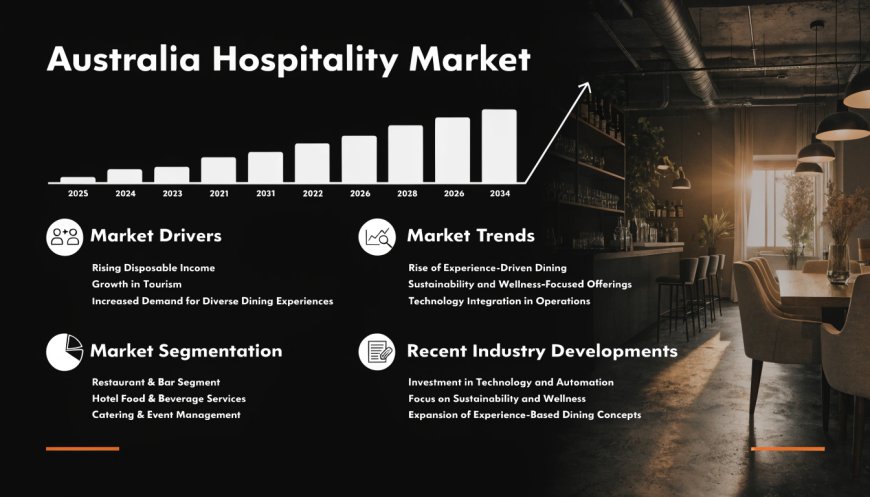
The Australia hospitality market size was valued at USD 37454.48 Million in 2025 and is projected to reach USD 70933.81 Million by 2034, growing at a compound annual growth rate of 7.35% from 2026-2034.

Market Overview
The Australia hospitality market is expanding steadily, supported by rising domestic and international tourism, increasing demand for premium accommodation and dining experiences, growth of event and leisure activities, and continued investment in service modernization. According to IMARC Group, the market size was valued at USD 37,454.48 Million in 2025 and is projected to reach USD 70,933.81 Million by 2034, exhibiting a compound annual growth rate (CAGR) of 7.35% during 2026‑2034.
The industry is receiving additional support through increasing hotel occupancy rates in urban areas, the development of new coastal resort projects, and the rising need for convention centers and event spaces. Hospitality operators now use technological solutions which include contactless systems, intelligent room control, and data‑based guest interaction systems to achieve better operational performance. The Australian Bureau of Statistics reported that November 2025 experienced 831,170 short-term visitor arrivals, a 19.5% increase, and 937,320 short-term resident returns, resulting in 1,849,990 total arrivals that marked an 8.4% rise compared to the previous year's corresponding period.
The Australia hospitality market is poised for sustained expansion, driven by record tourism arrivals, rising demand for premium and eco‑friendly accommodations, and the integration of smart hospitality technologies. With chain hotels dominating the market and mid‑scale hotels balancing affordability with quality, the industry presents significant opportunities for operators focused on service innovation, sustainability, and regional tourism development.
Australia Hospitality Market Summary
The Australia hospitality market encompasses a wide range of accommodation and service offerings, including chain hotels, independent hotels, service apartments, budget and economy hotels, mid‑scale and upper mid‑scale hotels, and luxury hotels. The ecosystem includes international hotel chains, well‑established domestic operators, boutique and independent hotels, and hospitality service providers catering to both business and leisure travelers across urban centers and leisure destinations.
-
By Type: Chain hotels dominate the market with a share of 58.4% in 2025, supported by strong brand presence, standardized services, and wide customer trust nationwide.
-
By Segment: Mid‑scale and upper mid‑scale hotels held the largest market share with 42.7% in 2025, fueled by their balance of affordability, comfort, and increasing demand from both business and leisure travelers.
-
By Region: Australia Capital Territory and New South Wales held the biggest segment, capturing 34.1% market share in 2025, driven by strong tourism arrivals, major corporate centres, and well‑established urban hospitality infrastructure.
PORTER'S FIVE FORCES ANALYSIS – AUSTRALIA HOSPITALITY MARKET
The competitive dynamics of the Australia hospitality market can be analysed using Porter's Five Forces framework.
Bargaining Power of Suppliers – Moderate
The market relies on a diverse network of suppliers including food and beverage providers, technology vendors, construction and maintenance firms, and staffing agencies. Large hotel chains leverage their scale to negotiate favorable terms, while independent operators face moderate supplier influence due to limited purchasing power. The growing emphasis on sustainable and locally sourced products is giving niche suppliers moderate leverage.
Bargaining Power of Buyers – High
Australian consumers have extensive choice among a wide range of accommodation options, from luxury hotels to budget stays and alternative lodging models. The rise of digital booking platforms has increased price transparency and ease of comparison, giving travelers significant negotiating power. The availability of alternative lodging models, including apartment‑style accommodations and mixed‑use developments, is reshaping the competitive landscape and further empowering buyers.
Threat of New Entrants – Moderate
Capital requirements for establishing new hotels and resorts are substantial, but the growing demand for alternative lodging models and boutique accommodations is attracting new entrants. The rising influence of short‑term rental reforms is beginning to alter market dynamics. Niche opportunities exist for boutique and lifestyle hotel operators focusing on unique experiences.
Threat of Substitutes – Low
While alternative lodging options such as short‑term rentals and serviced apartments compete for travelers, the unique value proposition of full‑service hotels—combining convenience, amenities, and personalized service—makes substitution limited. The growing demand for integrated hospitality experiences, including dining, wellness, and event facilities, further strengthens the position of traditional hospitality providers.
Competitive Rivalry – High
The market is highly competitive, with international hotel chains and well‑established domestic operators expanding across both urban centres and leisure destinations. Accor remains the dominant operator, managing 65,075 rooms across 406 properties in Australia, more than four and a half times the next largest operator. Marriott International remains comfortably atop the rankings for hotel parent companies, followed by IHG and EVT. Competition is driven by service differentiation, strong loyalty programmes, and ongoing investment in guest experience enhancements.
Request for Sample Report: https://www.imarcgroup.com/australia-hospitality-market/requestsample
MARKET GROWTH DRIVERS
Strong Tourism Inflows and International Arrivals Growth
Australia's hospitality market is being propelled by a significant rebound in international tourism and sustained domestic travel activity. The market is gaining advantages from both the return of international travelers and the continuous growth of domestic travel in important states. International short-term visitor arrivals to Australia increased by 7.9% over the same period in 2024, with full-year growth estimated at 8.5% for 2025. With about 10,500 new flights coming into Australia by the end of 2026 and a 25% projected increase in short-term international visitors, demand is likely to outstrip supply, which will support hotel room price growth. Major airlines including Qantas, Virgin Australia, Singapore Airlines, Emirates, and AirAsia are driving increased airline capacity, a primary driver of the Australia hotel growth surge. Increased airline capacity is a primary driver of the Australia hotel growth surge, with international airlines shaping pricing for hotel markets and international travel flows into Australia, while the bulk of hotel demand comes from the domestic market.
Rising Demand for Wellness-Oriented and Sustainable Hospitality
Australia's hospitality industry is seeing growing demand for wellness‑focused offerings, including spa retreats, fitness‑centred stays, and health‑conscious dining options. Health is a major driver of hospitality trends in 2026, with a surge in demand for wellness-focused amenities, from sleep tourism (specialised beds and lighting) to gut-friendly menus. Sustainability has become a major trend in Australia's hospitality industry. The Fullerton Hotel Sydney supports sustainability through the Green Stay Initiative, planting a tree in Byron Bay for each multi‑night guest who opts out of daily housekeeping. Globally, 68% of Australian travellers say sustainability credentials influence their hotel choice, and those who value sustainability are willing to pay an average 9.8% premium per night.
Expansion of Luxury and Boutique Accommodation Offerings
Australia's hospitality market is witnessing rising investment in luxury resorts and boutique hotels that cater to high‑spending travelers. In January 2026, Emirates and Marriott International announced their plan to open the world's first Ritz-Carlton Lodge in Australia's Wolgan Valley. The 40‑lodge resort spans a 7,000‑acre conservancy, creating around 150 local jobs and enhancing NSW's luxury and eco‑tourism sector. Operators are focusing on exclusive design concepts, wellness‑oriented amenities, and premium services to attract international tourists and affluent domestic visitors. Additionally, The Waldorf Astoria Sydney and the Ritz-Carlton Gold Coast are set to open later in 2026. Australia's newest luxury hotels have traded formality for design, neighbourhood, and the way people actually want to stay.
Expansion of Smart Hospitality Technologies
Hospitality providers in Australia are increasingly embracing smart technologies to enhance guest convenience and streamline operations. Hotels and resorts are adopting digital room access, automated check‑in and check‑out systems, and AI‑supported concierge services to improve efficiency and service reliability. 49% of hospitality operators are investing in guest engagement, 43% are prioritising smarter tech, and 40% are expanding online channels. Data‑driven platforms enable personalised guest interactions, allowing operators to tailor services, preferences, and offers in real time. The growing adoption of smart hospitality solutions is reshaping accommodation experiences across both urban and resort markets.
Regional Tourism Initiatives and Indigenous Tourism Experiences
Australia's hospitality market is seeing increased emphasis on regional travel and indigenous cultural tourism offerings. Several initiatives were implemented through the Queensland Government's USD 10 Million Year of Indigenous Tourism 2020–2021 and the Australian Government's USD 40 Million Indigenous Tourism Program. Operators are developing accommodation packages that incorporate local heritage experiences, eco‑tourism activities, and community‑based tourism partnerships. The NSW Government has launched the Visitor Economy Strategy 2035, targeting USD 91 Billion in annual visitor spend, 40,000 hotel rooms, 8.5 million airline seats and 150,000 jobs by 2035 through investment, events, aviation growth and data‑led tourism development. This trend supports tourism diversification beyond major cities and appeals to travelers seeking authentic, location‑specific stays.
Australia Hospitality Market Segmentation
Segmentation analysis provides a detailed view of the Australia hospitality market by category:
-
Type Insights: Chain Hotels (58.4% share in 2025), Independent Hotels
-
Segment Insights: Service Apartments, Budget and Economy Hotels, Mid and Upper Mid-scale Hotels (42.7% share in 2025), Luxury Hotels
-
Regional Insights: Australia Capital Territory & New South Wales (34.1% share in 2025), Victoria & Tasmania, Queensland, Northern Territory & Southern Australia, Western Australia
Competitive Landscape
The competitive landscape of the Australia hospitality market is highly competitive, with international hotel chains and well‑established domestic operators expanding across both urban centres and leisure destinations.
Accor remains the dominant operator, managing 65,075 rooms across 406 properties in Australia, more than four and a half times the next largest operator. Accor expanded its network by almost 1,700 rooms and added five hotels in 2025. Marriott International remains comfortably atop the rankings for hotel parent companies. IHG and EVT follow Accor in the operator rankings. Meriton was the top ranked hotel owner, followed by Salter Brothers and the Schwartz family.
Key players including Accor, Choice Hotels Asia-Pacific, IHG Hotels & Resorts, Marriott International, and Quest Apartment Hotels are leveraging increasing numbers of experienced third-party management, strategic expansion by brand management companies, and the growing appeal to hotel owners to exercise greater control over hotel operations. Competition is driven by service differentiation, strong loyalty programmes, and ongoing investment in guest experience enhancements. The market is characterised by strategic brand diversification and a growing diversity in operating models.
Regional Analysis
Regional dynamics within the Australia hospitality market are shaped by varying levels of tourism inflows, business travel volumes, and infrastructure development across states and territories.
-
Australia Capital Territory & New South Wales exhibits a clear dominance with a 34.1% share of the market in 2025, driven by high tourism inflows, strong business travel volumes, and the presence of major cultural and commercial centers. Sydney CBD averaged 83.6% occupancy across 2025. The NSW Government has launched the Visitor Economy Strategy 2035, targeting USD 91 Billion in annual visitor spend and 150,000 jobs by 2035.
-
Victoria & Tasmania represents a significant market, with Melbourne's vibrant events calendar, strong business travel, and growing tourism infrastructure supporting demand for diverse accommodation options.
-
Queensland is a key leisure destination, with coastal resorts and regional tourism hubs benefiting from domestic and international visitor inflows. Hotel construction rose slightly in Brisbane and the Gold Coast in 2025.
-
Western Australia demonstrates steady demand, with Perth's business travel and growing leisure tourism supporting accommodation providers. Perth led the country on occupancy across 2025, followed by Sydney, Hobart and Adelaide.
-
Northern Territory & Southern Australia, while smaller in market share, are seeing growth driven by regional tourism initiatives and emerging cultural tourism experiences.
Recent Industry Developments
-
March 2025: IHG Hotels & Resorts and Strategic Alliance announced its plan to open the 150‑room InterContinental Barossa Resort & Spa in 2028, bringing the first globally branded luxury hotel to South Australia's Barossa wine region and strengthening IHG's luxury portfolio.
-
July 2025: Paradox Hotels & Resorts debuted in Australia, rebranding Sydney's historic Radisson Blu Plaza Hotel as Paradox Sydney. The 364‑room heritage property combines luxury accommodation, award‑winning dining, modern facilities, and culturally inspired design.
-
October 2025: Choice Hotels International launched MainStay Suites in Australia, adding 581 rooms across seven properties, marking its first expansion outside North America. Targeting extended‑stay demand, the brand offers apartment‑style comfort for business, government, and project‑based travelers.
-
January 2026: Emirates and Marriott International announced their plan to open the world's first Ritz‑Carlton Lodge in Australia's Wolgan Valley. The 40‑lodge resort spans a 7,000‑acre conservancy, creating around 150 local jobs and enhancing NSW's luxury and eco‑tourism sector.
-
2025 (Throughout): CBRE's Hotels Australia Overview and Outlook report found transaction volumes hit $2.7 billion in 2025. Some 2,339 hotel rooms were delivered across Australia's ten major accommodation markets in 2025, lifting total supply by just 1.3% to 135,579 rooms.
Browse Full Report with TOC & List of Figures for In‑Depth Market Insights: https://www.imarcgroup.com/australia-hospitality-market
Note: If you need any specific information that is not covered currently within the scope of the report, we will provide the same as a part of customisation.
About Us
IMARC Group is a global management consulting firm that helps the world's most ambitious changemakers to create a lasting impact. The company provides a comprehensive suite of market entry and expansion services. IMARC offerings include thorough market assessment, feasibility studies, company incorporation assistance, factory setup support, regulatory approvals and licensing navigation, branding, marketing and sales strategies, competitive landscape and benchmarking analyses, pricing and cost research, and procurement research.
Contact Us
IMARC Group
134 N 4th St., Brooklyn, NY 11249, USA
Email: sales@imarcgroup.com
Tel No.: (D) +91 120 433 0800
United States: +1-201-971-6302
What's Your Reaction?