



























Australia Eyewear Market 2026 | Worth USD 5,845.0 Million by 2034
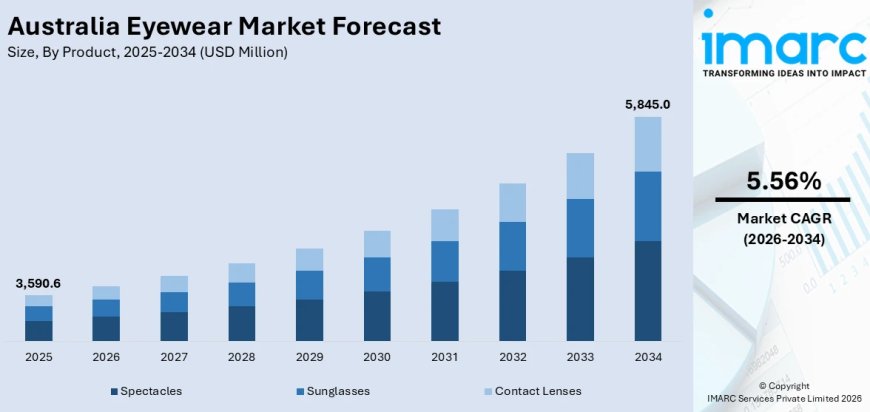
Australia eyewear market size reached USD 3,590.6 Million in 2025. Looking forward, IMARC Group expects the market to reach USD 5,845.0 Million by 2034, exhibiting a growth rate (CAGR) of 5.56% during 2026-2034



Market Overview
The Australia eyewear market is witnessing strong growth driven by the increasing use of digital devices, coupled with the rising demand for eyewear with blue light filters and various other features designed to reduce the impact of prolonged screen time. The market size reached USD 3,590.6 Million in 2025 and is projected to reach USD 5,845.0 Million by 2034, exhibiting a compound annual growth rate (CAGR) of 5.56% during 2026‑2034. Eyewear refers to accessories worn on or around the eyes to enhance vision, protect against environmental elements, or make a fashion statement.
This market is strategically important to Australia's retail and healthcare economy, supporting the nation's growing vision correction needs, UV protection requirements, and evolving fashion consciousness. The increasing awareness and concern regarding eye health have propelled the demand for eyewear products, while the growing prevalence of vision-related issues, particularly among the aging population, contributes significantly to market expansion.
The Australia eyewear market is poised for sustained expansion, driven by digital eye strain concerns, fashion consciousness, and technological innovation. With a projected CAGR of 5.56% through 2034, the market presents significant opportunities for manufacturers focusing on blue light filtering lenses, smart eyewear, and sustainable frame materials.
AUSTRALIA EYEWEAR MARKET SUMMARY
- The Australia eyewear market encompasses a wide range of products including spectacles, sunglasses, and contact lenses, catering to both functional vision correction and fashion-oriented consumer preferences.
- The ecosystem spans optical stores, independent brand showrooms, online stores, and retail stores, serving diverse consumer segments across the country.
- By product, the market is segmented into spectacles, sunglasses, and contact lenses.
- By gender, the market covers men, women, and unisex segments.
- By distribution channel, the market includes optical stores, independent brand showrooms, online stores, and retail stores.
- Key trends shaping the market include increasing awareness regarding eye health, evolving fashion trends transforming eyewear into a fashion accessory, technological advancements such as smart features and photochromic lenses, and the growing role of e‑commerce platforms providing convenient shopping experiences.
PORTER'S FIVE FORCES ANALYSIS – AUSTRALIA EYEWEAR MARKET
The competitive dynamics of the Australia eyewear market can be analysed using Porter's Five Forces framework.
Bargaining Power of Suppliers – Moderate
- Eyewear manufacturers rely on suppliers of lenses, frames, and specialised materials. The presence of multiple global and domestic suppliers provides sourcing options, balancing supplier influence. However, the technical expertise required for advanced lens technologies and smart eyewear gives specialised component suppliers moderate leverage.
Bargaining Power of Buyers – Moderate to High
- Australian consumers benefit from extensive choice across optical stores, independent brand showrooms, online stores, and retail stores. The ease of access to a wide range of eyewear products online has significantly contributed to consumer bargaining power. With growing fashion consciousness, consumers can switch between brands and styles easily, strengthening their negotiating position.
Threat of New Entrants – Moderate
- Significant capital requirements for optical retail infrastructure, brand building, and distribution networks create barriers. However, the rise of e‑commerce platforms has enabled online‑first eyewear brands to enter the market with differentiated offerings, particularly in the affordable and fashion‑oriented segments.
Threat of Substitutes – Low
- Laser eye surgery and contact lenses represent partial substitutes for spectacles, but the growing fashion appeal of eyewear and the rising demand for blue light filtering lenses provide strong differentiation. The transformation of eyewear from a mere necessity into a fashion accessory further reduces substitution pressure.
Competitive Rivalry – High (Healthy)
- The market features intense competition among established eyewear brands, independent optical stores, and online retailers. Competition is driven by product innovation, fashion trends, pricing, and distribution reach rather than purely price‑based rivalry. Technological advancements, such as the integration of smart features in eyewear, have attracted tech-savvy consumers, creating a new dimension in the market.
Request for Sample Report: https://www.imarcgroup.com/australia-eyewear-market/requestsample
MARKET GROWTH DRIVERS
Increasing Digital Device Usage and Blue Light Awareness
The increasing use of digital devices, coupled with the rising demand for eyewear with blue light filters and various other features designed to reduce the impact of prolonged screen time, is primarily driving the market growth across the country. As people become more conscious of the harmful effects of prolonged screen time and exposure to UV rays, the necessity for corrective and protective eyewear has surged. The growing prevalence of vision-related issues, particularly among the aging population, contributes significantly to the expansion of the eyewear market.
Evolving Fashion Trends and Personal Style Emphasis
Evolving fashion trends and a rising emphasis on personal style have transformed eyewear from a mere necessity into a fashion accessory. This shift in consumer perception has led to a continuous demand for innovative and stylish eyewear designs, boosting market growth. From classic frames to avant‑garde designs, eyewear encompasses a diverse range of styles, catering to both practical and aesthetic preferences.
Technological Advancements and Smart Eyewear
Technological advancements, such as the integration of smart features in eyewear, have attracted tech‑savvy consumers, creating a new dimension in the market. Innovations such as photochromic lenses that adjust to varying light conditions are expanding the functionality of eyewear. These advancements are driving consumer interest and encouraging regular upgrades, supporting sustained market growth.
E‑Commerce and Online Shopping Convenience
E‑commerce platforms have played a pivotal role, providing consumers with a convenient and diverse shopping experience. The ease of access to a wide range of eyewear products online has significantly contributed to the market's momentum. Online channels enable consumers to compare products, read reviews, and access a broader selection than traditional retail outlets, supporting market expansion across all regions.
AUSTRALIA EYEWEAR MARKET SEGMENTATION
Segmentation analysis provides a detailed view of the Australia eyewear market by category:
- Product Insights: Spectacles, Sunglasses, Contact Lenses.
- Gender Insights: Men, Women, Unisex.
- Distribution Channel Insights: Optical Stores, Independent Brand Showrooms, Online Stores, Retail Stores.
- Regional Insights: Australia Capital Territory & New South Wales, Victoria & Tasmania, Queensland, Northern Territory & Southern Australia, Western Australia.
COMPETITIVE LANDSCAPE
The competitive landscape of the Australia eyewear market features a diverse mix of optical retailers, independent brand showrooms, online stores, and retail chains. The market research report provides a comprehensive analysis of the competitive landscape, including market structure, key player positioning, top winning strategies, competitive dashboard, and company evaluation quadrant, with detailed profiles of all major companies provided in the full report. Competition is driven by product innovation, fashion trends, pricing, and distribution reach. The rise of e‑commerce platforms has intensified competition, enabling online‑first brands to reach consumers directly. Investment opportunities exist in blue light filtering lens technology, smart eyewear development, sustainable frame materials, and online retail expansion.
REGIONAL ANALYSIS
- Australia Capital Territory & New South Wales represents a critical demand centre, anchored by Sydney's large population, concentration of optical retail outlets, and strong consumer awareness of eye health and fashion trends.
- Victoria & Tasmania benefits from Melbourne's vibrant retail scene and growing demand for fashionable eyewear, with strong presence of independent brand showrooms and optical stores.
- Queensland sees rising demand driven by the state's growing population, increasing digital device usage, and the popularity of sunglasses for UV protection in the sunny climate.
- Western Australia experiences steady growth supported by Perth's expanding retail network and growing consumer interest in premium and technologically advanced eyewear.
- Northern Territory & Southern Australia, though smaller in market share, are benefiting from improved e‑commerce accessibility and growing awareness of blue light filtering eyewear.
RECENT INDUSTRY DEVELOPMENTS
- 2025 Activity: The Australia eyewear market continued its robust growth trajectory, driven by increasing digital device usage, rising demand for blue light filtering lenses, and evolving fashion trends transforming eyewear into a style accessory.
- 2025 Activity: E‑commerce platforms continued to expand their eyewear offerings, providing consumers with convenient and diverse shopping experiences and contributing to market momentum.
- 2025 Activity: Technological innovations, including smart features and photochromic lenses, attracted tech‑savvy consumers and created new dimensions in the market.
Note: If you need any specific information that is not covered currently within the scope of the report, we will provide the same as a part of customization.
https://www.imarcgroup.com/request?type=report&id=22003&flag=C
ABOUT US
IMARC Group is a global management consulting firm that helps the world's most ambitious changemakers to create a lasting impact. The company provides a comprehensive suite of market entry and expansion services. IMARC offerings include thorough market assessment, feasibility studies, company incorporation assistance, factory setup support, regulatory approvals and licensing navigation, branding, marketing and sales strategies, competitive landscape and benchmarking analyses, pricing and cost research, and procurement research.
CONTACT US
IMARC Group
134 N 4th St., Brooklyn, NY 11249, USA
Email: sales@imarcgroup.com
Tel No: (D) +91 120 433 0800
United States: +1 201 971 6302
What's Your Reaction?