































Australia Energy as a Service Market Growth, Outlook 2025-2033
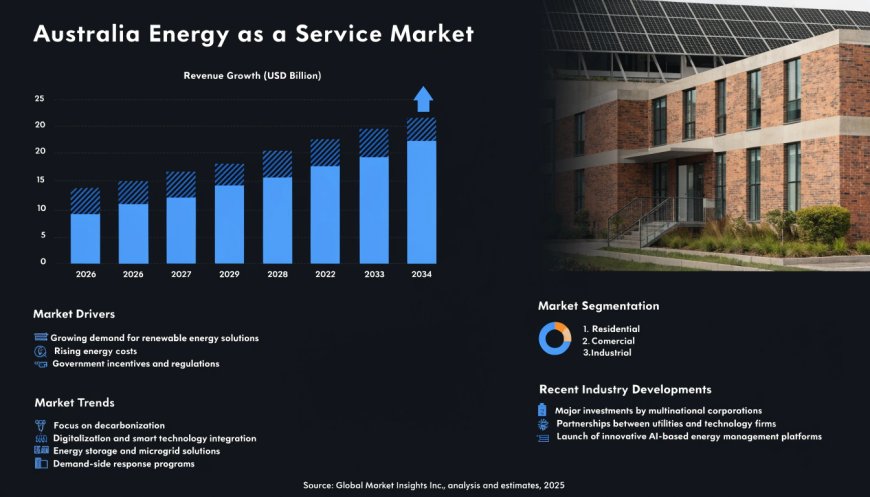
The Australia energy as a service market size reached USD 2.15 Billion in 2024. Looking forward, IMARC Group expects the market to reach USD 4.95 Billion by 2033, exhibiting a growth rate (CAGR) of 8.7% during 2025-2033. Rising energy costs, demand for decentralized energy solutions, increased adoption of renewable energy, government incentives, and the need for energy efficiency are some of the factors contributing to Australia energy as a service market share. Businesses seek flexible, subscription-based models to reduce carbon emissions and optimize energy management.
Market Overview
The Australia energy as a service market size reached USD 2.15 Billion in 2024 and is projected to reach USD 4.95 Billion by 2033, exhibiting a CAGR of 8.7% during 2025–2033. This dynamic market is experiencing accelerating growth driven by a confluence of rising electricity costs, corporate sustainability mandates, and the rapid maturation of distributed energy technologies that are collectively reshaping how businesses and communities procure, manage, and optimize their energy consumption. The energy as a service model, which replaces traditional capital-intensive energy asset ownership with flexible subscription-based arrangements, is gaining significant traction among Australian commercial and industrial operators seeking to reduce upfront investment requirements while simultaneously achieving measurable reductions in energy costs and carbon emissions. Government-backed incentive frameworks, state-level renewable energy targets, and Australia's national net-zero by 2050 commitment are creating a regulatory environment strongly conducive to EaaS adoption, as organizations seek trusted partners capable of designing, funding, and operating integrated clean energy solutions at scale. The convergence of solar photovoltaic generation, battery energy storage, smart meters, IoT-enabled building management systems, and AI-driven energy analytics platforms is enabling EaaS providers to deliver highly personalized, performance-guaranteed energy outcomes that traditional utility supply models are unable to match, positioning the market for sustained double-digit growth throughout the forecast period.
How AI is Reshaping the Future of the Australia Energy as a Service Market
• Energy Consumption Analytics and Baseline Profiling: AI platforms process granular smart meter data, building management system outputs, production schedules, and weather variables to generate precise energy consumption baselines and identify behavioral and operational inefficiencies across commercial and industrial customer sites, enabling EaaS providers to quantify guaranteed savings with greater accuracy, design more targeted energy efficiency interventions, and demonstrate measurable performance outcomes that strengthen long-term service contract renewals.
• Predictive Demand Management and Peak Shaving Automation: Machine learning algorithms continuously analyze real-time energy consumption patterns, wholesale market price signals, network demand response dispatch instructions, and on-site generation and storage availability to automatically control building loads, battery charge and discharge cycles, and backup generator operations, enabling EaaS customers to reduce peak demand charges, participate in frequency regulation markets, and lower total energy procurement costs without manual operator intervention.
• Solar Generation and Battery Storage Dispatch Optimization: AI control systems optimize the real-time dispatch of behind-the-meter solar generation and battery storage assets within EaaS portfolios, dynamically adjusting charging and discharging schedules in response to wholesale spot price forecasts, retailer time-of-use tariff structures, network export limits, and customer load profiles to maximize bill savings, minimize grid reliance, and ensure that service performance guarantees are consistently delivered across diverse commercial and industrial customer sites.
• Predictive Maintenance and Asset Lifecycle Management: AI-driven condition monitoring platforms analyze inverter performance data, battery cell voltage profiles, solar panel degradation rates, and HVAC system operating parameters across distributed EaaS asset portfolios to predict maintenance requirements before failures occur, enabling providers to schedule proactive interventions that prevent service outages, extend asset operational lifespans, reduce emergency repair costs, and maintain the high system availability commitments embedded in performance-based energy service agreements.
• Carbon Accounting and ESG Reporting Automation: AI analytics engines aggregate real-time generation mix data, energy consumption records, scope 1 and scope 2 emissions inventories, and renewable energy certificate retirement records across commercial and industrial EaaS customer portfolios, automating the preparation of carbon accounting reports, sustainability disclosures aligned with Australian Sustainability Reporting Standards, and net-zero progress tracking dashboards that satisfy increasing regulatory reporting obligations and investor ESG due diligence requirements.
• Customer Energy Profile Modeling and Contract Design: AI algorithms analyze prospective customer energy bills, consumption data, site characteristics, roof space availability, grid connection parameters, and operational profiles to generate optimized EaaS contract structures including appropriate solar and storage sizing, performance guarantee levels, service fee structures, and contract durations, enabling providers to accelerate sales cycles, reduce proposal development costs, and improve the commercial viability of new service agreements across diverse customer segments.
• Grid Integration and Virtual Power Plant Coordination: AI orchestration platforms aggregate distributed EaaS assets including commercial rooftop solar, behind-the-meter batteries, and flexible demand loads across multiple customer sites into coordinated virtual power plant formations, enabling providers to bid aggregated capacity into wholesale energy markets, ancillary service markets, and network demand response programs, generating additional revenue streams that reduce net service costs for customers and improve the overall economics of the EaaS business model.
Grab a sample PDF of this report : https://www.imarcgroup.com/australia-energy-as-a-service-market/requestsample
Market Growth Factors
Escalating commercial and industrial electricity costs are the primary catalyst driving Australian businesses toward energy as a service adoption. As wholesale electricity prices and network charges remain elevated, organizations are seeking alternatives to traditional utility supply that provide cost certainty and guaranteed savings. The subscription-based EaaS model eliminates capital barriers to clean energy adoption, enabling businesses of all sizes to deploy integrated solar, storage, and energy management solutions without upfront asset investment or operational complexity.
The convergence of mature renewable energy technologies and advanced digital platforms is dramatically expanding the commercial viability of EaaS offerings in Australia. Wärtsilä's April 2025 deployment of one of Australia's first DC-coupled solar and battery storage projects with a long-term performance service agreement demonstrates the sector's evolution toward guaranteed-outcome delivery models. Community battery programs such as Ausgrid's August 2024 Cabarita subscription storage service are extending EaaS benefits to residential and suburban markets beyond traditional commercial users.
Government renewable energy incentives and corporate net-zero commitments are accelerating EaaS market expansion across Queensland, New South Wales, and Victoria. The January 2025 Sojitz, CS Energy, and Nippon Koei partnership for an integrated Queensland renewable energy and battery storage project with energy trading functionality exemplifies how EaaS models are scaling into utility-grade clean energy infrastructure. Rising demand for emissions transparency under Australia's evolving Sustainability Reporting Standards is further compelling commercial and industrial operators to transition toward performance-guaranteed, low-carbon energy service arrangements.
Market Segmentation
By Service Type:
• Energy Supply Services
• Maintenance and Operation Services
• Energy Efficiency and Optimization Services
By End User:
• Commercial
• Industrial
By Region:
• Australia Capital Territory & New South Wales
• Victoria & Tasmania
• Queensland
• Northern Territory & Southern Australia
• Western Australia
Key Players
• AGL Energy Limited
• Origin Energy Limited
• Ausgrid
• Wärtsilä Australia
• Sojitz Corporation (Australia)
• CS Energy
• EnergyAustralia
• Schneider Electric Australia
• Enel X Australia
• Engie Australia
Recent Development & News
January 2025: Sojitz Corporation, in partnership with CS Energy and Nippon Koei, announced a large-scale renewable energy and battery storage project in Queensland designed as a fully integrated energy as a service initiative combining utility-scale solar generation, grid-scale battery storage, advanced control systems, and energy trading capabilities. The project is structured under a long-term service agreement model, with Sojitz providing capital and operational management while CS Energy contributes grid connection expertise and energy market participation knowledge. The initiative is expected to deliver approximately 150 MW of solar generation capacity paired with 60 MWh of battery storage, targeting energy supply for commercial and industrial offtakers across Queensland's grid. The partnership underscores growing interest from Japanese trading houses and international energy companies in Australia's EaaS sector as a vehicle for deploying clean energy infrastructure under bankable, performance-guaranteed commercial frameworks.
April 2025: Wärtsilä confirmed the successful delivery of one of Australia's first DC-coupled energy storage projects, integrating solar photovoltaic generation directly with battery storage through a shared DC bus architecture that maximizes round-trip energy efficiency and reduces conversion losses compared to conventional AC-coupled configurations. The project is supported by a comprehensive long-term service agreement covering performance monitoring, predictive maintenance, software optimization updates, and guaranteed uptime commitments, demonstrating the full energy as a service delivery model for utility-scale clean energy infrastructure. The DC-coupled system, located in regional Australia, is rated at 20 MW solar with 10 MW/40 MWh of co-located battery storage and is expected to generate annual operational savings of approximately AUD 3.2 million for the host facility through reduced grid energy procurement and network demand charge avoidance. Wärtsilä's entry into the Australian EaaS segment marks a significant expansion of its global energy storage services business into the Asia-Pacific region.
September 2025: Schneider Electric Australia announced a AUD 120 million expansion of its EcoStruxure Microgrid as a Service platform, targeting 200 new commercial and industrial customer deployments across New South Wales, Victoria, and Queensland over a 24-month rollout period focusing on manufacturing facilities, logistics centers, and large-format retail properties with average annual energy consumption exceeding 2 GWh. Each deployment integrates rooftop solar systems ranging from 500 kW to 5 MW, behind-the-meter battery storage of 250 kWh to 2 MWh, AI-driven building energy management systems, and optional EV charging infrastructure, all delivered under a unified subscription service contract with guaranteed minimum savings of 20% against baseline energy costs. The platform leverages Schneider Electric's global EcoStruxure IoT architecture to provide customers with real-time energy dashboards, automated demand response participation, and monthly carbon footprint reporting aligned with Australia's new Sustainability Reporting Standards. The expansion positions Schneider Electric as one of Australia's largest EaaS platform operators by installed capacity, with a total contracted portfolio targeting 850 MW of distributed clean energy assets under management by 2027.
Customization Note
If you require any specific information that is not currently covered within the scope of the report, we will provide the same as a part of the customization.
Request Customization: https://www.imarcgroup.com/request?type=report&id=33925&flag=E
Follow our Linkedin Page For more Articles: https://www.linkedin.com/company/australia-latest-report/
About Us
IMARC Group is a global management consulting firm that helps the world's most ambitious changemakers create a lasting impact. The company provides a comprehensive suite of market entry and expansion services. IMARC offerings include market assessment, feasibility studies, company incorporation assistance, factory setup support, regulatory approvals and licensing navigation, branding, marketing and sales strategies, competitive landscape and benchmarking analyses, pricing and cost research, and procurement research.
Contact Us
IMARC Group
134 N 4th St. Brooklyn, NY 11249, USA
Email: sales@imarcgroup.com
Tel No: (D) +91 120 433 0800
United States: +1-201-971-6302
What's Your Reaction?