































Australia Drilling Equipment Market | Size, Growth, Trends and Analysis 2026‑2034
The Australia drilling equipment market size reached USD 186.2 Million in 2025. Looking forward, IMARC Group expects the market to reach USD 276.2 Million by 2034, exhibiting a growth rate (CAGR) of 4.34% during 2026-2034.

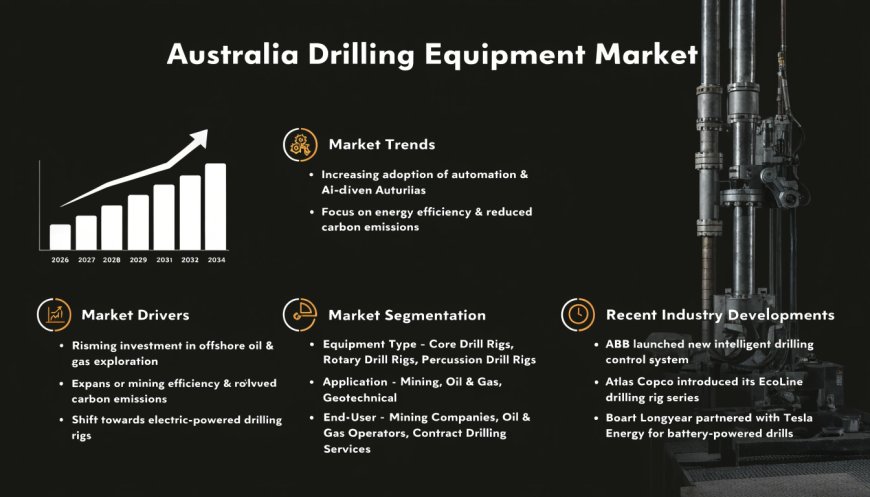
Market Overview
The Australia drilling equipment market is advancing at a steady pace, driven by the nation's rich mineral endowment, an ongoing wave of exploration and mining investment, and a decisive industry shift toward automated, data‑driven drilling technologies. According to IMARC Group, the market size reached USD 186.2 Million in 2025 and is projected to reach USD 276.2 Million by 2034, exhibiting a compound annual growth rate (CAGR) of 4.34% during 2026‑2034.
Australia is among the world's top exporters of minerals such as coal, iron ore, and gold, creating consistent and substantial demand for high‑performance drilling equipment capable of accessing deep mineral deposits. At the same time, mining companies are actively investing in advanced technologies—including automation, artificial intelligence (AI), and real‑time monitoring systems—to optimise operational efficiency and minimise downtime in remote and high‑risk environments. The federal government’s support for infrastructure projects, water‑resource development, and energy‑security initiatives is further broadening the scope of drilling applications across the country.
The market is strategically important to Australia’s economy as it underpins the resource extraction sector—a key pillar of export earnings—and supports the development of critical infrastructure, groundwater resources, and renewable energy projects. As the industry accelerates the adoption of eco‑efficient drilling practices and autonomous systems, the drilling equipment market is becoming an essential enabler of Australia’s broader digital transformation and decarbonisation goals.
The Australia drilling equipment market is poised for sustained expansion, driven by a projected CAGR of 4.34% through 2034, robust exploration and mining activity, and the rapid integration of autonomous and AI‑enabled drilling systems. With major miners committing to electric‑powered drill fleets and industry‑wide collaboration on autonomous open‑pit technology, the market offers significant opportunities for manufacturers, technology partners, and equipment suppliers focused on efficiency, safety, and environmental performance.
Australia Drilling Equipment Market Summary
The Australia drilling equipment market encompasses a wide range of machinery, including drawworks, traveling blocks, coiled tubing, drilling instrumentation, drilling generators, wireline equipment, completion tools, oil tools, and pipe handling systems. The ecosystem includes global equipment manufacturers, domestic mining and oil‑gas contractors, and technology partners, serving end‑users across the construction, oil and gas, mining, water management, and other sectors.
Key Segments
-
Type: Drawworks, Traveling Blocks, Coiled Tubing, Drilling Instrumentation, Drilling Generators, Wireline Equipment, Completion Tools, Oil Tools, Pipe Handling Systems, Others.
-
Category: Automatic, Manual.
-
Power Source: Electric, Non‑Electric.
-
Mount Type: Truck Mounted, Trailer Mounted.
-
Distribution Channel: Direct Sales, Indirect Sales.
-
End‑Use: Construction, Oil and Gas, Mining, Water Management, Others.
-
Region: Australia Capital Territory & New South Wales, Victoria & Tasmania, Queensland, Northern Territory & Southern Australia, Western Australia.
The market is characterised by a shift toward automation and AI‑driven analytics, growing adoption of electric and autonomous drill rigs, and strong demand from the mining sector. The automatic segment benefits from the industry's pursuit of improved safety and operational consistency, while the mining end‑use segment dominates due to the country’s prolific iron ore, gold, and base‑metal deposits.
Porter’s Five Forces Analysis – Australia Drilling Equipment Market
The competitive dynamics of the Australia drilling equipment market can be analysed using Porter's Five Forces framework.
Bargaining Power of Suppliers – Moderate
The market relies on a mix of global drilling‑equipment manufacturers and specialised technology providers. Major suppliers such as Sandvik, Epiroc, Caterpillar, and Atlas Copco hold significant influence due to their proprietary automation platforms and AI‑enabled systems. However, the presence of multiple international vendors and a growing number of rental and second‑hand equipment options provide buyers with alternative sourcing channels, balancing supplier power.
Bargaining Power of Buyers – High
Buyers include large‑scale mining corporations (BHP, Rio Tinto, Fortescue), oil‑gas companies, civil contractors, and water‑drilling enterprises. These buyers have considerable negotiating leverage, particularly when procuring fleet‑wide equipment upgrades or signing long‑term service contracts. The availability of performance‑based rental agreements and the emergence of autonomous‑drilling‑as‑a‑service models further strengthen buyer power.
Threat of New Entrants – Moderate
The threat of new entrants is moderate. Establishing a national presence in drilling equipment manufacturing requires substantial capital investment and a proven track record in safety‑critical environments. However, the growing demand for specialised automation and digital‑integration solutions is attracting new technology‑focused entrants. The increasing use of equipment‑rental and after‑market service models also lowers entry barriers for smaller, niche players.
Threat of Substitutes – Low
There is a low threat of substitutes. While alternative rock‑breaking methods exist for certain applications, drilling remains the most efficient and scalable method for accessing deep mineral deposits, constructing wells, and carrying out geotechnical investigations. The unique combination of precision, speed, and automation offered by modern drill rigs cannot be fully replicated by other techniques.
Competitive Rivalry – Moderate
The market is moderately competitive, with global equipment manufacturers competing on technology, automation capabilities, fuel efficiency, and after‑sales support. The industry has seen recent high‑value contracts for autonomous and electric drill fleets, indicating that differentiation through technological innovation is a key competitive lever. The growing importance of sustainability performance is also influencing competitive dynamics, as operators favour equipment that reduces emissions and energy consumption.
Request for Sample Report: https://www.imarcgroup.com/australia-drilling-equipment-market/requestsample
Market Growth Drivers
Rising Demand from the Mining and Exploration Sectors
A primary factor propelling the Australia drilling equipment market is the sustained strength of the nation’s resource extraction industry. Australia is a top global exporter of coal, iron ore, and gold, and mining companies are continually investing in new exploration campaigns and the expansion of existing operations. Accessing deeper ore bodies and lower‑grade deposits requires robust, high‑performance drilling equipment capable of maintaining high penetration rates under demanding conditions.
The integration of automation, AI, and advanced sensing technologies is central to this trend. Modern drill rigs equipped with real‑time data analytics, auto‑positioning, and remote operation capabilities help mining companies improve drilling accuracy, reduce non‑productive time, and enhance operator safety. For example, the deployment of autonomous blasthole drills by leading iron‑ore producers has demonstrated the significant productivity gains achievable through automation.
Technological Advancements and Equipment Modernisation
Rapid technological advancement is a core driver of market expansion. Drilling equipment manufacturers are increasingly incorporating IoT sensors, real‑time monitoring platforms, and digital‑twin technology to enable predictive maintenance and reduce unplanned downtime. AI‑powered analytics help operators to optimise drilling parameters, extend tool life, and lower fuel consumption.
The shift toward autonomous drilling systems is particularly notable. Advanced automation platforms allow a single remote operator to oversee multiple drill rigs from a centralised control centre, dramatically improving safety and productivity in hazardous environments. These technological breakthroughs are not only revolutionising operational workflows but also providing a strong competitive edge to early adopters.
Government Infrastructure and Energy‑Security Initiatives
The Australian government plays an active role in driving drilling equipment demand through its support for infrastructure development and energy security. Major projects in remote and regional areas—including road and rail construction, utility installations, port expansions, and water‑supply schemes—require extensive drilling for geotechnical investigation, foundation work, and resource access.
Investments in energy security are also expanding the scope of drilling activities. The government’s push for renewable energy sources, including geothermal exploration and hydrogen‑production hubs, is creating new markets for specialised drilling equipment. Public‑private partnerships are helping to fund these capital‑intensive projects, ensuring a steady pipeline of demand for drilling solutions.
Market Growth Drivers
Growing Adoption of Eco‑Efficient and Electric Drilling Equipment
Environmental stewardship has become a central consideration for Australian mining and infrastructure projects. Drilling‑equipment manufacturers are responding by developing electric‑powered and hybrid drill rigs that significantly reduce carbon emissions, noise pollution, and fuel consumption. In a landmark contract in April 2025, Epiroc secured its largest‑ever order to supply Fortescue with a fleet of autonomous and electric‑powered mining equipment for its Western Australian iron‑ore mines. The fleet includes electric blasthole drill rigs such as the Pit Viper 271 E and SmartROC D65 BE, which are expected to reduce carbon emissions by 90,000 tonnes annually. The autonomous machines are remotely operated from Fortescue’s Integrated Operations Centre in Perth, over 1,500 kilometres away, demonstrating the synergy between decarbonisation and digitalisation.
Expansion of Autonomous and Remote‑Controlled Drilling Capabilities
Autonomous drilling is rapidly moving from pilot projects to mainstream deployment across Australia’s mining sector. BHP’s $4.5 billion South Flank iron ore project in the Pilbara introduced its first autonomous drill rig, an Epiroc Pit Viper 271, as part of a plan to operate five fully autonomous drill rigs at the site. The rigs are remotely controlled from BHP’s Integrated Remote Operations Centre in Perth, building on the company’s prior success converting 18 Pit Viper rigs to autonomous operation at multiple sites.
In a parallel development, Rio Tinto has partnered with Sandvik to integrate Sandvik’s i‑series drill rigs with Rio Tinto’s Autonomous Drilling System (ADS). The co‑development program will enable remote, multi‑rig, and multi‑site autonomous operations, with site‑based testing planned for Rio Tinto’s Western Australian operations. The partnership combines Rio Tinto’s extensive experience in autonomous drilling with Sandvik’s AutoMine automation technology, aiming to improve safety, productivity, and system compatibility in open‑pit environments.
Major Drilling‑Services Contracts and Lithium‑Project Developments
The Australian drilling services sector has seen several significant contract awards that indicate sustained demand for drilling equipment. In May 2026, Core Lithium awarded a US$274 million (approximately A$430 million) three‑year underground mining contract to Dev Mining Services for the BP33 deposit at the Finniss Lithium Operation in the Northern Territory. The contract includes drill‑and‑blast, load‑and‑haul, decline development, and production activities.
Other notable contract awards include Swick Mining Services securing an underground drilling contract for MMG’s Golden Grove and Rosebery mines, and Downer EDI being awarded a 4.5‑year contract for mining services at the Roy Hill iron‑ore mine. These agreements underscore the breadth of drilling‑equipment demand across gold, base‑metal, and iron‑ore operations, as well as the emerging lithium sector.
Australia Drilling Equipment Market Segmentation
Segmentation analysis provides a detailed view of the Australia drilling equipment market by category:
-
Type Insights: Drawworks, Traveling Blocks, Coiled Tubing, Drilling Instrumentation, Drilling Generators, Wireline Equipment, Completion Tools, Oil Tools, Pipe Handling Systems, Others.
-
Category Insights: Automatic, Manual.
-
Power Source Insights: Electric, Non‑Electric.
-
Mount Type Insights: Truck Mounted, Trailer Mounted.
-
Distribution Channel Insights: Direct Sales, Indirect Sales.
-
End‑Use Industry Insights: Construction, Oil and Gas, Mining, Water Management, Others.
-
Regional Insights: Australia Capital Territory & New South Wales, Victoria & Tasmania, Queensland, Northern Territory & Southern Australia, Western Australia.
Competitive Landscape
The competitive landscape of the Australia drilling equipment market is shaped by a mix of global equipment manufacturers, technology specialists, and integrated service providers. Key players drive the market by expanding their automation and electrification portfolios, forming strategic partnerships with major miners, and strengthening their after‑market service networks.
Key Companies Operating in the Market:
-
Sandvik Mining and Rock Solutions – Launched the Ranger DX1010i surface drill rig at CONEXPO‑CON/AGG 2026, featuring a long‑feed configuration capable of single‑pass drilling up to 6.4 metres. The rig incorporates the iCab cabin, automation features, and digital‑solution connectivity, targeting improved productivity and safety in surface mining.
-
Epiroc – Secured a MAUD 350 (SEK 2.2 billion) contract to supply Fortescue with a fleet of autonomous and electric‑powered mining equipment, including Pit Viper 271 E and SmartROC D65 BE electric blasthole drill rigs. Also unveiled the SmartROC D65, the industry’s first fully autonomous surface drill rig.
-
Sandvik and Rio Tinto – Entered into a co‑development partnership to integrate Sandvik’s i‑series drill rigs with Rio Tinto’s Autonomous Drilling System, enabling remote, multi‑rig autonomous open‑pit drilling.
-
BHP – Deployed its first autonomous drill rig at the $4.5 billion South Flank iron ore project, part of a plan to operate five fully autonomous drill rigs remotely from Perth.
-
Other Notable Players – Caterpillar Inc., Atlas Copco AB, Komatsu Ltd., Boart Longyear Ltd., Liebherr Group, Schramm Inc., and a range of specialist rental and after‑market service providers.
Regional Analysis
Regional dynamics within the Australia drilling equipment market are shaped by the concentration of mineral resources, mining activity, and infrastructure projects across states and territories.
-
Western Australia is the largest market region, driven by the Pilbara’s world‑class iron‑ore mines, extensive gold operations, and lithium projects. The region is at the forefront of autonomous and electric drilling technology adoption, with major miners and equipment manufacturers conducting live trials and fleet rollouts.
-
Australia Capital Territory & New South Wales is a significant market, supported by gold, base‑metal, and coal mining in the state’s western and northern areas, as well as large‑scale infrastructure development around Sydney and regional centres.
-
Queensland sees strong demand from coal‑seam gas operations, metallurgical coal mines, and infrastructure projects associated with the 2032 Brisbane Olympics. The state is also a hub for water‑resource drilling and agricultural bore‑field development.
-
Northern Territory & Southern Australia are emerging markets, with growing exploration activity in lithium, gold, copper, and rare‑earth elements. South Australia hosts major copper‑gold operations and the world’s largest zircon‑rich deposit, while the Northern Territory benefits from new lithium‑project development and gas‑exploration campaigns.
-
Victoria & Tasmania, while smaller in mining activity, have steady demand from civil construction, water‑management projects, and geotechnical investigations.
Recent Industry Developments
-
April 2025: Epiroc won its largest‑ever contract to supply Fortescue with a fleet of autonomous and electric‑powered mining equipment for use at its iron ore mines in Western Australia. The contract, valued at MAUD 350 (SEK 2.2 billion), includes electric blasthole drill rigs such as the Pit Viper 271 E and SmartROC D65 BE, which will help reduce carbon emissions by 90,000 tonnes annually. The autonomous machines will be operated remotely from Fortescue's Integrated Operations Centre in Perth, over 1,500 kilometres away.
-
March 2025: Sandvik announced the launch of the Ranger DX1010i surface drill rig at CONEXPO‑CON/AGG 2026. The new model expands the capabilities of the Ranger DXi top hammer drill rig family, introducing a long‑feed configuration capable of single‑pass drilling up to 6.4 metres. The rig features the RD930 long‑piston rock drill, an 11 m³/min compressor, and Sandvik’s iCab cabin with automation features including improved one‑hole automation and the iClean drilling system.
-
May 2026: Core Lithium awarded a US$274 million (approximately A$430 million) three‑year underground mining contract to Dev Mining Services for the BP33 deposit at the Finniss Lithium Operation in the Northern Territory. The scope of work includes drill and blast, load and haul, decline development, production, and ground support.
-
March 2026: BHP introduced its first autonomous drill rig at the $4.5 billion South Flank iron ore project in the Pilbara. The Epiroc Pit Viper 271 marks the start of autonomous production drilling at the site, with BHP planning to operate five fully autonomous drill rigs at South Flank, controlled remotely from its Integrated Remote Operations Centre in Perth.
-
June 2026: Rio Tinto partnered with Sandvik to co‑develop and integrate Sandvik’s i‑series drill rigs with Rio Tinto’s Autonomous Drilling System. The collaboration aims to enable remote, multi‑rig, and multi‑site autonomous open‑pit drilling operations. Site‑based testing is slated for Rio Tinto’s Western Australian operations.
-
2025 (Throughout): The Australia mineral exploration equipment market continued its strong growth trajectory, with increasing exploration spending across Western Australia, Queensland, and the Northern Territory. Gold and lithium exploration led the activity, supported by record‑high commodity prices and government co‑funding for greenfields drilling programmes.
-
2025–2026 (Throughout): AI‑powered drilling optimisation and predictive maintenance platforms gained wider adoption among Australian mining operators, enabling real‑time adjustment of drilling parameters to improve penetration rates and reduce bit wear. Digital‑twin technology was increasingly used to model drilling activities and pre‑empt equipment failures before they cause downtime.
Browse Full Report with TOC & List of Figures for In‑Depth Market Insights: https://www.imarcgroup.com/australia-drilling-equipment-market
Note: If you need any specific information that is not covered currently within the scope of the report, we will provide the same as a part of customisation.
About Us
IMARC Group is a global management consulting firm that helps the world's most ambitious changemakers to create a lasting impact. The company provides a comprehensive suite of market entry and expansion services. IMARC offerings include thorough market assessment, feasibility studies, company incorporation assistance, factory setup support, regulatory approvals and licensing navigation, branding, marketing and sales strategies, competitive landscape and benchmarking analyses, pricing and cost research, and procurement research.
Contact Us
IMARC Group
134 N 4th St., Brooklyn, NY 11249, USA
Email: sales@imarcgroup.com
Tel No.: (D) +91 120 433 0800
United States: +1-201-971-6302
What's Your Reaction?