































Australia Courier, Express and Parcel (CEP) Market 2025 | Worth USD 17.7 Billion by 2033
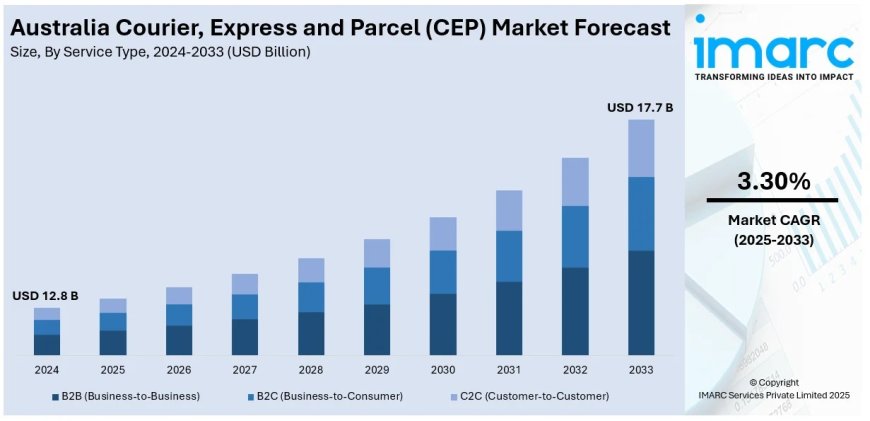
Australia courier, express and parcel market size reached USD 12.8 Billion in 2024. Looking forward, IMARC Group expects the market to reach USD 17.7 Billion by 2033, exhibiting a growth rate (CAGR) of 3.30% during 2025-2033.

Australia Courier, Express and Parcel (CEP) Market Overview
The Australia courier, express and parcel (CEP) market is experiencing steady growth, driven by the sustained expansion of e-commerce, accelerating digital transformation across logistics networks, increasing consumer expectations for faster and more flexible delivery options, and significant infrastructure investments by both public and private sector stakeholders. The Australia courier, express and parcel (CEP) market size reached USD 12.8 Billion in 2024, reflecting the critical role of parcel logistics in Australia's rapidly digitalising economy. Over 80% of Australian households — approximately 9.5 million — received a parcel in 2023, with 5.6 million households making online purchases each month, underscoring the scale of consumer dependence on courier and parcel services. Total e-commerce volume in Australia reached USD 89.4 billion in 2024, with online consumers spending roughly AUD 95.8 billion on e-commerce products. The e-commerce segment led the market with a 35.78% revenue share in 2025, while click-and-collect contributed approximately 40% of national e-commerce sales in 2024 as retailers waived delivery fees to encourage in-store pickup.
Looking forward, the Australia courier, express and parcel (CEP) market is expected to reach USD 17.7 Billion by 2033, exhibiting a growth rate (CAGR) of 3.30% during 2025-2033. This growth trajectory is being supported by massive infrastructure investments across the logistics value chain, the adoption of AI-powered automation and electric vehicle fleets, and the continued expansion of same-day and next-day delivery capabilities into regional and metropolitan markets. Australia Post has announced a USD 500 million AI-powered mega parcel hub at the former Holden site in Elizabeth, South Australia, covering 83,000 square metres with capacity to handle up to 400,000 parcels per day — nearly double the current Adelaide Airport facility — with full operations expected by 2028. The company also incorporated 5,131 electric vehicles into its fleet in 2024, reinforcing its sustainability commitment. The Australian Government has committed AUD 120 billion for land transport infrastructure projects in the 2024-25 budget, providing foundational support for logistics network expansion. DHL Supply Chain is constructing an advanced Transport Hub in Derrimut, Victoria, adding 16,600 square metres of warehouse and office space, while FedEx opened a new 2,400 square metre state-of-the-art sortation facility in Coffs Harbour, New South Wales. Toll Group is enhancing its road freight capacity through the acquisition of Glen Cameron Group, creating a combined entity with revenue exceeding AUD 1 billion and establishing itself as one of Australia's largest logistics enterprises.
Request for a sample copy of this report: https://www.imarcgroup.com/australia-courier-express-parcel-market/requestsample
How AI is Reshaping the Future of the Australia Courier, Express and Parcel (CEP) Market
Artificial intelligence is fundamentally transforming Australia's courier, express and parcel industry, revolutionising route optimisation, warehouse automation, demand forecasting, customer experience, and sustainability outcomes across the entire logistics value chain. As parcel volumes continue to scale with e-commerce growth, AI is enabling operators to manage complexity, reduce costs, and deliver faster service. Key developments include:
- AI-Powered Route Optimisation and Dynamic Dispatch: Machine learning algorithms are transforming last-mile delivery by analysing real-time traffic patterns, weather conditions, parcel density, delivery windows, and driver workload to generate optimal delivery routes dynamically. Advanced dispatch software automatically matches deliveries to the right driver based on location, vehicle size, and schedule constraints, reducing delivery times by 15-20% while lowering fuel consumption and carbon emissions. DHL Express is leveraging AI-powered logistics software to accurately forecast shipping volumes and achieve precision in courier route planning across Australian metropolitan and regional networks.
- Automated Parcel Sorting and Robotic Warehouse Operations: AI-driven robotic systems and computer vision technology are revolutionising parcel sorting and warehouse management at scale. Australia Post's planned USD 500 million mega parcel hub in Elizabeth will rely heavily on artificial intelligence, robotics, and smart automation to process up to 400,000 parcels daily with improved accuracy and speed. High-speed conveyor systems integrated with AI-powered barcode scanners can process thousands of parcels in minutes, dramatically reducing manual handling requirements and minimising error rates across the sorting and distribution pipeline.
- Predictive Demand Forecasting and Capacity Planning: AI-powered demand forecasting models are enabling courier operators to anticipate parcel volume surges during peak periods such as Black Friday, Click Frenzy, and holiday seasons with significantly greater accuracy than traditional planning methods. By analysing historical shipment data, e-commerce trends, promotional calendars, and macroeconomic indicators, these systems optimise fleet deployment, temporary staffing, and warehouse capacity allocation to maintain service levels during demand spikes while avoiding overcapacity during quieter periods.
- AI-Enhanced Customer Experience and Real-Time Visibility: Natural language processing chatbots, AI-powered tracking systems, and predictive delivery time estimation algorithms are elevating the customer experience in Australian parcel delivery. AI systems analyse delivery patterns to provide increasingly accurate estimated time of arrival windows, proactively notify recipients of delays, and offer intelligent rerouting options. Australia Post launched a new five-member panel of technology service providers in September 2024 to support the delivery of industry-leading digital experiences powered by AI and data analytics.
- Sustainable Logistics Through AI and Electric Vehicle Integration: AI is enabling the optimisation of electric vehicle fleet operations for parcel delivery, with research from April 2025 demonstrating that combining EVs with AI-enabled logistics systems achieves 15-20% faster deliveries, 10-25% higher energy efficiency, and up to 40% lower CO2 emissions in last-mile operations. AI algorithms manage battery charge optimisation, route planning based on vehicle range, and dynamic load balancing across mixed EV and conventional fleets, supporting Australia Post's deployment of over 5,131 electric vehicles and the broader industry transition toward carbon-neutral delivery operations.
Australia Courier, Express and Parcel (CEP) Market Trends
Mega-Hub Infrastructure and Automation Investment Reshaping Logistics Capacity
Australia's courier, express and parcel industry is undergoing a structural transformation driven by unprecedented infrastructure investment in automated mega-hubs, advanced sortation facilities, and technology-enabled distribution centres that are fundamentally expanding processing capacity and operational efficiency. Australia Post's landmark USD 500 million AI-powered mega parcel hub at the former Holden site in Elizabeth, South Australia represents the most significant single investment in Australian logistics infrastructure, with 83,000 square metres of automated processing space capable of handling up to 400,000 parcels per day — nearly doubling the capacity of the existing Adelaide Airport facility. The hub will be fully operational by 2028 and will integrate artificial intelligence, robotics, and smart automation systems throughout the sorting and distribution pipeline. Additionally, Australia Post is building a multimillion-dollar parcel facility on the Sunshine Coast to support Queensland's growing parcel demand, expected to open in late 2026 with high-tech automation processing up to 16,000 parcels per day. DHL Supply Chain invested AUD 150 million in automation and robotics across its Australian warehouses, including the commissioning of 1,000 new assisted picking robots, while its advanced Transport Hub in Derrimut, Victoria adds 16,600 square metres of warehouse and office space. FedEx Australia opened a new 2,400 square metre state-of-the-art sortation and distribution facility in Coffs Harbour, New South Wales, designed to support small and medium-sized enterprises in expanding domestic and international e-commerce operations. The Australian Government's commitment of AUD 120 billion for land transport infrastructure projects in the 2024-25 budget provides foundational road and rail upgrades that improve connectivity between these logistics hubs and end consumers, reducing transit times and supporting the expansion of same-day and next-day delivery coverage across metropolitan and regional Australia.
Electric Vehicle Adoption and Sustainability Transformation in Last-Mile Delivery
Sustainability has emerged as a defining competitive differentiator and strategic priority across Australia's CEP industry, with electric vehicle adoption, carbon-neutral delivery commitments, and sustainable packaging initiatives reshaping the last-mile delivery landscape. Australia Post has positioned itself as a sector leader in fleet electrification, incorporating 5,131 electric vehicles into its delivery fleet in 2024, creating one of the largest EV logistics fleets in the Asia-Pacific region. The company's June 2024 expansion of next-day delivery services to Perth and Adelaide demonstrated how operational efficiency gains from route optimisation and infrastructure investment can be combined with sustainability improvements to enhance service speed without increasing environmental impact. Research published in April 2025 validated the dual benefits of AI-enabled EV logistics, demonstrating that combining electric vehicles with intelligent route planning achieves 15-20% faster deliveries, 10-25% higher energy efficiency, and up to 40% lower CO2 emissions compared to conventional diesel-powered last-mile operations. Amazon has introduced sustainable packaging initiatives across its Australian operations, reducing packaging waste and aligning with consumer expectations for environmentally responsible e-commerce fulfilment. The non-express shipment segment — which held 74.84% of market share in 2025 — is particularly well-suited for EV adoption due to predictable route patterns and overnight charging windows, while the express segment's expected 5-6% CAGR growth through 2031 is driving investment in fast-charging infrastructure and extended-range electric delivery vehicles. Corporate sustainability reporting requirements, consumer environmental awareness, and government emissions reduction targets are collectively creating a regulatory and market environment where sustainable logistics capabilities are becoming a prerequisite for competitive positioning rather than a discretionary investment, compelling operators across the CEP value chain to accelerate their transition timelines.
Australia Courier, Express and Parcel (CEP) Market Summary
- The Australia CEP market reached USD 12.8 Billion in 2024 and is projected to reach USD 17.7 Billion by 2033 at a CAGR of 3.30%, driven by e-commerce expansion, logistics infrastructure investment, and technology adoption across the delivery value chain.
- Over 80% of Australian households (9.5 million) received a parcel in 2023, with 5.6 million households making online purchases monthly, while total e-commerce volume reached USD 89.4 billion in 2024, fuelling sustained parcel demand growth.
- Australia Post announced a USD 500 million AI-powered mega parcel hub at the former Holden site in Elizabeth, South Australia, with 83,000 square metres of automated space capable of processing up to 400,000 parcels per day, expected to be fully operational by 2028.
- Australia Post incorporated 5,131 electric vehicles into its fleet in 2024, while research demonstrated that AI-enabled EV logistics achieve 15-20% faster deliveries, 10-25% higher energy efficiency, and up to 40% lower CO2 emissions in last-mile operations.
- The Australian Government committed AUD 120 billion for land transport infrastructure in the 2024-25 budget, while Toll Group's acquisition of Glen Cameron Group created a combined entity exceeding AUD 1 billion in revenue, reshaping the competitive logistics landscape.
Australia Courier, Express and Parcel (CEP) Market Growth Drivers
E-Commerce Expansion and Evolving Consumer Delivery Expectations Driving Parcel Volume Growth
The sustained expansion of Australia's e-commerce sector is the primary structural driver of CEP market growth, as increasing online shopping penetration, rising digital payment adoption, and evolving consumer expectations for faster, more flexible, and more transparent delivery services generate steadily growing parcel volumes across both B2C and B2B channels. Total e-commerce volume in Australia reached USD 89.4 billion in 2024, with online consumers spending approximately AUD 95.8 billion on e-commerce products. Over 80% of Australian households — approximately 9.5 million — received a parcel in 2023, with 5.6 million households making online purchases each month, demonstrating the structural integration of parcel delivery into daily consumer behaviour. The e-commerce segment led the CEP market with a 35.78% revenue share in 2025, and this share is expected to grow as social commerce, mobile shopping, and marketplace platforms continue to expand. Click-and-collect contributed approximately 40% of national e-commerce sales in 2024, reflecting the growing sophistication of omnichannel fulfilment strategies that blend digital ordering with physical pickup convenience. Consumer expectations are evolving rapidly toward same-day and next-day delivery as standard offerings rather than premium services — Australia Post's June 2024 expansion of next-day delivery to Perth and Adelaide exemplifies this trend. The rise of subscription-based delivery models, recurring grocery and household goods deliveries, and the growing small and medium enterprise e-commerce segment are creating multiple growth vectors for CEP operators. IKEA's August 2024 three-year contract with Australia Post for delivery of over 250,000 parcels annually illustrates how major retailers are partnering with logistics providers to build dedicated high-volume delivery capabilities that serve increasingly demanding consumer expectations.
Government Infrastructure Investment and Digital Transformation Enabling Network Expansion
The convergence of large-scale government infrastructure investment and private sector digital transformation is creating a powerful growth catalyst for Australia's CEP market by expanding logistics network capacity, improving connectivity between urban and regional areas, and enabling the technology-driven efficiency gains that support profitable service expansion. The Australian Government's commitment of AUD 120 billion for land transport infrastructure projects in the 2024-25 budget is providing foundational road and rail improvements that reduce transit times, lower freight costs, and extend the geographic reach of reliable parcel delivery services. This public infrastructure investment is being complemented by massive private sector capital deployment in logistics automation and technology — Australia Post's USD 500 million Elizabeth mega hub, DHL Supply Chain's AUD 150 million automation investment including 1,000 assisted picking robots, and FedEx's new sortation facilities collectively represent a step change in industry processing capacity. The adoption of AI across 35% of businesses in the Distribution industry and 45% in Retail Trade as of Q4 2024, according to the Australian Department of Industry, Science and Resources, demonstrates the breadth of digital transformation occurring across the logistics ecosystem. Australia Post's September 2024 launch of a five-member technology service provider panel to deliver industry-leading digital experiences signals the strategic priority placed on technology-driven customer engagement and operational excellence. Toll Group's acquisition of Glen Cameron Group — creating a combined entity exceeding AUD 1 billion in revenue — illustrates the consolidation dynamic that is enabling operators to achieve the scale necessary for technology investment. CouriersPlease is expanding its network reach across metropolitan and regional Australia, while the express shipment segment's anticipated 5-6% CAGR through 2031 reflects the growing willingness of consumers and businesses to pay premium prices for speed and reliability, creating attractive margin opportunities that justify continued infrastructure and technology investment.
Australia Courier, Express and Parcel (CEP) Market Segments
The Australia courier, express and parcel (CEP) market is comprehensively segmented across service type, destination, transportation mode, end use sector, and region, providing a detailed framework for analysing growth opportunities and competitive dynamics across the logistics value chain.
- Breakup by Service Type: The market is segmented into B2B (business-to-business), B2C (business-to-consumer), and C2C (customer-to-customer) categories. The B2C segment is experiencing the fastest growth trajectory driven by e-commerce expansion, with over 9.5 million Australian households receiving parcels annually and rising consumer expectations for same-day and next-day delivery options reshaping service standards across the industry.
- Breakup by Destination: The market is divided into domestic and international segments. Domestic deliveries dominate the market driven by high intra-country e-commerce volumes and the geographic challenges of serving Australia's dispersed population centres, while international shipments are growing as Australian SMEs increasingly access global e-commerce marketplaces and cross-border trade volumes expand.
- Breakup by Type: The market encompasses air, ship, subway, and road transportation modes. Road transport represents the dominant mode for domestic parcel delivery due to Australia's extensive highway network and the flexibility of door-to-door service, while air freight serves time-critical express deliveries and long-distance intercity routes where speed is the primary competitive differentiator.
- Breakup by End Use Sector: The market serves services (BFSI — banking, financial services, insurance), wholesale and retail trade (e-commerce), manufacturing, construction and utilities, and other sectors. The wholesale and retail trade segment — particularly e-commerce — is the largest end use category with a 35.78% revenue share in 2025, driven by the structural shift toward online shopping and the growing sophistication of omnichannel retail fulfilment strategies.
- Breakup by Region: The market is segmented across Australian Capital Territory & New South Wales, Victoria & Tasmania, Queensland, Northern Territory & Southern Australia, and Western Australia. New South Wales and Victoria lead in parcel volumes driven by the concentration of Australia's largest metropolitan populations in Sydney and Melbourne, major logistics hub infrastructure, and the highest e-commerce penetration rates in the country.
Australia Courier, Express and Parcel (CEP) Market Competitive Landscape
The Australia courier, express and parcel market features a competitive landscape comprising national postal operators, global logistics corporations, and regional specialist carriers. Key players operating in the market include Australia Post, Toll Group (Japan Post Holdings), DHL Supply Chain (Deutsche Post DHL Group), FedEx Corporation, TNT Express (FedEx), StarTrack (Australia Post subsidiary), CouriersPlease, Aramex Australia, Sendle, Amazon Logistics, and Allied Express, among others. These companies compete through network coverage, delivery speed, technology integration, pricing strategies, and sustainability credentials to serve the diverse logistics requirements of Australia's e-commerce retailers, SMEs, and corporate customers.
Latest News & Development in the Australia Courier, Express and Parcel (CEP) Market
- October 2025: Australia Post unveiled a USD 500 million AI-powered mega parcel hub at the former Holden site in Elizabeth, South Australia, covering 83,000 square metres with capacity to process up to 400,000 parcels per day using advanced robotics and smart automation, with full operations expected by 2028.
- September 2024: Australia Post launched a new five-member panel of technology service providers to support the delivery of industry-leading digital experiences across its parcel tracking, customer engagement, and logistics management platforms.
- August 2024: IKEA signed a three-year contract with Australia Post for parcel delivery services, with Australia Post committing to deliver over 250,000 parcels annually for the furniture and home goods retailer across its Australian customer base.
- June 2024: Australia Post expanded its next-day delivery service to Perth and Adelaide, enhancing speed and reliability for retailers and shoppers in Western Australia and South Australia, extending premium delivery coverage to the nation's western and southern metropolitan markets.
- 2025: Toll Group enhanced its road freight capacity through the acquisition of Glen Cameron Group, merging operations to create a combined entity exceeding AUD 1 billion in revenue and establishing itself as one of Australia's largest logistics and freight enterprises.
Note: If you require any specific information not currently covered within the scope of the report, IMARC Group will provide it as part of customization.
Speak to an analyst:
https://www.imarcgroup.com/request?type=report&id=31799&flag=E
What's Your Reaction?