






























Australia Commercial Vehicle Market 2026–2034 | Trends, Growth and Forecast
The Australia commercial vehicle market size was valued at USD 24.45 Billion in 2025 and is projected to reach USD 39.01 Billion by 2034, growing at a compound annual growth rate of 4.61% from 2026-2034.
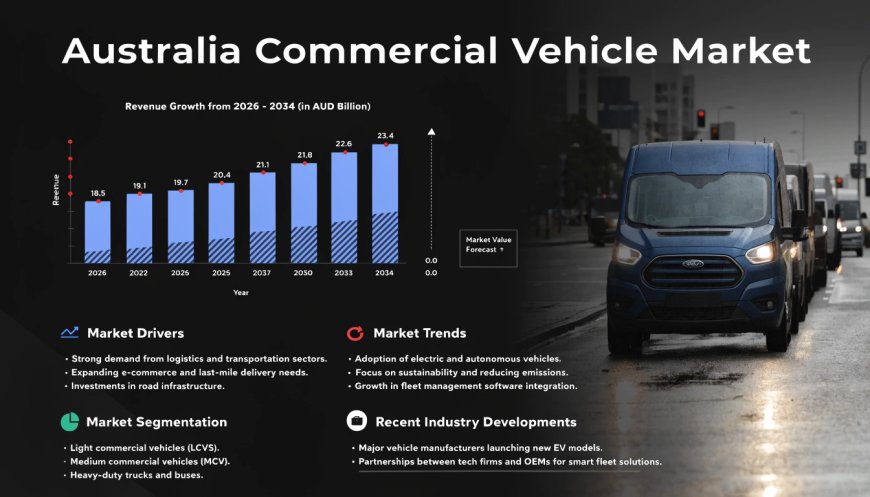
Market Overview
The Australia commercial vehicle market size reached USD 24.45 Billion in 2025 and is projected to reach USD 39.01 Billion by 2034, growing at a CAGR of 4.61% during 2026–2034. This robust growth trajectory is driven by the intersection of multiple powerful structural forces including sustained federal and state government investment in major infrastructure programs, the unrelenting expansion of Australia's mining and resource extraction sector demanding heavy-duty fleet support, and the rapid proliferation of e-commerce logistics activity requiring expanded light commercial vehicle fleets for urban and suburban last-mile delivery operations. Light commercial pick-up trucks maintain market dominance with a 42.5% share in 2025, reflecting the deep cultural and functional entrenchment of utility vehicles across Australia's construction, agriculture, trade services, and mining support sectors, while internal combustion engine powertrains retain a 69.0% share even as electrified alternatives gain meaningful commercial traction. Plug-in hybrid vehicle sales across Australia surged 130.9% year-on-year in 2025 to reach 53,484 units according to Federal Chamber of Automotive Industries data, signaling accelerating fleet operator appetite for lower-emission alternatives, supported by Linfox's landmark May 2025 order of 30 heavy-duty electric trucks from Volvo representing the largest battery-electric truck order in Australian history. The New Vehicle Efficiency Standard, government fleet electrification programs, and expanding charging infrastructure investment are collectively reshaping the competitive landscape, compelling manufacturers to accelerate investment in electric, hybrid, and alternatively fueled commercial vehicle models tailored to Australia's diverse operational environments spanning dense urban corridors, remote mining regions, and interstate freight highways.
How AI is Reshaping the Future of the Australia Commercial Vehicle Market
• AI-Powered Telematics and Real-Time Fleet Operations Management: AI fleet management platforms aggregate real-time data streams from GPS tracking systems, onboard diagnostics, engine control units, driver behavior sensors, and fuel consumption monitors across commercial vehicle fleets to generate comprehensive operational dashboards, automatically identify inefficiencies including idling time, suboptimal routing, and excessive fuel consumption, calculate driver performance scores, and generate actionable fleet management recommendations that enable Australian logistics operators, mining contractors, and delivery companies to reduce operating costs and improve asset utilization rates across diverse geographic environments.
• Predictive Maintenance and Component Failure Prevention: AI condition monitoring systems analyze vibration sensor data, oil quality indicators, brake wear measurements, coolant temperature profiles, and historical failure records from commercial vehicle fleets to predict component failures before they cause unplanned breakdowns, enabling fleet managers to schedule preventive maintenance interventions during planned downtime windows, minimize expensive emergency repairs, optimize parts inventory management, reduce vehicle off-road time, and extend asset operational lifespans across truck fleets operating in the demanding conditions of Australia's mining, construction, and long-haul transport sectors.
• Autonomous and Semi-Autonomous Driving in Mining Applications: AI perception and control systems powering autonomous and semi-autonomous heavy-duty trucks operating in Australian mining operations continuously process data from LiDAR sensors, cameras, radar systems, and GPS positioning equipment to navigate haul roads, detect obstacles including personnel and equipment, execute precise loading and dumping cycles, and maintain coordinated convoy operations under remote supervision, enabling mining companies in the Pilbara and Queensland coalfields to improve operational productivity, enhance site safety outcomes, and reduce dependence on scarce qualified heavy vehicle operator workforces in remote locations.
• AI-Optimized Route Planning and Multi-Stop Delivery Scheduling: AI logistics optimization platforms process real-time traffic data, road condition reports, delivery time window constraints, vehicle payload capacities, driver hour-of-service compliance requirements, and customer priority parameters to generate dynamically optimized delivery route sequences for light commercial vehicle fleets, enabling Australian courier companies, food distributors, and urban logistics operators to increase the number of stops completed per vehicle per day, reduce total kilometers driven per delivery, lower fuel costs, and improve customer delivery time accuracy across metropolitan and suburban service areas.
• Electric Commercial Vehicle Battery Management and Range Optimization: AI battery management systems in electric commercial vehicles continuously monitor individual cell voltage levels, temperature distribution patterns, state of charge, state of health, and thermal management system performance to optimize charge-discharge cycling strategies that maximize battery pack longevity and available energy capacity, while AI range prediction algorithms integrate real-time vehicle load, terrain gradient, weather conditions, and traffic speed data to provide accurate remaining range estimates that reduce driver range anxiety and support confident deployment of electric trucks on urban delivery and regional transport routes.
• Driver Fatigue Detection and Advanced Safety Monitoring: AI computer vision systems mounted within commercial vehicle cabins continuously analyze driver eye blink frequency, gaze direction, head position, and facial expression patterns to detect signs of fatigue, distraction, and microsleeping in real time, automatically triggering auditory and haptic alerts, notifying fleet operations centers, and initiating vehicle speed reduction or lane-keeping interventions when impairment indicators reach critical thresholds, helping Australian transport operators comply with Chain of Responsibility obligations under the Heavy Vehicle National Law and reduce the incidence of fatigue-related commercial vehicle accidents.
• Demand Forecasting and Commercial Vehicle Fleet Procurement Planning: AI demand planning platforms integrate infrastructure project pipeline data, mining expansion announcements, construction activity forecasts, e-commerce volume growth trajectories, and macroeconomic indicators to generate accurate multi-year fleet procurement demand forecasts for specific commercial vehicle categories and configurations, enabling major fleet operators, government transport agencies, and vehicle manufacturers and dealers to optimize production scheduling, inventory positioning, capital procurement timing, and service network capacity planning across Australia's geographically dispersed commercial vehicle market.
Grab a sample PDF of this report: https://www.imarcgroup.com/australia-commercial-vehicle-market/requestsample
Market Growth Factors
Australia's sustained commitment to large-scale infrastructure development is generating consistent and broad-based demand across all commercial vehicle segments. Federal and state government programs encompassing road network upgrades, rail corridors including the Inland Rail project, Western Sydney Airport construction, and urban public transport expansion are directly requiring extensive heavy-duty truck fleets, specialized utility vehicles, and light commercial workhorses. Australia's new truck and van registrations reached 51,277 units in 2024, with construction-related demand remaining the dominant driver of fleet procurement activity across New South Wales, Queensland, and Victoria.
The electrification of commercial vehicle fleets is accelerating significantly as government policy, corporate sustainability commitments, and expanding charging infrastructure lower adoption barriers. Australia's plug-in hybrid vehicle sales surged 130.9% year-on-year in 2025 to 53,484 units, while hybrid vehicles reached 199,133 units sold, demonstrating broad fleet operator appetite for cleaner alternatives. Linfox's May 2025 order of 30 heavy-duty Volvo electric trucks, the largest battery-electric truck order in Australian history, marks a decisive commercial inflection point confirming that zero-emission heavy transport is progressing from pilot programs to mainstream fleet procurement decisions.
The structural growth of Australia's e-commerce sector is fundamentally expanding last-mile delivery fleet requirements for light commercial vans and urban delivery vehicles across metropolitan and suburban distribution networks. Rising same-day delivery expectations, micro-fulfillment centre proliferation, and major retailer fleet investment programs are sustaining demand for maneuverable, fuel-efficient commercial vehicles optimized for high-stop urban routing. Australia's mining sector, generating iron ore, lithium, and copper shipments for global markets, simultaneously reinforces long-term heavy-duty truck demand across Western Australia, Queensland, and Northern Territory resource operations requiring reliable, high-payload fleet solutions.
Market Segmentation
By Vehicle Body Type:
• Buses
• Heavy-Duty Commercial Trucks
• Light Commercial Pick-Up Trucks
• Light Commercial Vans
By Propulsion Type:
• Hybrid and Electric Vehicles
• BEV
• FCEV
• HEV
• PHEV
• ICE
• CNG
• Diesel
• Gasoline
• LPG
By Region:
• Australia Capital Territory & New South Wales
• Victoria & Tasmania
• Queensland
• Northern Territory & Southern Australia
• Western Australia
Key Players
• Toyota Australia (HiLux / LandCruiser)
• Ford Australia (Ranger / Transit)
• Isuzu Trucks Australia
• Volvo Group Australia
• Mercedes-Benz Trucks (Daimler Australia)
• Kenworth Trucks Australia (PACCAR)
• Hino Motors Australia
• Mitsubishi Fuso Truck and Bus (MFTBC)
• Linfox Logistics (Fleet Operator)
• Toll Group (Fleet Operator)
Recent Development & News
May 2025: Linfox, one of Australia's largest privately owned logistics and transport companies, confirmed receipt of an order for 30 Volvo FH Electric heavy-duty battery-electric trucks, representing the largest single battery-electric truck order placed by an Australian fleet operator in the country's transport history and marking a decisive commercial milestone in the electrification of Australia's long-haul freight sector. The 30 Volvo FH Electric trucks are rated at 490 kW and equipped with up to 540 kWh of battery capacity, enabling an operational range of approximately 300 kilometres per charge suitable for metropolitan freight corridors and medium-range regional distribution routes where depot-based overnight charging infrastructure is available. Linfox confirmed the electric truck deployment will initially cover freight operations across the Melbourne to Geelong and Sydney metro corridors, with the vehicles integrated into the company's AI-powered fleet management system for real-time energy monitoring, route optimization, and predictive maintenance scheduling. The order is supported by a comprehensive 10-year battery and powertrain service agreement with Volvo Trucks Australia and reflects Linfox's corporate commitment to achieving net-zero emissions across its Australian transport fleet by 2035.
August 2025: Ford Australia announced a AUD 150 million investment to accelerate the introduction of its next-generation Ranger platform, including the launch of the Ranger PHEV plug-in hybrid variant and the Ranger BEV fully electric configuration targeting Australian commercial fleet operators, tradesperson segments, and mining services contractors seeking lower-emission alternatives without sacrificing the towing, payload, and all-terrain capability demanded by Australian working conditions. The Ranger PHEV offers an all-electric urban range of approximately 45 kilometres combined with a total range exceeding 800 kilometres when the internal combustion engine engages, addressing the range anxiety concerns that have historically slowed light commercial vehicle electrification adoption among operators working across both metropolitan and regional areas. Ford Australia confirmed pre-orders for the Ranger PHEV exceeded 4,200 units within the first six weeks of order opening, with commercial fleet operators and government fleet managers accounting for approximately 68% of initial orders, reflecting strong institutional demand for electrified utility vehicles meeting the performance and safety requirements of Australian workplace health and safety obligations. The investment supports Ford's broader commitment to offer electrified variants across its entire commercial vehicle lineup by 2030 in the Australian market.
November 2025: Isuzu Trucks Australia announced a AUD 45 million expansion of its Dandenong assembly and distribution facility in Victoria, increasing annual light-to-medium duty truck processing capacity from 8,500 units to 12,000 units per year to meet projected demand growth from construction, e-commerce logistics, food and beverage distribution, and municipal services fleet segments across southeastern Australia. The expansion includes installation of a new digital pre-delivery inspection system using AI-powered quality control cameras capable of automatically detecting 240 defined defect types across truck cab, chassis, and body configurations, reducing pre-delivery preparation time by an average of 35% per unit and improving first-pass inspection quality rates to above 98%. Isuzu Australia also confirmed the formal launch of its N-Series EV electric truck range in the Australian market, with 150 pre-orders secured from fleet operators including supermarket distribution fleets, waste management contractors, and local government utility operators, supported by a national charging infrastructure partnership with Chargefox providing priority access to its commercial charging network at over 300 locations. The Dandenong facility expansion creates approximately 120 new permanent positions including technicians, quality assurance specialists, and logistics coordinators, strengthening Isuzu's operational capacity to support Australia's fastest-growing commercial vehicle segments throughout the forecast period.
Customization Note
If you require any specific information that is not currently covered within the scope of the report, we will provide the same as a part of the customization.
Request Customization: https://www.imarcgroup.com/request?type=report&id=34527&flag=E
About Us
IMARC Group is a global management consulting firm that helps the world's most ambitious changemakers create a lasting impact. The company provides a comprehensive suite of market entry and expansion services. IMARC offerings include market assessment, feasibility studies, company incorporation assistance, factory setup support, regulatory approvals and licensing navigation, branding, marketing and sales strategies, competitive landscape and benchmarking analyses, pricing and cost research, and procurement research.
Contact Us
IMARC Group
134 N 4th St. Brooklyn, NY 11249, USA
Email: sales@imarcgroup.com
Tel No: (D) +91 120 433 0800
United States: +1-201-971-6302
What's Your Reaction?