































Australia Bioreactors Market to Reach USD 413.31 Million by 2034
Australia bioreactors market to Grow at a CAGR of 9.96% from 2026 to 2034 as Artificial Intelligence and Digital Twins Revolutionize Biopharmaceutical Production

Market Overview
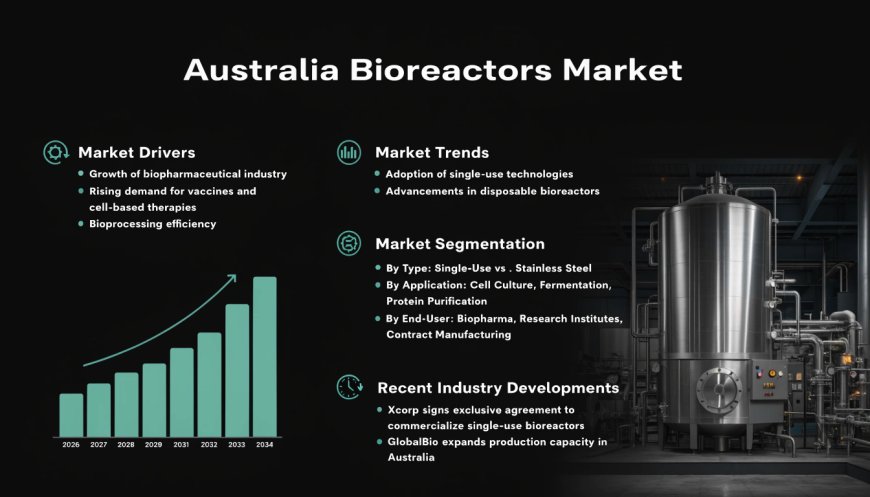
The Australia bioreactors market size reached USD 175.93 Million in 2025, according to the latest report from IMARC Group. The market is projected to reach USD 413.31 Million by 2034, exhibiting a growth rate (CAGR) of 9.96% during 2026-2034.
Market growth is driven by the growing adoption of single-use bioreactor systems for enhanced operational efficiency, government investment in biopharmaceutical manufacturing infrastructure and sovereign capability building, and expansion of cell and gene therapy manufacturing capabilities driving specialized bioreactor demand. These factors are collectively propelling the Australia bioreactors market share as the nation positions itself as a key biomanufacturing hub in the Asia-Pacific region.
Request Sample Report (Including Graphs, Charts & Figures):
https://www.imarcgroup.com/australia-bioreactors-market/requestsample
How AI is Reshaping the Future of the Australia Bioreactors Market
The integration of artificial intelligence and digital twin technology into Australia‘s biopharmaceutical manufacturing sector is fundamentally transforming how bioreactors are operated, monitored, and optimized.
AI-Powered Process Optimization and Digital Twins – Through predictive modeling, real-time process optimization, and digital twin simulations that allow exact control of crucial factors like temperature, pH, oxygen levels, and nutrient distribution, artificial intelligence and machine learning are revolutionizing the development of bioprocesses. Manufacturers may use sophisticated process control techniques, lower batch variability, reduce contamination concerns, and expedite the transition from laboratory to commercial production with AI-driven solutions. Leading biopharmaceutical companies are deploying AI platforms for continuous monitoring of mammalian cell culture bioreactors to boost yields and enhance operational efficiency across global manufacturing sites.
AI-Enabled Tissue Culture Platforms – In February 2025, the Australian Government awarded $1,042,872 to Gelomics Pty Ltd to commercialize the LunaX 3D Tissue Culture System, an AI-powered platform that accelerates drug discovery by generating living human microtissues. The grant funding will help establish advanced biotech manufacturing and position Australia as a global leader in non-animal testing technology.
Automated Cell Therapy Manufacturing – In March 2025, Xcell Biosciences and Royal Perth Hospital announced a collaboration to develop an automated, clinical-scale manufacturing workflow for tumor-infiltrating lymphocyte (TIL) therapies using the AVATAR Foundry system, which produces cell therapies under cGMP protocols in a fully automated capacity.
AI in Bioprocess Research – The Australian Centre for Artificial Intelligence in Medical Innovation (ACAMI) and La Trobe‘s NVIDIA DGX H200 supercomputer, the first in Australia‘s tertiary sector, are enabling advanced AI-driven research in bioprocess optimization and drug discovery.
Australia Bioreactors Market Trends
Growing Adoption of Single-Use Bioreactor Systems for Enhanced Operational Efficiency – Single-use bioreactor systems are experiencing rapid adoption across Australia‘s biopharmaceutical manufacturing sector due to their compelling operational and economic advantages. By eliminating the need for lengthy cleaning and sterilizing processes between manufacturing batches, these disposable solutions greatly shorten turnaround times and reduce the possibility of cross-contamination. The capital investment requirements for single-use systems are approximately 40 percent lower compared to traditional stainless-steel bioreactors, making them particularly attractive for contract manufacturing organizations and emerging biotechnology companies with limited infrastructure budgets. Energy and water consumption are reduced by 45-50 percent, aligning with sustainability objectives while delivering measurable cost savings. Single-use bioreactors captured approximately 80 percent of the stirred tank bioreactor segment in 2024.
Expansion of Cell and Gene Therapy Manufacturing Capabilities – Australia is becoming more involved in cell and gene therapy research, necessitating sophisticated bioreactor systems to facilitate stem cell cultures, viral vector production, and precision biologics. As clinical pipelines advance, the need for scalable and compliant bioreactor solutions increases across therapeutic areas. In October 2025, AusBiotech and Medicines Australia launched the Advanced Therapies Advisory Group to support national coordination for Australia‘s growing advanced therapies sector, building on the two-year Cell and Gene Catalyst initiative.
Government Investment in Biopharmaceutical Manufacturing Infrastructure – The Federal Government has announced the Solutions for Manufacturing Advanced Regenerative Therapies (SMART) Cooperative Research Centre (CRC), which will help Australian companies bring a 10-year pipeline of life-changing therapies to market, creating an estimated $4.5 billion in economic value and 1,500 skilled jobs. The NSW Government has opened a $96 million RNA Research and Manufacturing Facility, the only site in Australia capable of producing a wide range of RNA therapeutics under one roof, with an additional $119 million planned over 10 years for RNA R&D projects.
Growing Bioprocessing Research and Academia – Academic institutions, research centers and biotech startups are investing in bioreactor platforms to accelerate translational research, optimize fermentation processes and support early-stage development. Training the next generation of bioprocess engineers and scientists further expands demand for laboratory-scale and mid-sized bioreactor systems.
Australia Bioreactors Market Summary
- Market Valuation: The market reached USD 175.93 Million in 2025 and is projected to reach USD 413.31 Million by 2034, registering a CAGR of 9.96% during 2026-2034.
- Key Segments: The market is segmented by Type (Single-use, Multi-use), Usage (Lab-scale Production, Pilot-scale Production, Full-scale Production), Scale (5L-20L, 20L-200L, 200L-1500L, Above 1500L), and Control Type (Manual, Automated).
- Product Diversity: The market includes stirred-tank bioreactors, rocking motion bioreactors, fixed-bed and hollow-fibre bioreactors, airlift and bubble column systems, and single-use bioreactor platforms.
- Applications: Biopharmaceutical production, vaccine manufacturing, cell culture and tissue engineering, microbial fermentation, research and development, and industrial biotechnology.
- End Users: Pharmaceutical and biotech companies, research institutions and universities, contract development and manufacturing organizations (CDMOs), healthcare and diagnostic facilities, and industrial biotechnology firms.
- Regional Demand: New South Wales, Victoria, Queensland, Western Australia, and other regions drive demand, with strong biotechnological hubs across the country.
Australia Bioreactors Market Growth Drivers
Expansion of Cell and Gene Therapy Manufacturing – Australia‘s growing involvement in cell and gene therapy research is driving demand for specialized bioreactor systems. The Advanced Therapies Advisory Group, established in October 2025 by AusBiotech and Medicines Australia, is supporting national coordination for the sector. The SMART CRC, hosted by UQ, brings together 63 partners including Queensland and South Australian governments, regenerative therapy companies, healthcare providers, universities, and research institutes. The CRC will directly target manufacturing bottlenecks, harnessing scientific and technological expertise to ensure next-generation treatments can be scaled up effectively for clinical use.
Government Investment in Sovereign Biomanufacturing Capability – The Australian Government‘s commitment to domestic biopharmaceutical manufacturing is a fundamental growth driver. The $96 million RNA Research and Manufacturing Facility at Macquarie University Innovation Precinct is now operational, positioning NSW as a global leader in RNA therapeutics. The facility is the only site in Australia capable of producing a wide range of RNA therapeutics under one roof, with applications ranging from vaccines to treatments for cancers and rare genetic diseases. The NSW Government plans to provide an additional $119 million over 10 years in support of RNA R&D projects.
Rising Demand for Biologics and Biosimilars – The global movement towards biologics—comprising monoclonal antibodies, therapeutic proteins, and vaccines—is evident in Australia‘s research and production environment. Bioreactors are essential for the large-scale manufacturing of these intricate biologics, allowing for accurate regulation of culture parameters, improved yield, and uniform quality. Public policy support for innovation, life sciences research grants and infrastructure funding help strengthen Australia‘s biotechnology capabilities, enabling broader adoption of advanced bioreactor technologies for commercial and academic applications.
Single-Use Bioreactor Adoption by CDMOs – Single-use bioreactor systems are particularly favored by contract development and manufacturing organizations due to operational flexibility and reduced turnaround times between batches. The ability to rapidly switch between different cell lines and production processes without extensive cleaning validation makes single-use systems ideal for CDMOs serving multiple clients. The capital investment reduction of approximately 40 percent compared to stainless-steel systems makes them attractive for emerging biotechnology companies with limited infrastructure budgets.
Australia Bioreactors Market Segments
Breakup by Type
- Single-use Bioreactors
- Multi-use Bioreactors
Breakup by Usage
- Lab-scale Production
- Pilot-scale Production
- Full-scale Production
Breakup by Scale
- 5L-20L
- 20L-200L
- 200L-1500L
- Above 1500L
Breakup by Control Type
- Manual
- Automated
Breakup by Region
- New South Wales
- Victoria
- Queensland
- Western Australia
- Others
Competitive Landscape of the Australia Bioreactors Market
The competitive landscape of the Australia bioreactors market features a dynamic mix of global bioprocessing equipment manufacturers, specialized automation providers, contract development and manufacturing organizations, and emerging precision fermentation startups.
Major global players operating in the Australia bioreactors market include Sartorius, Thermo Fisher Scientific, Merck KGaA, Danaher, and Eppendorf. These companies provide glass, stainless steel, and single-use bioreactor platforms equipped with integrated control systems, process analytical technology, and support services for research organizations, contract development and manufacturing organizations, and food biotechnology companies.
Key suppliers and integrators include Uma Pharmatech Machinery, Scientex, and Solida Biotech, focusing on Australia due to its strong biotechnological hubs, reliable regulatory environment, and the necessity for modular, validated systems. Their value propositions emphasize customizable vessel designs, on-site technical assistance, and the capability to transition from laboratory to pilot to industrial scale with minimal delays.
Emerging Australian biomanufacturing companies include Cauldron Ferm, which has raised $13.25M in Series A2 funding for its continuous “hyper-fermentation” technology, recognized on Fast Company‘s list of the Most Innovative Asia-Pacific Companies of 2026 for lowering the costs of industrial-scale biomanufacturing. Cauldron is the only business approved to manufacture precision-fermented protein ingredients at the 10,000-litre scale in Australia.
Cell and gene therapy manufacturing includes Xcell Biosciences Australia, collaborating with Royal Perth Hospital on automated TIL manufacturing workflows using the AVATAR Foundry system.
CDMOs and research facilities include the UTS Biologics Innovation Facility (BIF) , which has expanded operational capacity with additional monitored process gas lines to support aseptic upstream processing and bioreactor operations up to 200L, including seed train development.
Competition is centered on automation capabilities, AI integration, single-use technology innovation, regulatory compliance with TGA GMP standards, and the ability to support scale-up from laboratory to commercial production. The growing adoption of AI-driven bioprocessing solutions is becoming an increasingly important differentiator as Australian manufacturers seek to improve yields, reduce batch variability, and accelerate time-to-market.
Latest Recent News & Development in the Australia Bioreactors Market
April 2026: The NSW Government announced an additional $119 million over 10 years in support of RNA R&D projects at the $96 million RNA Research and Manufacturing Facility, along with the $17.6 million NSW RNA Research and Training Network and the $6 million RNA Pipeline Grants Program.
April 2026: The federal government announced five innovation initiatives will share $6.9 million in funding under the Industry Growth Program, including Seascape Restorations Australia receiving $750,000 to build a patented photobioreactor system for cultivating native seaweed that can reduce methane gas.
March 2026: Cauldron Ferm raised $13.25M in Series A2 funding for its continuous “hyper-fermentation” platform, led by Main Sequence Ventures with participation from Horizons Ventures, SOSV, and NGS Super. The startup was named on Fast Company‘s list of the Most Innovative Asia-Pacific Companies of 2026.
February 2026: The UTS Biologics Innovation Facility (BIF) expanded operational capacity with additional monitored process gas lines in PC2 cleanroom suites, supporting existing aseptic upstream processing and bioreactor operations up to 200L.
February 2025: The Australian Government awarded $1,042,872 to Gelomics Pty Ltd to commercialize the LunaX 3D Tissue Culture System, an AI-powered platform that generates living human microtissues for drug discovery.
October 2025: AusBiotech and Medicines Australia launched the Advanced Therapies Advisory Group to support national coordination for Australia‘s growing advanced therapies sector, building on the two-year Cell and Gene Catalyst initiative.
March 2025: Xcell Biosciences and Royal Perth Hospital announced a collaboration to develop an automated, clinical-scale manufacturing workflow for TIL therapies using the AVATAR Foundry system.
Browse Full Report with TOC & List of Figures:
https://www.imarcgroup.com/australia-bioreactors-market
About Us
IMARC Group is a leading market research company that offers management strategy and market research worldwide. We partner with clients in all sectors and regions to identify their highest-value opportunities, address their most critical challenges, and transform their businesses.
IMARC‘s information products include major market, scientific, economic and technological developments for business leaders in pharmaceutical, industrial, and high technology organizations. Market forecasts and industry analysis for bioprocessing, biotechnology, medical devices, and novel processing methods are at the top of the company’s expertise.
Contact Us
IMARC Group
134 N 4th St., Brooklyn, NY 11249, USA
Email: sales@imarcgroup.com
Tel No: (D) +91 120 433 0800
United States: +1-631-791-1145
What's Your Reaction?