































Australia Battery Management System Market 2026 | Worth USD 1,339.9 Million by 2034
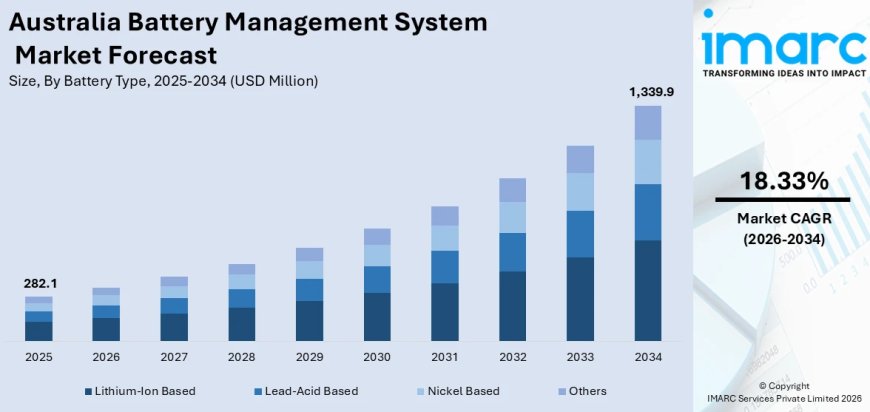
Australia battery management system market reached USD 282.1 Million in 2025. Looking forward, IMARC Group expects the market to reach USD 1,339.9 Million by 2034, exhibiting a growth rate (CAGR) of 18.33% during 2026-2034.

Australia Battery Management System Market Overview
The Australia battery management system (BMS) market is experiencing exceptional growth, driven by the nation's accelerating renewable energy transition, rapid electrification of transport fleets, and the proliferation of grid-scale and behind-the-meter battery energy storage systems. According to the latest report by IMARC Group, titled "Australia Battery Management System Market: Industry Trends, Share, Size, Growth, Opportunity and Forecast 2026-2034," the Australia battery management system market reached USD 282.1 Million in 2025. Looking forward, IMARC Group expects the market to reach USD 1,339.9 Million by 2034, exhibiting a growth rate (CAGR) of 18.33% during 2026-2034.
Australia's battery management system industry encompasses a range of technologies designed to monitor, protect, and optimize battery performance across multiple applications. BMS solutions manage critical parameters including state of charge (SOC), state of health (SOH), voltage balancing, temperature regulation, and current distribution to ensure battery packs operate safely and efficiently throughout their lifecycle. The market spans lithium-ion based, lead-acid based, nickel based, and other battery chemistries, with lithium-ion systems dominating due to their superior energy density and declining costs. BMS architectures include centralized, distributed, and modular topologies, deployed across motive batteries powering electric vehicles and stationary batteries supporting grid storage and renewable energy integration.
The Australian BMS market is being propelled by several powerful converging factors. Australia boasts the world's leading pipeline of announced battery energy storage system (BESS) projects, exceeding a staggering 40 gigawatts (GW), reflecting the nation's commitment to building renewable-dominated electricity grids that require advanced storage infrastructure. The progressive electrification of public transport fleets — particularly urban bus networks — and the accelerating adoption of electric passenger vehicles are creating substantial demand for automotive-grade BMS solutions. Behind-the-meter residential and commercial battery installations continue to proliferate as households and businesses pair solar PV systems with battery storage to maximize energy independence and reduce electricity costs. The rising demand for long-duration grid storage is further catalyzing investment in sophisticated BMS platforms capable of managing multi-hour discharge cycles across large-scale installations.
Request a Business Sample Report for Procurement & Investment Evaluation:
https://www.imarcgroup.com/australia-battery-management-system-market/requestsample
How AI is Reshaping the Future of the Australia Battery Management System Market
Artificial intelligence is fundamentally transforming battery management systems in Australia, enabling a transition from rule-based monitoring to intelligent, predictive platforms that optimize battery performance, extend operational life, and enhance safety. AI-powered BMS solutions are drawing increasing interest from Australian utilities and investors, with AI-driven predictive maintenance delivering approximately 50% cost savings compared to traditional approaches.
• Deep Learning for State of Charge Estimation: Advanced deep learning architectures — including Long Short-Term Memory (LSTM) networks, Convolutional Neural Networks (CNN), and Gated Recurrent Units (GRU) — are revolutionizing SOC estimation accuracy in BMS platforms. Hybrid frameworks combining Extended Kalman Filters with LSTM optimized through particle swarm optimization achieve exceptional accuracy and robustness, enabling Australian EV operators and grid storage managers to maximize usable battery capacity while maintaining safety margins.
• AI-Powered Predictive Maintenance and RUL Prediction: Machine learning algorithms are enabling BMS platforms to predict remaining useful life (RUL) and identify degradation patterns in battery cells before failures occur. For Australian businesses operating BESS installations, AI-driven predictive maintenance translates to smarter dispatch scheduling, reduced unplanned downtime, and approximately 50% savings on maintenance costs compared to traditional time-based maintenance approaches.
• Intelligent Thermal Management: AI algorithms are optimizing battery thermal management by predicting heat generation patterns across cells and dynamically adjusting cooling strategies. This capability is critical for Australia's climate conditions, where extreme temperatures in regions such as Western Australia and Queensland can significantly impact battery performance and lifespan. Machine learning models continuously analyze temperature sensor data to maintain optimal thermal conditions across battery packs.
• Digital Twin Integration for Battery Optimization: AI-powered digital twin technologies are creating virtual replicas of battery systems that enable real-time lifecycle optimization and cloud-edge integration. These digital twins simulate battery aging, predict capacity fade trajectories, and optimize charging strategies based on usage patterns — helping Australian grid operators and fleet managers make data-driven decisions about battery deployment, replacement scheduling, and second-life applications.
• Smart Grid Integration and Energy Dispatch: AI-enhanced BMS platforms are enabling smarter energy dispatch from BESS installations by analyzing grid demand forecasts, electricity pricing signals, and renewable generation patterns. For Australian utilities managing the integration of intermittent solar and wind generation, AI-driven BMS solutions optimize charge-discharge cycles to maximize revenue from energy arbitrage while supporting grid stability through frequency regulation and peak demand management services.
Australia Battery Management System Market Trends
Massive Grid-Scale BESS Pipeline Driving BMS Demand
Australia's position as the world leader in announced battery energy storage system projects — with a pipeline exceeding 40 GW — is a defining trend driving unprecedented demand for advanced battery management systems. The nation's transition toward a renewable energy-dominated electricity grid necessitates large-scale storage infrastructure capable of balancing intermittent solar and wind generation with baseload demand. Long-duration storage projects are particularly prominent, with Energy Vault and Enervest's 125 MW/1.0 GWh Stoney Creek BESS in New South Wales featuring 8-hour duration storage that requires sophisticated BMS platforms capable of managing extended discharge cycles, cell balancing across thousands of battery units, and thermal optimization throughout prolonged operations. Global BESS demand jumped 315 GWh in 2026, with Australia representing a significant share of this expansion. The stationary battery segment is directly benefiting from this infrastructure buildout, as each GWh-scale installation requires dedicated BMS hardware and software to ensure safe, efficient, and commercially optimized operation.
Electric Vehicle Adoption Accelerating Automotive BMS Growth
The progressive electrification of Australia's transport sector is creating substantial growth in the automotive BMS segment. The expanding adoption of electric passenger vehicles, e-bikes, and golf carts is driving demand for automotive-grade BMS solutions that manage lithium-ion battery packs with precision state-of-charge estimation, cell balancing, and safety protection functions. The electrification of public transport — particularly urban bus networks — is a significant catalyst, as state and territory governments commit to zero-emission bus fleet transitions aligned with national carbon reduction targets. Custom Denning, an Australian electric bus manufacturer, and Forsee Power, a battery systems provider, are actively contributing to this transition with BMS-integrated battery solutions designed for Australian transit operations. The growing installed base of EVs is also creating secondary demand for BMS-equipped second-life battery applications, where repurposed EV batteries — equipped with advanced management systems — are being deployed for behind-the-meter energy storage, as demonstrated by a carmaker using repurposed EV batteries to help power its factory in Australia.
Australia Battery Management System Market Summary
• Market Size (2025): USD 282.1 Million
• Market Forecast (2034): USD 1,339.9 Million
• Growth Rate (CAGR 2026-2034): 18.33%
• Key Segments: By Battery Type (Lithium-Ion Based, Lead-Acid Based, Nickel Based, Others), By Type (Motive Battery, Stationary Battery), By Topology (Centralized, Distributed, Modular), By Application (Automotive — Electric Vehicles, E-Bikes, Golf Carts — Military and Defense, Healthcare, Consumer Electronics, Telecommunications, Renewable Energy Systems, Others)
• Key Regions: Australia Capital Territory & New South Wales, Victoria & Tasmania, Queensland, Northern Territory & Southern Australia, Western Australia
Australia Battery Management System Market Growth Drivers
Renewable Energy Integration and Long-Duration Storage Demand
Australia's ambitious renewable energy targets and the transition to a renewable-dominated electricity grid are creating massive demand for battery energy storage systems and the sophisticated BMS platforms that manage them. The rising demand for long-duration grid storage — systems capable of 4-hour, 8-hour, and even longer discharge durations — requires BMS solutions with advanced capabilities including precise cell-level monitoring across thousands of battery units, sophisticated thermal management algorithms, and intelligent state-of-health tracking that ensures reliable performance over 15-20 year project lifetimes. The growing penetration of rooftop solar PV across Australian households — among the highest per-capita adoption rates globally — is complementing grid-scale storage with behind-the-meter residential battery installations, each requiring BMS hardware. This dual growth in utility-scale and distributed storage creates a broad-based demand foundation that sustains BMS market expansion across centralized, distributed, and modular topology segments.
Military, Healthcare, and Telecommunications Sector Requirements
Beyond automotive and renewable energy, the military and defense, healthcare, and telecommunications sectors are emerging as important growth drivers for the Australian BMS market. Military applications demand ruggedized BMS solutions capable of operating in extreme conditions while managing specialized battery packs for portable equipment, unmanned systems, and field power systems. Australia's defense modernization programs and increasing investment in advanced military technologies are creating procurement opportunities for high-reliability BMS platforms. In healthcare, the growing adoption of battery-powered medical devices, hospital backup power systems, and portable diagnostic equipment requires BMS solutions that meet stringent safety and reliability standards. The telecommunications sector drives demand for BMS-managed battery backup systems that ensure uninterrupted service at cell towers and data centers, with the expansion of 5G infrastructure across Australia creating additional deployment points requiring reliable battery management.
Australia Battery Management System Market Segments
The Australia battery management system market can be segmented across multiple dimensions. By battery type, the market includes lithium-ion based, lead-acid based, nickel based, and others, with lithium-ion systems dominating due to superior energy density and declining costs. By type, the market divides into motive battery (powering vehicles and equipment) and stationary battery (grid storage and backup power) segments. By topology, the market encompasses centralized, distributed, and modular architectures. By application, the market serves automotive (electric vehicles, e-bikes, golf carts), military and defense, healthcare, consumer electronics, telecommunications, renewable energy systems, and other sectors. By region, the market spans Australia Capital Territory & New South Wales, Victoria & Tasmania, Queensland, Northern Territory & Southern Australia, and Western Australia.
Breakup by Battery Type:
• Lithium-Ion Based
• Lead-Acid Based
• Nickel Based
• Others
Breakup by Type:
• Motive Battery
• Stationary Battery
Breakup by Topology:
• Centralized
• Distributed
• Modular
Breakup by Application:
• Automotive (Electric Vehicles, E-Bikes, Golf Carts)
• Military and Defense
• Healthcare
• Consumer Electronics
• Telecommunications
• Renewable Energy Systems
• Others
Breakup by Region:
• Australia Capital Territory & New South Wales
• Victoria & Tasmania
• Queensland
• Northern Territory & Southern Australia
• Western Australia
Australia Battery Management System Market Competitive Landscape
The competitive landscape of the Australia battery management system market features a combination of global energy technology companies and specialized domestic providers. Key players in the market include Energy Vault, Enervest, Custom Denning, Forsee Power, Wartsila, Octopus Australia, and ACEN Australia. Energy Vault is establishing a significant presence through major BESS projects incorporating advanced BMS platforms, with its partnership with Enervest on the 125 MW/1.0 GWh Stoney Creek project demonstrating capability in long-duration storage management. Wartsila is contributing through its GEMS Power Plant Controller and DC-coupled battery systems deployed in hybrid renewable projects such as Octopus Australia's Fulham facility. Custom Denning and Forsee Power are driving the automotive BMS segment through electric bus manufacturing and battery systems for public transport electrification. ACEN Australia represents the growing participation of renewable energy developers who specify and procure BMS-integrated storage solutions for their generation portfolios.
Australia Battery Management System Market Latest News and Development
• December 2025: A major carmaker announced the use of repurposed electric vehicle batteries — equipped with advanced BMS technology — to help power its factory in Australia, demonstrating the growing viability of second-life battery applications with integrated management systems.
• April 2025: Wartsila began delivering a 64 MW/128 MWh DC-coupled battery system for Octopus Australia's Fulham Hybrid project, integrated with the GEMS Power Plant Controller featuring advanced BMS capabilities for optimized renewable energy integration and grid support services.
• March 2025: Energy Vault and Enervest entered into a 14-year Long-Term Energy Service Agreement for the Stoney Creek BESS project in New South Wales, featuring a 125 MW/1.0 GWh, 8-hour duration storage system integrating advanced BMS technology for long-duration grid storage management.
• 2026: Global BESS demand jumped 315 GWh, with Australia representing a significant share of this expansion. The nation maintained its position as the world leader in announced BESS projects, with a pipeline exceeding 40 GW, driving unprecedented demand for sophisticated BMS platforms.
• 2025-2026: AI-powered BMS solutions gained rapid traction in Australia, with deep learning-based SOC and SOH estimation, predictive maintenance delivering approximately 50% cost savings, and digital twin integration for lifecycle optimization becoming standard capabilities across grid-scale and commercial BESS installations.
Note: If you require any specific information not currently covered within the scope of the report, IMARC Group will provide it as part of customization.
Speak to an analyst:
https://www.imarcgroup.com/request?type=report&id=34013&flag=E
What's Your Reaction?