
































Australia Artificial Intelligence Market Size, Share, Report 2026-2034
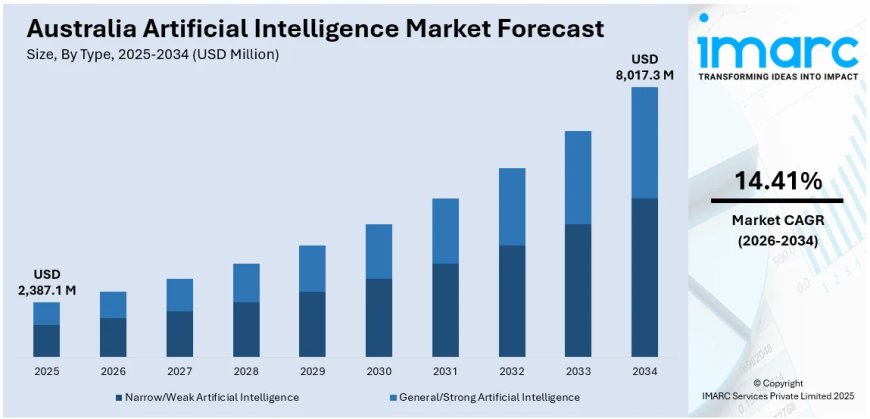
Australia artificial intelligence market size reached USD 2,387.1 Million in 2025. Looking forward, IMARC Group expects the market to reach USD 8,017.3 Million by 2034, exhibiting a growth rate (CAGR) of 14.41% during 2025-2034.

Australia Artificial Intelligence Market Overview
The Australia artificial intelligence market stands at the forefront of the nation's digital transformation, fueled by unprecedented levels of government investment, massive hyperscale data center deployments, and the rapid adoption of AI-powered solutions across healthcare, finance, mining, agriculture, and public services. According to IMARC Group, the Australia artificial intelligence market size reached USD 2,387.1 Million in 2025. Looking forward, IMARC Group expects the market to reach USD 8,017.3 Million by 2034, exhibiting a growth rate (CAGR) of 14.41% during 2025-2034.
Australia's AI landscape was fundamentally reshaped in late 2025 with the release of the National AI Plan on December 2, 2025, which set out the government's ambition to position Australia as a global leader in responsible, inclusive, and innovative AI development and adoption. The plan is anchored in three strategic goals: capturing the opportunity through smart infrastructure and domestic AI capability; spreading the benefits through scaled adoption, workforce training, and improved public services; and managing risks through responsible governance frameworks. The government backed this vision with concrete initiatives, including the launch of GovAI as a centralized AI hosting service for public agencies, the establishment of an AI Safety Institute with AUD 29.9 million in funding to launch in early 2026, and the announcement of an AI Accelerator funding round through the Cooperative Research Centres program.
The private sector has responded with extraordinary investment commitments. Microsoft announced a landmark AUD 25 billion (USD 18 billion) investment in Australia's digital infrastructure spanning AI, cybersecurity, and workforce upskilling. Amazon Web Services pledged AUD 20 billion, and OpenAI committed AUD 7 billion for AI-focused data center capacity. These investments, collectively exceeding AUD 50 billion, are establishing Australia as a major Asia-Pacific hub for AI computing infrastructure and creating a robust foundation for the domestic AI ecosystem. The Australian Government further released its Expectations for Data Centres and AI Infrastructure Developers in March 2026, setting national priorities around clean energy transition, sustainable water use, workforce skills investment, and strengthening local research capabilities.
Read more about Australia Artificial Intelligence Market
https://www.imarcgroup.com/australia-artificial-intelligence-market
How AI is Reshaping the Future of the Australia Artificial Intelligence Market
Artificial intelligence is not merely a technology being adopted in Australia; it is the defining force reshaping the nation's economic structure, competitive positioning, and public service delivery. The convergence of generative AI breakthroughs, sovereign AI infrastructure investment, and cross-industry adoption is creating a self-reinforcing growth cycle that is accelerating the market's expansion trajectory.
• Generative AI Transforming Enterprise Operations: Generative AI is driving a paradigm shift across Australian enterprises, with organizations deploying large language models and foundation models for content generation, code development, customer service automation, and strategic decision support. An estimated 91% of Australian and New Zealand retail businesses are investing in generative AI, while 77% of ANZ retailers believe AI agents will be essential for competition within a year. The economic impact is projected at AUD 45-115 billion annually by 2030, making generative AI the single most significant technology investment priority for Australian businesses across virtually every sector.
• Sovereign AI Infrastructure and GovAI Platform: The Australian Government's launch of GovAI as a centralized, sovereign AI hosting service represents a landmark in public sector AI adoption. This secure, Australian-based platform enables government agencies to develop customized AI solutions at low cost while maintaining data sovereignty and security compliance. The initiative is expected to accelerate AI adoption across federal, state, and local government services, driving efficiencies in areas ranging from citizen service delivery and regulatory compliance to defense intelligence analysis and public health surveillance.
• AI-Powered Mining and Resource Optimization: Australia's mining and resources sector, the backbone of the national economy, is undergoing an AI-driven transformation. Machine learning algorithms are being deployed for autonomous haul truck operations, predictive maintenance of heavy equipment, ore grade optimization, and environmental monitoring across remote mine sites. Computer vision systems are improving worker safety by detecting hazards in real time, while AI-powered geological modeling is accelerating resource discovery and reducing exploration costs. These applications are particularly impactful in Australia given the sector's scale, remote operating conditions, and the nation's position as a global leader in mining technology innovation.
• AI in Healthcare and Medical Research: Australian healthcare institutions are at the forefront of clinical AI adoption, deploying machine learning for medical imaging diagnostics, drug discovery acceleration, genomic analysis, and patient outcome prediction. AI-powered diagnostic tools are being integrated into radiology workflows, enabling faster and more accurate detection of cancers, cardiovascular conditions, and neurological disorders. The Therapeutic Goods Administration (TGA) is developing regulatory frameworks for AI-enabled medical devices, creating clarity that is encouraging further investment and deployment of clinical AI applications across the Australian healthcare system.
• AI Safety and Responsible Governance: Australia is establishing itself as a leader in responsible AI governance through the AI Safety Institute, funded with AUD 29.9 million and launched in early 2026. Rather than pursuing prescriptive EU AI Act-style legislation, Australia is taking a principles-based approach, relying on existing technology-neutral legal frameworks supplemented by sector-specific guidance. From December 10, 2026, the Privacy Act will require regulated entities to disclose substantially automated decisions affecting individuals' rights, establishing one of the region's first concrete AI transparency obligations and setting the stage for further responsible AI governance measures.
Request a Business Sample Report for Procurement & Investment Evaluation:
https://www.imarcgroup.com/australia-artificial-intelligence-market/requestsample
Australia Artificial Intelligence Market Trends
Hyperscale Data Center Buildout Enabling AI Compute at Scale
Australia is experiencing an unprecedented wave of hyperscale data center construction, with combined investment commitments exceeding AUD 50 billion from global technology leaders. Microsoft's AUD 25 billion investment, Amazon Web Services' AUD 20 billion commitment, and OpenAI's AUD 7 billion pledge are collectively establishing Australia as a major Asia-Pacific AI computing hub. These data centers are purpose-built to support AI workloads, incorporating high-bandwidth memory architectures, advanced cooling systems for GPU-dense server configurations, and high-speed interconnects optimized for distributed AI training and inference. The concentration of data center development in New South Wales, Victoria, and Queensland is creating regional AI capability clusters that attract complementary investment in AI startups, research institutions, and talent pools. The Australian Government's March 2026 Expectations for Data Centres and AI Infrastructure Developers establish national priorities around clean energy transition, sustainable water usage, workforce skills investment, and research capability strengthening, ensuring that this infrastructure buildout aligns with broader national interests while maintaining Australia's sustainability commitments.
AI Adoption Accelerating Across Traditional Industries
Beyond the technology sector, AI adoption is accelerating across Australia's traditional economic pillars including mining, agriculture, financial services, and healthcare, creating broad-based market growth drivers. In agriculture, AI-powered precision farming systems are optimizing irrigation, pest detection, and yield prediction across Australia's vast agricultural regions, with machine learning models analyzing satellite imagery, soil sensors, and weather data to guide decision-making. The financial services sector is deploying AI for fraud detection, algorithmic trading, credit risk assessment, and personalized wealth management, with Australia's major banks investing heavily in AI capabilities. The mining sector is leveraging autonomous operations, predictive maintenance, and AI-driven exploration tools to improve safety, reduce costs, and optimize production. This cross-industry adoption pattern is critical for sustainable market growth, as it diversifies the AI market beyond technology-centric use cases and creates a robust, economy-wide demand base. Over 45% of Australian retail SMEs have already implemented AI solutions, demonstrating that adoption is extending well beyond large enterprises to small and mid-sized businesses across the economy.
Australia Artificial Intelligence Market Summary
The following bullet points provide a quick summary of the key insights from the Australia artificial intelligence market report:
• Market Size (2025): USD 2,387.1 Million
• Market Forecast (2034): USD 8,017.3 Million
• CAGR (2025-2034): 14.41%
• Key Growth Drivers: Massive hyperscale data center investments exceeding AUD 50 billion, the National AI Plan and government-backed sovereign AI initiatives, rapid generative AI adoption across enterprises, cross-industry AI deployment in mining, healthcare, agriculture, and finance, and the establishment of responsible AI governance frameworks.
• Major Industry Players: Microsoft Australia, Amazon Web Services (AWS), Google Cloud Australia, IBM Australia, Salesforce Australia, Canva, Atlassian, Appen Limited, CSIRO's Data61, and Flamingo AI.
Australia Artificial Intelligence Market Growth Drivers
Government Policy and Strategic Investment in AI Ecosystem
The Australian Government's comprehensive policy framework and strategic investment commitment represent a primary structural driver of AI market growth. The National AI Plan released in December 2025 established a clear national vision for AI leadership, backed by concrete initiatives including the GovAI sovereign AI platform for public agencies, the AI Safety Institute with AUD 29.9 million in funding, and the AI Accelerator funding round through the Cooperative Research Centres program. These government actions are de-risking private sector AI investment, creating demand through public sector adoption, and establishing the governance frameworks that institutional investors and enterprise customers require for confident AI deployment. The government's principles-based regulatory approach, which relies on existing technology-neutral legal frameworks rather than prescriptive AI-specific legislation, provides regulatory certainty while avoiding the compliance burden that could slow innovation. The Privacy Act amendment effective December 10, 2026, requiring disclosure of substantially automated decisions, exemplifies this measured approach by establishing transparency obligations without restricting AI deployment.
Digital Data Proliferation and Cloud Infrastructure Maturity
The exponential growth of digital data generated across Australian industries provides the essential fuel for AI systems, while the rapid maturation of cloud infrastructure delivers the compute capacity required to process it. Australia's advanced telecommunications infrastructure, including the ongoing 5G rollout and extensive fiber-optic networks, enables the high-speed data collection and transmission that AI applications require. The mining sector generates petabytes of sensor data from connected equipment and geological surveys, healthcare institutions produce vast volumes of medical imaging and genomic data, and the financial services sector processes billions of transactions that AI systems can analyze for patterns and insights. The coincidence of this data explosion with the massive hyperscale data center investments from Microsoft, AWS, and OpenAI creates a powerful growth dynamic: as more data becomes available and more compute capacity comes online, the range of economically viable AI applications expands, driving further adoption and data generation in a self-reinforcing cycle that is accelerating market growth across the Australian economy.
Australia Artificial Intelligence Market Segments
The Australia artificial intelligence market report provides a detailed breakup and analysis of the market based on various segments:
Breakup by Technology: Machine Learning, Natural Language Processing, Computer Vision, and Others.
Machine learning dominates the technology segmentation of the Australian AI market, underpinning the majority of enterprise AI deployments across predictive analytics, recommendation systems, anomaly detection, and automated decision-making applications. Deep learning, a subset of machine learning, is driving breakthroughs in complex pattern recognition tasks across mining, healthcare, and financial services. Natural language processing (NLP) is experiencing rapid growth driven by the generative AI revolution, with large language models being deployed for customer service chatbots, document analysis, legal research automation, and content generation. Computer vision applications are expanding across mining safety, agricultural monitoring, retail analytics, and autonomous systems, leveraging Australia's abundant satellite imagery and sensor data. The emergence of multimodal AI systems that combine text, image, and audio processing is creating new application categories that span traditional technology boundaries.
Breakup by Application: Healthcare, BFSI, Retail, Manufacturing, Mining, Agriculture, Government, and Others.
Healthcare represents one of the fastest-growing AI application segments in Australia, with clinical AI deployments spanning medical imaging diagnostics, drug discovery, genomic analysis, and patient outcome prediction. The Banking, Financial Services, and Insurance (BFSI) sector is a major adopter, deploying AI for fraud detection, credit risk assessment, algorithmic trading, regulatory compliance, and personalized financial advisory services. Retail and e-commerce leverage AI for demand forecasting, personalized marketing, supply chain optimization, and automated customer service. Manufacturing is adopting AI for predictive maintenance, quality control, and production optimization. Mining remains a uniquely significant Australian AI application area, with autonomous operations, predictive equipment maintenance, and AI-driven exploration delivering substantial value in the sector. Agriculture utilizes precision farming AI for crop monitoring, yield optimization, and resource management across Australia's vast farming regions. Government adoption is accelerating through the GovAI platform, with AI applications in citizen service delivery, regulatory compliance, defense, and public health.
Australia Artificial Intelligence Market Competitive Landscape
The competitive landscape of the Australia artificial intelligence market is characterized by the dominant presence of global hyperscale cloud providers, a growing ecosystem of domestic AI companies, and strengthening contributions from government research institutions. Microsoft Australia has emerged as the market's most prominent player following its AUD 25 billion investment commitment, providing Azure AI services, Copilot integrations, and partnership initiatives spanning cybersecurity and workforce upskilling. Amazon Web Services (AWS), backed by its AUD 20 billion Australian investment, offers a comprehensive AI and machine learning services portfolio through its Sydney and Melbourne regions. Google Cloud Australia competes through its Vertex AI platform, generative AI offerings, and partnerships with Australian research institutions. Among domestic players, Canva and Atlassian have integrated AI capabilities into their globally used software platforms, while Appen Limited provides data annotation and AI training services to global technology companies. CSIRO's Data61 serves as the nation's leading AI research institution, driving innovation in areas including responsible AI, quantum computing, and industry-applied machine learning. The market also features a vibrant startup ecosystem focused on sector-specific AI solutions for mining technology, agricultural technology, health technology, and financial technology applications.
Latest News and Development in the Australia Artificial Intelligence Market
The following are some of the latest news and developments shaping the Australia artificial intelligence market:
• April 2026: Microsoft expanded its AI footprint in Australia with a landmark AUD 25 billion (USD 18 billion) investment in digital infrastructure, partnering with the Australian Government on initiatives spanning AI development, cybersecurity enhancement, and workforce upskilling programs.
• March 2026: The Australian Government released the Expectations for Data Centres and AI Infrastructure Developers, establishing national priorities around clean energy transition, sustainable water use, workforce skills investment, and strengthening local research and innovation capabilities for AI infrastructure projects.
• December 2025: The Australian Government released its National AI Plan, establishing the national ambition for AI leadership and launching the GovAI sovereign AI hosting platform, the AI Safety Institute with AUD 29.9 million funding, and the AI Accelerator through the Cooperative Research Centres program.
• December 2025: OpenAI announced a AUD 7 billion investment in AI-focused data center capacity in Australia, joining Microsoft's AUD 25 billion and AWS's AUD 20 billion commitments, bringing total hyperscale AI infrastructure investment in the country to over AUD 50 billion.
• December 2026 (Upcoming): Privacy Act amendments will take effect requiring regulated entities to include information in their privacy policies about substantially automated decisions affecting individuals' rights or interests, establishing one of Australia's first concrete AI transparency obligations.
Note: If you require any specific information not currently covered within the scope of the report, IMARC Group will provide it as part of customization.
Speak to an analyst:
https://www.imarcgroup.com/request?type=report&id=21965&flag=E
What's Your Reaction?