






























Philippines Warehousing Market Size, Share, Trends and Forecast by 2026-2034
Philippines Warehousing Market, Philippines Warehousing, Warehousing market, warehouse,

Market Overview
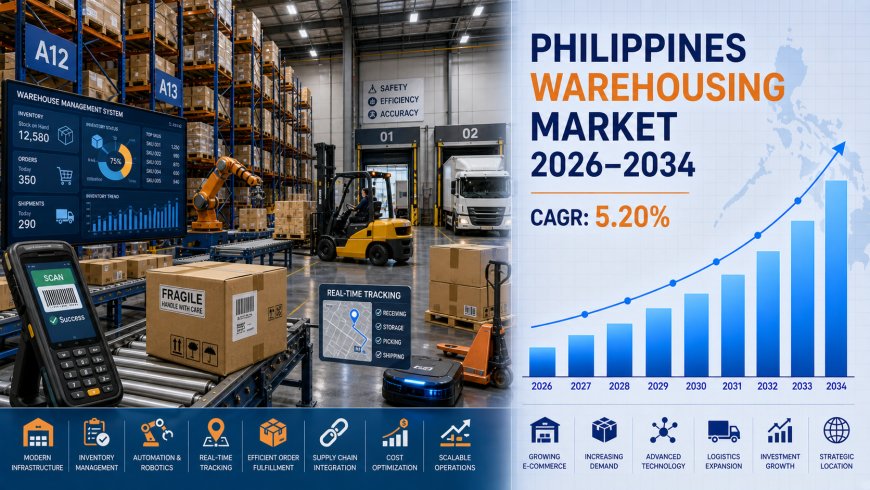
The Philippines warehousing market size reached USD 441.7 Million in 2025 and is projected to reach USD 706.8 Million by 2034, growing at a compound annual growth rate of 5.20% from 2026–2034. The market is expanding driven by numerous strategic collaborations between logistics and real estate players, the thriving e-commerce sector generating surging fulfilment centre demand, and rising focus on supply chain optimisation across food, pharmaceutical, and consumer durables industries. UPS's March 2024 announcement to construct a new logistics hub at Clark International Airport, Cemex Philippines' April 2024 launch of a new 1,500m² warehouse in Batangas, total warehouse storage demand doubling to 1.37 million m² in 2024, and the Philippine government's USD 17.7 billion infrastructure development allocation for 2024 are collectively reinforcing the market's strong and sustained growth trajectory throughout the forecast period.
Request for Sample Report: https://www.imarcgroup.com/philippines-warehousing-market/requestsample
Market Trends
Strategic Collaborations and Institutional Investment
Warehousing developers are actively forging partnerships with logistics companies to design and construct custom-built facilities optimised for operational efficiency and maximum space utilisation across strategic provincial corridors. Real estate developers are simultaneously entering joint ventures with institutional investors and financial institutions to finance large-scale warehouse projects, enabling capital access while providing investors with exposure to the growing market. Mergers and acquisitions are further reshaping the competitive landscape, with major firms expanding geographic reach and consolidating market share. UPS's March 2024 announcement to build a new logistics hub at Clark International Airport exemplifies the scale of foreign investment confidence in Philippines warehousing infrastructure.
Thriving E-Commerce Sector Driving Fulfillment Demand
The rapid expansion of the Philippines' e-commerce market — which reached USD 21 billion in 2023 and is projected to approach USD 30 billion by 2025 — is generating structural and sustained demand for large-scale fulfillment centers, distribution hubs, and last-mile delivery facilities. Online retailers and third-party logistics providers are investing in automated inventory management systems and urban-proximate distribution centers to meet consumer expectations for fast and reliable delivery. Advanced warehousing technologies including real-time inventory visibility, automated replenishment, and robotics integration are becoming standard operational requirements across the e-commerce warehousing segment throughout Luzon, Visayas, and Mindanao.
Rising Demand for Cold Storage and Specialized Facilities
Cold chain infrastructure is emerging as the Philippines warehousing market most dynamically expanding subsegment, driven by surging demand from food and beverage logistics, pharmaceutical distribution, and agricultural supply chains requiring temperature-controlled storage. The cold storage market expanded at a CAGR of 5.39% from 2019 to 2024, with the Board of Investments projecting the sector to generate PHP 20 billion in income by 2023. The PHP 30.80 billion Port Cold Chain Network Project — targeting a nationwide cold chain logistics network across major Philippine ports—and rising pharmaceutical warehousing requirements are reinforcing cold storage as a strategically critical and commercially high-growth warehousing category across the archipelago.
Market Growth Drivers
Robust E-Commerce Growth and Digital Retail Expansion
The Philippines' e-commerce sector represents the warehousing market's most structurally powerful and consistently reliable demand driver, with online retail growth directly translating into non-discretionary investment in fulfilment infrastructure at scale. E-commerce accounting for 7.5% of total retail in 2023 — forecast to reach 9.5% by 2028 — is compelling logistics operators and property developers to expand warehousing capacity across Metro Manila, Cebu, and Davao, and in strategically positioned inter-urban logistics corridors. Supply concentration in key provinces including Rizal, Cavite, Laguna, Pampanga, Cebu, and Davao forms the backbone of the nation's warehousing network serving this accelerating digital commerce demand.
Favorable Government Infrastructure Investment
The Philippine government's sustained and large-scale infrastructure investment programme is materially enhancing logistics connectivity, enabling new warehousing development zones, and directly stimulating market activity across the archipelago. The government's 2024 infrastructure budget allocation of USD 17.7 billion is funding transportation, port, and road projects that reduce inter-island logistics costs and expand the geographic viability of industrial and warehousing development. The USD 3.91 billion Bataan-Cavite Interlink Bridge — funded by the ADB, AIIB, and the Philippine government — will significantly enhance logistics connectivity upon completion, unlocking new supply chain corridors and warehousing development opportunities that will benefit the market throughout the entire forecast period.
Supply Chain Optimization and Technology Adoption
Growing corporate recognition of supply chain resilience as a strategic priority — accelerated by pandemic-era disruptions that exposed the vulnerabilities of lean inventory and single-source sourcing models — is compelling Philippine businesses across food, pharmaceuticals, electronics, and consumer durables to invest in modern, technology-integrated warehousing solutions. The Philippine Department of Transportation confirmed that 40% of logistics players had initiated sustainability initiatives in their supply chains by 2022, including energy-efficient technologies and reduced carbon footprint measures. Smart warehouse management systems, IoT-enabled asset tracking, and automated handling equipment are increasingly being deployed across newly commissioned facilities, raising operational standards and productivity benchmarks across the Philippines warehousing sector.
Porter's Five Forces Analysis of the Philippines Warehousing Market
1. Threat of New Entrants — Moderate
- High capital requirements for land acquisition, warehouse construction, and technology integration across modern fulfilment and cold storage facilities create meaningful entry barriers favouring established developers and international logistics operators over undercapitalised new participants
- The Philippines' archipelagic geography creates inter-island logistics complexity that advantages regionally established operators with existing multi-island infrastructure networks, port access relationships, and intermodal connectivity over greenfield entrants building supply chains from scratch
- Joint venture frameworks between real estate developers and institutional investors are progressively enabling market entry through capital-sharing partnerships, moderately lowering the individual capital threshold for new participants with strong operational credentials but limited balance sheet capacity
2. Bargaining Power of Suppliers — Low to Moderate
- Construction material and civil engineering contractors — particularly those with large-scale industrial warehouse construction expertise — hold moderate leverage given sustained infrastructure development activity across the Philippines that competes for skilled contractor capacity and construction material supply
- Land owners in strategically located industrial zones across Rizal, Cavite, Laguna, and Pampanga command meaningful leverage due to the limited availability of appropriately zoned, well-connected industrial land parcels suitable for large-scale logistics and warehousing facility development
- Warehouse technology suppliers providing racking systems, automated handling equipment, warehouse management software, and cold chain refrigeration infrastructure hold moderate leverage given the specialised technical nature of their products and the high switching costs associated with facility reconfiguration
3. Bargaining Power of Buyers — Moderate to High
- Large e-commerce operators, multinational FMCG companies, and pharmaceutical distributors procuring warehousing space in bulk volumes command substantial lease negotiation leverage through long-term tenancy commitments and the ability to drive competitive bidding among multiple warehousing developers and 3PL operators
- The growing supply of modern Grade-A warehouse facilities across key logistics corridors is increasing tenant choice and modestly constraining landlord pricing power, particularly for standard ambient-temperature general warehousing space where comparable alternatives are increasingly available
- Smaller domestic SME tenants and regional food processors hold lower individual negotiating leverage, but their collective demand for smaller-footprint, flexibly leased warehousing space is attracting a growing range of multi-tenant facility operators offering competitive pricing across the mid-market segment
4. Threat of Substitutes — Low
- Physical warehousing and storage infrastructure has no genuine functional substitute for businesses requiring inventory holding, order fulfilment, temperature-controlled distribution, and supply chain buffer capacity across the Philippines' geographically dispersed consumer and industrial markets
- Cross-docking and transit hub models represent operational alternatives that reduce warehousing dwell time but cannot fully replace inventory-holding capacity for sectors including food and beverage, pharmaceuticals, consumer durables, and agricultural products requiring staged distribution across island logistics networks
- The Philippines' archipelagic geography — requiring inter-island shipping between major supply chain nodes — inherently amplifies the strategic value of strategically located warehousing facilities as essential supply chain buffer infrastructure, effectively reducing substitution risk across all end-user segments
5. Competitive Rivalry — Moderate to High
- Domestic real estate developers including Ayala Land Logistics and Robinsons Land Corporation compete with international 3PL operators and multinational logistics companies including UPS for market share across premium Grade-A warehousing, cold storage, and container freight depot segments across key industrial corridors
- The rapid expansion of e-commerce warehousing demand is simultaneously attracting new facility development investment and intensifying competition among established operators for premium logistics park sites, long-term anchor tenants, and strategic last-mile delivery hub locations near major urban population centres
- Market fragmentation across numerous smaller regional operators competing alongside large integrated logistics and real estate players sustains moderate-to-high competitive intensity at the sub-regional level, particularly in Luzon's industrial corridor where supply concentration and tenant demand are highest
Market Segments
By Type:
- General Warehousing
- Container Freight
- Cold Storage
- Agriculture
- Others
By End User:
- Food and Beverages
- Chemicals and Materials
- Electronics
- Pharmaceutical
- Consumer Durables
- Others
By Region:
- Luzon
- Visayas
- Mindanao
Competitive Landscape
The market research report has provided a comprehensive analysis of the competitive landscape in the Philippines warehousing market. Competitive analysis covering market structure, key player positioning, top winning strategies, competitive dashboard, and a company evaluation quadrant with detailed profiles of all major companies has been included in the report. Key participants including Ayala Land Logistics, Robinsons Land Corporation, JLL, and international logistics operators compete across general warehousing, cold storage, container freight, and agricultural storage segments through facility development, joint venture partnerships, technology integration, and strategic positioning near major port and intermodal logistics hubs throughout Luzon, Visayas, and Mindanao.
Latest News and Developments
May 2026: The Philippines and the United States accelerated negotiations on a proposed long-term economic security zone in New Clark City aimed at strengthening advanced manufacturing, logistics, warehousing, and supply-chain infrastructure. The proposed development covers approximately 4,000 acres and forms part of the broader “Pax Silica” technology supply-chain initiative.
April 2026: Philippine warehousing operators increased investments in cold-chain storage, automated inventory systems, and AI-driven warehouse management technologies as e-commerce and food logistics demand continued rising nationwide.
March 2026: Luzon remained the dominant warehousing region in the Philippines with approximately 62.5% market share, supported by Metro Manila, the CALABA industrial corridor, Clark International Airport, and major seaport connectivity. Food and beverage companies accounted for around 28.9% of warehousing demand.
February 2026: Third-party logistics (3PL) providers continued expanding outsourced warehousing operations as retailers, manufacturers, and e-commerce companies strengthened regional fulfillment and distribution networks across the Philippines.
January 2026: The Philippine warehousing market reached approximately USD 441.7 million in 2025, supported by infrastructure investments, logistics modernization, rising supply-chain optimization efforts, and stronger demand for pharmaceutical and food cold storage facilities.
December 2025: The government continued implementation of the “Build Better More” infrastructure program, improving road, port, airport, and industrial corridor connectivity supporting warehousing and logistics expansion nationwide.
November 2025: Warehouse developers accelerated construction of modern logistics parks near Metro Manila, Cavite, Laguna, Batangas, Pampanga, and Clark to support increasing manufacturing activity and e-commerce fulfillment demand.
September 2025: Germany-based logistics company Rhenus announced plans to invest approximately USD 20 million in the Philippines to expand warehousing infrastructure, logistics facilities, and supply-chain services amid rising freight and distribution demand.
August 2025: Philippine warehousing demand strengthened further as online retail and digital commerce activity continued expanding rapidly, increasing requirements for last-mile distribution hubs and regional fulfillment centers.
June 2025: Cold-chain warehousing investment accelerated due to rising food safety requirements, pharmaceutical distribution expansion, and increasing demand for temperature-controlled logistics infrastructure across the country.
2025: The Philippines logistics and freight industry was valued at approximately USD 15.26 billion, supporting strong growth in warehousing, transportation, fulfillment services, and supply-chain infrastructure modernization nationwide.
Note: If you require any specific information that is not currently covered within the scope of the report, we will provide the same as a part of the customisation.
Speak to an Analyst for a customized sample report: https://www.imarcgroup.com/request?type=report&id=23582&flag=C
About Us
IMARC Group is a global management consulting firm that helps the world's most ambitious changemakers to create a lasting impact. The company provides a comprehensive suite of market entry and expansion services. IMARC offerings include thorough market assessment, feasibility studies, company incorporation assistance, factory setup support, regulatory approvals and licensing navigation, branding, marketing and sales strategies, competitive landscape and benchmarking analyses, pricing and cost research, and procurement research.
Contact Us
IMARC Group
134 N 4th St., Brooklyn, NY 11249, USA
Email: sales@imarcgroup.com
Tel. No.: (D) +91 120 433 0800
United States: +1-201-971-6302
What's Your Reaction?