

























Philippines Retail Sector Market 2026-2034: Industry Trends, Growth and Future Outlook to 2034
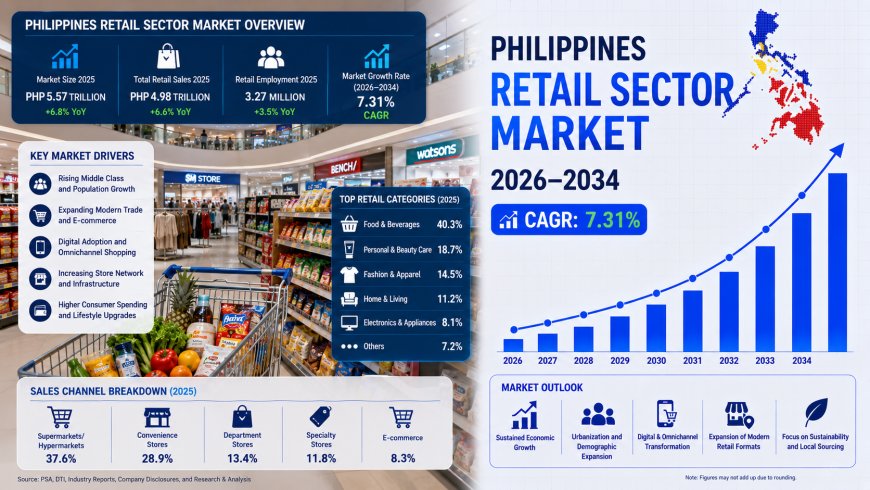
The Philippines retail sector market size reached USD 648.2 Billion in 2025 and is projected to reach USD 1,223.1 Billion by 2034, growing at a compound annual growth rate of 7.31% from 2026–2034.

Market Overview
The Philippines retail sector market size reached USD 648.2 Billion in 2025 and is projected to reach USD 1,223.1 Billion by 2034, growing at a compound annual growth rate of 7.31% from 2026–2034. The market is primarily driven by increasing consumer spending, e-commerce expansion, technological advancements, accelerating urbanization, and rising disposable incomes enabling greater household spending across essential and lifestyle retail categories. The August 2025 entry of Japan's ABC-MART into Bonifacio Global City, the July 2025 debut of Samsung C&T's 8 Seconds fashion brand at SM Mall of Asia, and KK Group's May 2025 announcement of plans to open 200 stores in the Philippines by 2028 are collectively reinforcing the market's strong and sustained growth trajectory throughout the forecast period.
Request for Sample Report: https://www.imarcgroup.com/philippines-retail-sector-market/requestsample
How AI is Reshaping the Future of Philippines Retail Sector Market
- AI-powered consumer behaviour analytics and demand forecasting platforms are being integrated by Philippine retail operators across food and beverages, personal care, apparel, and electronics categories to analyse purchasing patterns across Luzon, Visayas, and Mindanao regions, optimise inventory allocation across supermarket, convenience store, specialty store, and online distribution channels, and reduce overstock and stockout occurrences throughout the national retail supply chain network.
- Machine learning-driven personalisation and recommendation engines are being deployed by Philippine omnichannel retailers and e-commerce platforms to deliver individually tailored product suggestions, dynamic promotional offers, and customised loyalty programme rewards based on consumer purchase histories, browsing behaviour, and demographic profiles, increasing basket sizes, driving repeat visit frequency, and building sustained brand loyalty among digitally engaged Filipino shoppers across urban and provincial markets.
- AI-enabled chatbots and virtual customer service assistants are being adopted by Philippine retail brands operating across online stores and physical retail formats to provide instant, round-the-clock consumer support, personalised product guidance, and seamless order management assistance in Filipino-language interfaces, improving overall customer satisfaction scores and reducing service resolution times across supermarket, specialty store, and e-commerce retail touchpoints nationwide.
- Predictive analytics and AI-powered pricing optimisation platforms are being utilised by Philippine retailers across food and beverages, electronics, and apparel segments to dynamically adjust product pricing in response to real-time competitive intelligence, seasonal demand fluctuations, and consumer price sensitivity signals, enabling more precise margin management, promotional effectiveness measurement, and competitive positioning across both physical and online retail distribution channels throughout the archipelago.
- AI-driven supply chain visibility and logistics optimisation tools are being adopted by Philippine retail sector operators to monitor inventory movement across supermarket chains, convenience store networks, and e-commerce fulfilment centres, predict transportation disruption risks arising from the archipelago's complex multi-island geography, and improve last-mile delivery efficiency and cost management across urban, peri-urban, and emerging provincial retail market areas throughout the country.
Market Trends
Rise of E-Commerce
Online shopping has experienced substantial growth across the Philippines, driven by convenience, expansive product variety, and competitive pricing that appeal strongly to Filipino consumers across diverse income segments. Smartphone household penetration reached 74.1% in 2021, rising 2% from the prior year, while e-money users surged more than fourfold from 8% in 2019 to 36% in 2021, reinforcing the digital commerce foundation. The COVID-19 pandemic accelerated behavioural shifts by compelling consumers to purchase both necessities and non-essentials online. Retailers are responding by expanding digital presences and investing in user-friendly platforms, driving sustained e-commerce adoption across food, personal care, apparel, and electronics product categories throughout the archipelago.
Integration of Advanced Technologies
Philippine retailers are actively adopting artificial intelligence, machine learning, and big data analytics to gain deeper consumer behavioural insights, optimise inventory management, and enhance operational efficiency across physical and digital retail formats. AI-powered chatbots and virtual assistants are delivering instant customer support and personalised product recommendations that improve overall shopping experiences. According to Microsoft Philippines, 86% of Filipino knowledge workers are integrating AI into their daily work routines, surpassing both the global average of 75% and the regional average of 83%. Augmented reality and virtual reality technologies are additionally enabling immersive shopping experiences that allow customers to visualise products in real-world environments before committing to purchase decisions.
Increasing Emphasis on Personalized Customer Experiences
Modern Filipino consumers increasingly expect retailers to understand their individual preferences and deliver meaningfully tailored shopping experiences across every touchpoint. Retailers are leveraging data analytics to segment customer bases and offer personalised product recommendations, targeted promotions, and customised marketing communications across digital and physical channels. Loyalty programmes rewarding consumers based on purchasing patterns are strengthening repeat purchase behaviour and deepening brand affinity. In-store experiences are being enhanced through location-based beacon technologies delivering targeted offers to customers' smartphones in real time. The growing adoption of omnichannel retail strategies providing seamless integrated experiences across online, mobile, and physical store formats is further driving sustained retail sector market growth across the Philippines.
Market Growth Drivers
Rising Disposable Income
Consistent growth in disposable incomes among the Philippine middle class is driving significantly increased consumer spending across essential and lifestyle retail categories. Households are allocating larger budget shares toward modern retail products spanning fashion, electronics, personal care, and packaged foods. Rising income levels are accelerating demand for branded goods and premium offerings previously perceived as aspirational luxuries. Higher purchasing power is also elevating consumer expectations for superior shopping experiences, stimulating expansion of organised retail formats and sophisticated e-commerce platforms. Growing willingness to invest in quality and convenience is creating substantial opportunities for retailers to diversify product ranges, deepen customer engagement, and introduce innovative business models that serve evolving Filipino consumer expectations effectively.
Urbanization and Modern Lifestyle Shifts
The Philippines is experiencing rapid urbanization, with growing populations relocating to cities where modern lifestyles create heightened demand for retail convenience and product accessibility. Urban consumers increasingly prefer organised retail settings including malls, supermarkets, and convenience stores over traditional wet markets, drawn by variety, quality assurance, and comfortable shopping environments. Exposure to global consumer trends is further influencing demand for international brands and aspirational lifestyle products. Fast-paced urban lifestyles lead consumers to prioritise shopping convenience, prompting retailers to expand store networks and adopt online-to-offline integrated models. These combined forces position urbanization as a fundamental structural catalyst driving broad-based Philippines retail sector market demand growth across all major product and distribution channel segments.
Government Infrastructure Development
Government investments in transportation networks, logistics systems, and commercial infrastructure are playing a critical enabling role in shaping and expanding the Philippines retail landscape. Enhanced road connectivity and urban planning initiatives are improving retailer access to emerging provincial markets beyond major metropolitan areas. Modern logistics facilities are facilitating more efficient supply chains, reducing operational costs, and ensuring timely product delivery across diverse geographic regions. Infrastructure development is simultaneously attracting foreign and domestic investment into shopping malls, supermarkets, and mixed-use commercial developments in growing secondary cities. By strengthening the foundational accessibility and distribution capacity of the retail sector, these government-led initiatives are creating sustained new opportunities for retail growth and competitiveness across the Philippine archipelago.
Market Segments
By Product:
- Food and Beverages
- Personal and Household Care
- Apparel, Footwear and Accessories
- Furniture, Toys and Hobby
- Electronic and Household Appliances
- Others
By Distribution Channel:
- Supermarkets and Hypermarkets
- Convenience Stores
- Specialty Stores
- Online Stores
- Others
By Region:
- Luzon
- Visayas
- Mindanao
Competitive Landscape
The market research report has provided a comprehensive analysis of the competitive landscape in the Philippines retail sector market. Competitive analysis covering market structure, key player positioning, top winning strategies, competitive dashboard, and a company evaluation quadrant with detailed profiles of all major companies has been included in the report. Key participants across the Philippines retail sector include established domestic conglomerates, international fashion and lifestyle brands, pharmacy and healthcare retail chains, specialty store operators, online marketplace platforms, and convenience store networks competing across food and beverages, personal care, apparel, electronics, and household product categories. Competition centres on pricing strategy, store network expansion, omnichannel integration, digital payment adoption, loyalty programme development, provincial market penetration, and the ability to deliver differentiated and personalised consumer experiences across supermarket, convenience store, specialty store, and online retail distribution channels throughout Luzon, Visayas, and Mindanao.
Latest News and Developments
May 2026: Philippine retailers accelerated investments in omnichannel retailing, AI-powered inventory management, and digital payment integration as rising smartphone penetration and e-wallet adoption continued reshaping consumer purchasing behavior across urban centers.
April 2026: The Philippine Statistics Authority reported that the General Retail Price Index (GRPI) in the National Capital Region increased by 4.8% year-on-year in March 2026, compared with 2.1% in February 2026, mainly driven by a 6.7% increase in food retail prices.
February 2026: The OECD stated that the Philippines continued recording strong economic growth and rapid poverty reduction supported by macroeconomic stability and expanding consumer demand, strengthening long-term retail sector activity nationwide.
January 2026: Industry reports showed that the food and beverage segment accounted for nearly 50% of the Philippine retail market, while supermarkets and hypermarkets represented approximately 40% market share, highlighting strong demand for organized retail formats.
December 2025: The Asian Development Bank approved a US$400 million policy-based loan program to help improve the Philippine business environment, strengthen digital infrastructure, and support easier retail and commercial investment operations.
December 2025: Philippine retail and consumer spending activity strengthened during the holiday season as modern retail chains and e-commerce platforms expanded promotional campaigns, digital payment options, and rapid-delivery services nationwide.
November 2025: Retail industry assessments highlighted that sari-sari stores continued contributing significantly to the Philippine economy with approximately PHP 8 billion in retail sales and around 21% annual growth, while government digitization initiatives supported modernization of traditional retail channels.
September 2025: Ayala Center Cebu continued its large-scale redevelopment project scheduled through 2026, with mall expansion expected to increase gross floor area to approximately 280,000–300,000 square meters, strengthening modern retail infrastructure in the Visayas region.
Note: If you require any specific information that is not covered currently within the scope of the report, we will provide the same as a part of the customization.
Speak to an Analyst for a Customized Sample Report: https://www.imarcgroup.com/request?type=report&id=23546&flag=C
About Us
IMARC Group is a global management consulting firm that helps the world's most ambitious changemakers to create a lasting impact. The company provides a comprehensive suite of market entry and expansion services. IMARC offerings include thorough market assessment, feasibility studies, company incorporation assistance, factory setup support, regulatory approvals and licensing navigation, branding, marketing and sales strategies, competitive landscape and benchmarking analyses, pricing and cost research, and procurement research.
Contact Us
IMARC Group
134 N 4th St., Brooklyn, NY 11249, USA
Email: sales@imarcgroup.com
Tel. No.: (D) +91 120 433 0800
United States: +1-201-971-6302
What's Your Reaction?