





























India Home Decor Market 2026-2034: Size, Share, Emerging Trends and Outlook Report
The home decor market size in India was valued at USD 26.88 Billion in 2025 and is projected to reach USD 42.36 Billion by 2034, growing at a compound annual growth rate of 5.18% from 2026-2034.

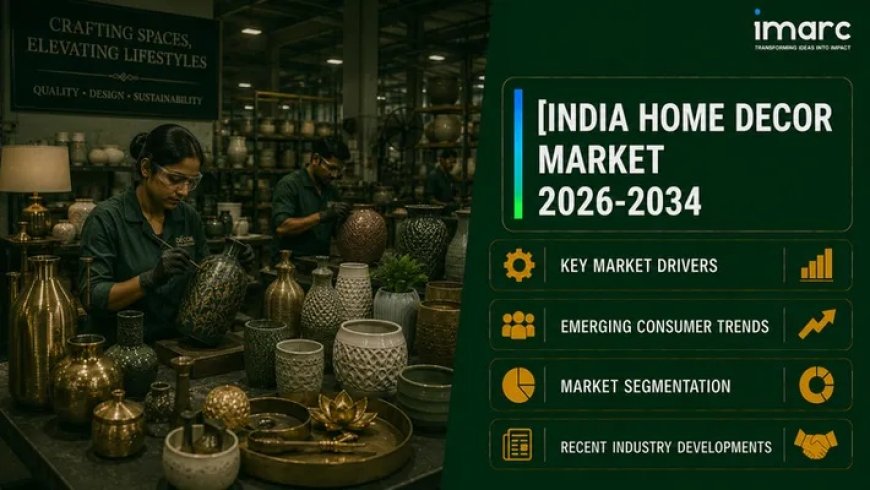
According to IMARC Group’s report titled “India Home Decor Market Size, Share, Trends and Forecast by Product Type, Distribution Channel, and Region, 2026-2034“, the report offers a comprehensive analysis of the industry, including market share, forecast, growth and regional insights.
The home decor market size in India was valued at USD 26.88 Billion in 2025 and is projected to reach USD 42.36 Billion by 2034, growing at a compound annual growth rate of 5.18% from 2026-2034. The consumer retail and corporate real estate sectors in India are undergoing a rapid structural formalization, transitioning from a highly fragmented unorganized trade to a high-margin, brand-led experiential ecosystem. Driven by a fundamental shift in urban consumer behavior and an unprecedented real estate lifecycle expansion, the production, design, and retail distribution of premium domestic furnishings present highly stable, asset-backed entry points for corporate investors and retail conglomerates.
- Premiumization Alpha Capture: Directing investment toward luxury, eco-friendly, and artisan-crafted portfolios taps into a fast-expanding urban demographic willing to absorb elevated price-per-unit metrics for sustainable interior assets.
- Core Product Dominance: Prioritizing product development within the core home furniture category secures a primary position in a structural segment that commands 52.1% of the aggregate market share.
- Omnichannel Logistic Efficiencies: Investing in unified digital storefronts and integrated quick-commerce fulfillment architectures taps into an online store distribution channel that leads the market with a 32.08% market share.
The Strategic Market Challenge: Navigating the Home Decor Market in India A critical operational challenge confronting enterprise leaders within the retail sector is managing supply chain fragmentation while rapidly scaling production to meet modern design standardizations. Because approximately 85% of domestic furniture and artifact manufacturing remains confined within highly unorganized, inward-oriented regional workshops, large-scale branded retailers experience extreme variance in raw material processing, unpredictable lead times, and unstable quality-assurance metrics. This structural deficit heavily restricts corporate agility, inflating inventory storage overhead and disrupting just-in-time fulfillment schedules demanded by digitized modern trade networks.
➤ Access Key Market Statistics and Actionable Insights - Request Sample Report
India's Strategic Vision for the Home Decor Market:
-
Macro-Class Demographic Mobilization: National economic growth strategies are structured to leverage an expanding domestic middle class, which is projected to reach 61% of the total population by 2047, structurally transforming discretionary lifestyle spending.
-
Artisanal Cluster Integration: Public policy initiatives actively target the formalization of rural craft hubs across regional states, providing institutional credit lines to transition traditional handicraft clusters into compliant global export nodes.
-
Digital Infrastructure Integration: Strategic public blueprints focus on accelerating deep internet penetration into Tier-2 and Tier-3 urban ecosystems, enabling authorized direct-to-consumer (D2C) brands to bypass traditional multi-tiered wholesale distribution leakages.
Why Invest in the India Home Decor Market: Key Growth Drivers & ROI
-
Macro-Real Estate Infrastructure Support: Massive public and private investments in premium residential developments, mixed-use commercial tech parks, and urban transformation projects create a permanent, high-volume baseline for corporate interior fit-out contracts.
-
Evolving Urban Consumer Consumption Trends: Accelerated migration into metropolitan high-rise apartments is driving a structural demand shift away from heavy legacy furnishings toward highly versatile, space-saving, and multifunctional minimalist furniture configurations.
-
Advanced Visual Technological Upgrades: The enterprise integration of augmented reality (AR) spatial visualization tools and automated inventory ledger systems lowers retail return rates by 25% while maximizing transactional conversion velocities across digital storefronts.
India Home Decor Market Trends & Future Outlook:
-
Predictable Value Compounding: The domestic market value is structurally positioned to expand at a steady compound annual growth rate (CAGR) of 5.18% between 2026 and 2034, ensuring highly predictable long-term asset appreciation for early institutional investors.
-
Eco-Conscious Premiumization Vectors: The rapid mainstream adoption of verified low-VOC finishes alongside sustainable core inputs like bamboo, jute, and reclaimed wood is forming a distinct, high-margin revenue pocket across health-conscious urban cohorts.
-
Strategic Experience Center Proliferation: Major international and national brands are increasingly deploying heavy capital to open expansive physical experience centers across major metropolitan hubs to facilitate high-value touch-and-feel commerce loops.
-
Digital Marketplace Dominance: E-commerce architectures and collaborative lifestyle retail aggregators continue to capture dominant consumer spending share, expanding their product selections by double digits to accommodate diverse design preferences.
Regulatory Landscape & Policy Catalysts in India:
-
Quality Control Orders (QCO) for Furniture: According to the Ministry of Commerce and Industry and the Department for Promotion of Industry and Internal Trade (DPIIT), the strict implementation of mandatory QCO certifications requires comprehensive adherence to uniform Bureau of Indian Standards (BIS) parameters across all commercial manufacturing lines.
-
Geographical Indication (GI) Protection Laws: According to the Ministry of Commerce and Industry, rigorous legal protection frameworks governing regional design crafts are enhancing the global brand equity of indigenous handicraft networks.
-
Goods and Services Tax (GST) Compliance Frameworks: According to the Ministry of Finance, the removal of informal tax arbitrage through systemic electronic invoicing under the standardized GST layout continues to accelerate market share migration toward organized, corporate retail networks.
-
National Retail Policy Directives: According to the Ministry of Consumer Affairs, Food and Public Distribution, emerging ease-of-doing-business guidelines seek to simplify multi-state commercial operations, dramatically lowering bureaucratic friction for large-scale branded store rollouts.
➤ Explore the Exact Chapters and Data Scope - Get Full Brochure
India Home Decor Market Segmentation:
The market report offers a comprehensive analysis of the segments, highlighting those with the largest India home decor market share. It includes forecasts for the period 2026-2034 and historical data from 2020-2025 for the following segments.
Product Type Insights:
- Home Furniture
- Home Textiles
- Flooring
- Wall Decor
- Lighting
- Others
Home furniture dominates with a market share of 40.12% of the total India home decor market in 2025.
Distribution Channel Insights:
- Home Decor Stores
- Supermarkets and Hypermarkets
- Online Store
- Gift Shops
- Others
Online store leads with a share of 32.08% of the total India home decor market in 2025.
Regional Insights:
- South India
- North India
- West and Central India
- East India
North India exhibits a clear dominance with a 33% share of the total India home decor market in 2025.
Note: If you need specific information that is not currently within the scope of the report, we can provide it to you as a part of the customization.
By the IMARC Group, the Top Competitive Landscape & their Positioning:
Covering an in-depth analysis of the competitive landscape, market structure, key player positioning, competitive dashboards, top winning strategies, and detailed profiles of all major industry participants you will gain access to all these exclusive insights within the full research report.
➤ Shape the Data to Answer Your Specific Questions - Request Customization
Frequently Asked Questions (FAQs)
Q1: What is the current value and projected growth of the India Home Decor Market?
A1: According to IMARC Group, the India home decor market size was valued at USD 26.88 Billion in 2025. Looking forward, the market is projected to reach USD 42.36 Billion by 2034, exhibiting a structured compound annual growth rate (CAGR) of 5.18% during the 2026–2034 forecast period.
Q2: Which product type segment commands primary utilization within the domestic market?
A2: The extensive product matrix is distinctly categorized into Home Furniture, Home Textiles, Flooring, Wall Decor, Lighting, and Others. Home furniture commands clear dominance across the domestic industry, securing a major 52.1% share of total revenue in 2025 due to its central functional importance in living spaces.
Q3: What specific distribution channel is registering the fastest operational scaling?
A3: The retail fulfillment pipeline spans Home Decor Stores, Supermarkets and Hypermarkets, and Online Stores. Online stores lead the market expansion with a prominent distribution share of 32.08% in 2025, driven by expanding smartphone penetration and high-velocity e-commerce delivery networks across tier-2 and tier-3 cities.
Q4: How do regional interior design preferences vary across key geographical blocks in India?
A4: South India heavily prioritizes fusion home decor designs that blend traditional and modern elements, West India exhibits a distinct shift toward modern, minimalist aesthetics, and East India registers rising demand for heritage-inspired, traditional artisan motifs.
Q5: What primary factor is accelerating the institutional replacement cycle of home furnishings?
A5: Urban consumers are heavily upgrading their living environments due to social media design inspiration and an increasing awareness of how interior looks affect mental well-being and home productivity, leading to compressed repurchasing timelines for trendy home decor accessories.
Strategic Insight & Verdict:
The structural consolidation of India’s lifestyle retail space presents an exceptional window for high-volume corporate capital deployment. As consumer preferences permanently shift away from fragmented, unorganized local commodity trading toward traceable, brand-led interior solutions, we at IMARC Group have observed that the highest financial yields will favor investors who secure positions within unified omnichannel distribution models and deploy automated customization systems. Moving forward, the strategic positioning of consumer goods capital must prioritize vertical supply chain formalization and localized energy-efficient material processing to capture maximum market equity across the expanding domestic spiritual and real estate economy.
Verified Data Source: India Home Decor Market Report by IMARC Group
Written by: Gourav (Digital Market Research Strategist @ IMARC Group)
View my full professional profile and connect with me at [https://www.linkedin.com/in/gourav-shah-005425345] for exclusive market research insights and B2B growth strategies.
What's Your Reaction?