




























DRI Plant Setup Guide: Sponge Iron Production, Equipment & Profitability
Complete guide on DRI sponge iron manufacturing plant setup, process, cost, and profitability.

Introduction:
Setting up a DRI sponge iron manufacturing plant presents a high-value industrial opportunity due to the increasing demand for high-quality metallic iron used in steelmaking. Direct Reduced Iron (DRI), also known as sponge iron, is produced by reducing iron ore without melting it, resulting in a porous iron product with excellent metallurgical properties. It is widely used in electric arc furnaces, induction furnaces, and secondary steelmaking processes.
This project-report–style overview explains the industry scope, technical process, plant setup requirements, investment factors, and profitability insights for entrepreneurs planning to establish a sponge iron production facility.
Market Overview & Trends:
The demand for sponge iron continues to increase due to growing steel production, infrastructure expansion, and replacement of scrap metal with higher-quality DRI. Industries prefer DRI because it offers uniform composition, stable carbon content, lower impurities, and improved furnace efficiency. Market growth is driven by construction, automotive, machinery manufacturing, and energy projects. Environmental concerns are also shifting the industry toward DRI because it emits fewer greenhouse gases compared to blast furnace operations. However, challenges remain in securing consistent iron ore supplies, handling coal or gas reduction fuels, and meeting emission standards.
Download Your Sample Report: https://www.imarcgroup.com/dri-sponge-iron-manufacturing-plant-project-report/requestsample
Technical Aspects / Manufacturing Process:
The DRI manufacturing process typically uses either coal-based rotary kilns or gas-based shaft furnaces. Iron ore lumps or pellets are fed into the reduction unit, where they react with reducing agents such as coal or natural gas at controlled temperatures below the melting point. The reduction reaction removes oxygen from iron ore, producing high-purity sponge iron. The product is then cooled, screened, magnetically separated, and stored.
Key raw materials include iron ore (lumps/pellets), non-coking coal or natural gas (depending on the technology), limestone/dolomite as flux, and water for cooling systems.
Quality control measures evaluate metallization levels, carbon content, iron purity, size distribution, and mechanical strength to ensure it meets steelmaking specifications.
Plant Setup Requirements:
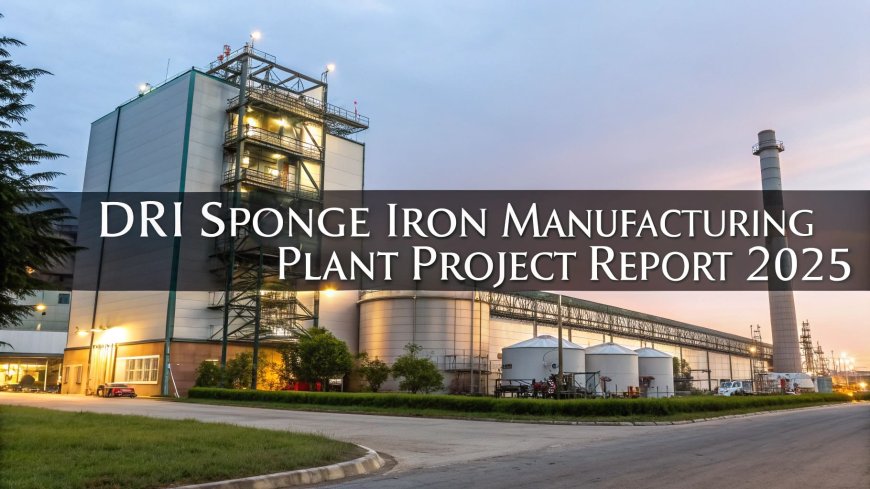
A sponge iron manufacturing plant requires a large site with strong logistics connectivity for raw material sourcing and product dispatch. The layout typically includes raw material handling units, crushing and screening sections, rotary kiln or shaft furnace, reduction zone, cooler, magnetic separators, storage silos, waste handling systems, power house, and administrative buildings.
Essential machinery includes rotary kilns or gas-based reduction furnaces, coal feeders, iron ore feeding systems, coolers, magnetic separators, conveyors, dust collectors, pollution control equipment, water systems, and weighing/packaging systems.
Crucial infrastructure requirements include reliable power supply, water availability, internal roads, pollution control systems, and safety equipment due to high-temperature operations and dust emissions.
Project Economics:
The DRI sponge iron manufacturing plant setup cost includes land acquisition, civil construction, equipment procurement, installation, power and utility systems, and working capital. Operating expenses consist of iron ore, coal or natural gas consumption, power, refractory maintenance, labor, environmental compliance, and transportation.
Production costs depend on ore quality, reduction efficiency, fuel costs, kiln operation stability, and energy utilization.
Revenue projections are based on sponge iron sales to steel manufacturers, foundries, and alloy producers. Financial analysis includes ROI, break-even point, payback period, and sensitivity analysis to determine long-term profitability and risk.
Risk Factors & Success Strategies:
Key risks include variability in iron ore pricing, fuel cost fluctuations, kiln inefficiencies, equipment breakdowns, and environmental regulatory challenges. The high energy consumption of the DRI process also affects overall profitability.
Success strategies include securing long-term iron ore contracts, adopting modern kiln technologies, implementing strong maintenance programs, optimizing fuel efficiency, and ensuring reliable pollution control systems. Diversifying product forms—such as cold briquetted iron (CBI)—can also Enhance export opportunities and market stability.
Talk to Our Analyst – Get a Tailored Investment Plan: https://www.imarcgroup.com/request?type=report&id=30549&flag=C
Conclusion:
Establishing a DRI sponge iron manufacturing plant is a technically demanding yet commercially viable investment, supported by the expanding steel industry and rising preference for high-quality metallic iron. With efficient process control, reliable raw material sourcing, upgraded technology, and adherence to environmental norms, investors can build a profitable and scalable DRI production facility.
FAQs — DRI Sponge Iron Manufacturing Plant
1. What raw materials are essential for a sponge iron manufacturing plant?
The primary materials include iron ore lumps or pellets, non-coking coal or natural gas, and fluxes like limestone/dolomite.
2. What type of machinery is used in a DRI plant?
Rotary kilns or shaft furnaces, coolers, magnetic separators, feeders, conveyors, pollution control units, and material handling systems are essential.
3 What factors influence the production cost of sponge iron?
Iron ore quality, fuel type and cost, energy consumption, kiln efficiency, maintenance needs, and labor significantly impact the overall production cost.
4. How can operational risks be minimized in a DRI plant?
Using high-quality raw materials, maintaining kiln efficiency, investing in automation, ensuring pollution control compliance, and adopting preventive maintenance help reduce risks.
How IMARC Can Help?
IMARC Group is a global management consulting firm that helps the world’s most ambitious changemakers to create a lasting impact. The company provide a comprehensive suite of market entry and expansion services. IMARC offerings include thorough market assessment, feasibility studies, company incorporation assistance, factory setup support, regulatory approvals and licensing navigation, branding, marketing and sales strategies, competitive landscape and benchmarking analyses, pricing and cost research, and procurement research.
Contact Us:
IMARC Group
134 N 4th St., Brooklyn, NY 11249, USA
Email: sales[@]imarcgroup.com
Tel No:(D) +91 120 433 0800
United States: (+1-201971-6302)
What's Your Reaction?