



























Australia Rooftop Solar Market Size, Share, Trends and Growth Report 2026-2034
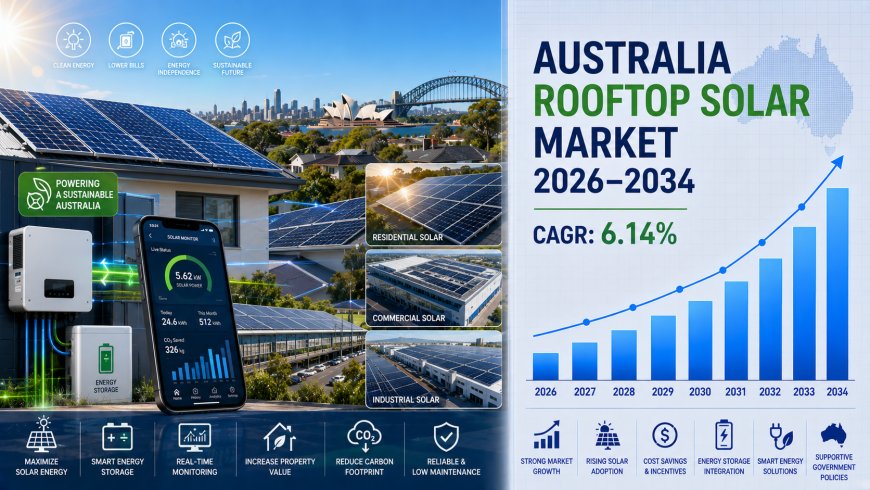
The Australia rooftop solar market size reached USD 1,528.1 Million in 2025. The market is projected to reach USD 2,654.1 Million by 2034, exhibiting a growth rate (CAGR) of 6.14% during 2026-2034.

Market Overview
The Australia rooftop solar market is propelled by strong policy support and the growing need for decentralized energy solutions. Government incentives and regulations are making rooftop systems more affordable and attractive, encouraging long-term adoption. Additionally, grid limitations and rising energy demands are encouraging investment in advanced technologies that integrate rooftop solar into broader energy systems. The market size reached USD 1,528.1 Million in 2025 and is projected to reach USD 2,654.1 Million by 2034, growing at a compound annual growth rate (CAGR) of 6.14% from 2026 to 2034.
Together, these factors are contributing to a steady rise in the Australia rooftop solar market share. The market is strategically important to Australia's economy as it enables households and businesses to reduce electricity bills, supports the nation's transition to renewable energy, alleviates strain on the main grid, and contributes to decarbonization goals.
Request a Sample Report for In-Depth Market Insights: https://www.imarcgroup.com/australia-rooftop-solar-market/requestsample
Australia Rooftop Solar Market Summary
- The Australia rooftop solar market encompasses a system where photovoltaic panels are installed on residential, commercial, and industrial rooftops to generate electricity, either connected to the grid (on-grid) or operating independently (off-grid).
- These rooftop solar systems are valued for their role in reducing electricity bills, decreasing dependence on the grid, lowering carbon emissions, providing energy independence, and contributing to decentralized energy generation.
- The ecosystem includes solar panel manufacturers (Aiko), technology providers (Itron, Jemena), installers, government regulators (Small-scale Renewable Energy Scheme SRES), utility companies, battery storage providers, and end users across residential, commercial, and industrial sectors.
- Major segments identified in the market include grid type (on-grid, off-grid), end user (industrial, commercial, residential), and region (Australia Capital Territory & New South Wales, Victoria & Tasmania, Queensland, Northern Territory & Southern Australia, Western Australia).
- The market is benefiting from grid constraints and decentralized energy needs, policy backing and state-level incentives (SRES, state rebates, net metering, feed-in tariffs), high residential adoption, rising electricity prices, environmental awareness, and technological advancements.
- Australia has become a world leader in rooftop solar adoption at the domestic level, with a large proportion of suburban and regional homes now boasting solar panels.
PORTER'S FIVE FORCES ANALYSIS — AUSTRALIA ROOFTOP SOLAR MARKET
Bargaining Power of Suppliers — Moderate
- Rooftop solar suppliers include solar panel manufacturers, inverter producers, battery storage providers, and mounting system suppliers. The presence of multiple global and domestic suppliers gives installers and consumers options.
- In February 2025, Aiko launched its new 480 W Neostar 2P rooftop solar panels in Australia, boasting a record 24.3% efficiency for residential PV modules, demonstrating that manufacturers with superior technology can command premium positioning.
- However, the global nature of solar PV manufacturing means that Australian installers can source from multiple international suppliers, reducing dependency on any single source.
Bargaining Power of Buyers — Moderate to High
- Buyers include residential homeowners, commercial businesses, and industrial facilities. Residential consumers have significant choice among installers and system configurations, creating price sensitivity.
- The high take-up of solar is driven by plenty of sunlight, rising power prices, and favorable policies. For many consumers, the savings from solar outweigh the upfront investment within a few years, making economic motivation a key factor in purchasing decisions.
- Government incentives (SRES, state rebates) effectively increase buyer purchasing power by reducing upfront costs. The Australian Government launched a $25 million "Solar for Apartment Residents" program in February 2025 covering up to 50% of installation costs.
- However, the need for quality installation and reliable equipment means that buyers often prioritize reputation and warranty over minimal pricing.
Threat of New Entrants — Moderate
- The rooftop solar installation market has relatively low barriers to entry for new installers, leading to a competitive landscape with many small and medium-sized players.
- However, established installers with strong brand recognition, quality certifications, and long-term warranties have competitive advantages. The need for compliance with grid connection requirements and safety standards creates some barriers.
- Technological advancements in panel efficiency (Aiko's 24.3% efficiency) and smart inverters mean that new entrants must stay current with rapidly evolving technology.
Threat of Substitutes—Low
- Grid electricity is a substitute for rooftop solar generation, but rising electricity prices make solar increasingly attractive as a cost-control measure.
- Community solar or virtual power plants are complementary rather than pure substitutes, as they often incorporate rooftop solar as part of distributed energy resources.
- The environmental awareness driving solar adoption means that fossil-fuel-based electricity is becoming less desirable as a substitute for environmentally conscious consumers.
Competitive Rivalry — High
- The Australian rooftop solar market features intense competition among installers, with a large proportion of suburban and regional homes already boasting solar panels.
- Differentiation occurs through panel efficiency (Aiko's 24.3% record), battery integration, smart inverter capabilities, installation quality, warranty offerings, pricing, and customer service.
- The market is mature in the residential segment, with continued growth supported by cost reductions, improved technology, and expanding consumer awareness. Competition is particularly intense in high-adoption regions.
MARKET GROWTH DRIVERS
Grid Constraints and Decentralized Energy Needs
With energy needs increasing in cities and grid reliability remaining uneven in remote communities, rooftop solar provides a decentralized alternative to alleviate strain on the main network. Creating energy at the location of utilization minimizes transmission losses and alleviates peak load strain. To handle this transition successfully, utilities are putting money into cutting-edge grid technologies that enable real-time interaction between distributed energy sources and the primary grid.
An important instance is the 2024 collaboration between Itron and Jemena, which launched a Low Voltage Distributed Energy Resource Management System (LV DERMS) in Australia. This system offered real-time information and remote-control features to align rooftop solar contributions with grid requirements, guaranteeing stability and efficiency. Such initiatives indicate a wider trend among energy suppliers to view rooftop solar not merely as a user product but as an essential part of grid infrastructure. These solutions are essential for managing power quality variations and preventing voltage spikes associated with increased solar integration. With the ongoing rise in decentralized solar use, systems such as LV DERMS are becoming crucial for incorporating distributed generation while maintaining reliability.
Policy Backing and State-Level Incentives
The Australia rooftop solar market growth is tied to steady policy commitments at both federal and state levels, which is making solar systems financially viable and widely accessible. Programs like the small-scale renewable energy scheme (SRES), along with state-specific rebates, net metering rules, and favorable feed-in tariffs, have collectively shortened payback periods and enhanced return on investment for individuals. These measures not only incentivize system installation but also promote long-term engagement in distributed energy generation and trading.
Importantly, government targets and clear renewable energy timelines provide a sense of stability that boosts user and installer confidence. For instance, in 2024, the state of Victoria launched a roadmap aiming to install 7.6 GW of solar by 2035, including 6.3 GW rooftop, 1.2 GW distributed, and 3 GW utility-scale solar. This program directly aided the state's wider objective of 95% renewable energy by 2035 and a net-zero aim for 2045. In February 2025, the Australian Government launched a $25 million "Solar for Apartment Residents" program to help apartment buildings in NSW install shared rooftop solar systems, covering up to 50% of installation costs.
High Residential Adoption
Australia has become a world leader in rooftop solar adoption at the domestic level. A large proportion of suburban and regional homes now boast solar panels, a testament to strong consumer demand to reduce electricity bills and be less dependent on the grid. The high take-up is driven by plenty of sunlight, increasing power prices, and favorable policies. Solar power systems are no longer a rare sight on rooftops, neither in large cities nor in small towns.
From a trend of early adopters to mainstream homeowners, the installations have become a routine part of home upgrades or home renovations. The long-term energy savings, coupled with increasing environmental concern, continue to fuel installations. As installation procedures grow more efficient and solar systems more powerful, homeowner demand is far from abating. According to Australia rooftop solar market analysis, residential uptake is expected to remain strong, with continued growth supported by cost reductions, improved technology, and expanding consumer awareness of the financial and environmental benefits.
Rising Electricity Prices
Electricity prices have steadily increased across Australia, placing a growing financial burden on households and small businesses. In response, many are choosing rooftop solar systems as a long-term cost-control measure. Solar power allows users to generate a portion of their energy needs on-site, reducing their dependence on the grid and lowering electricity bills. Time-of-use tariffs and rising peak charges have further incentivized self-generation.
For many consumers, the savings from solar outweigh the upfront investment within a few years. This economic motivation continues to be one of the most powerful drivers of solar adoption, especially as inflation and global energy market volatility push power prices higher. The ability to cut ongoing expenses makes rooftop solar a practical choice for energy-conscious property owners.
Technological Advancements
Ongoing technology improvements have resulted in rooftop systems that are more efficient, longer-lasting, and easier to use. Solar panels today produce more energy per square meter, using less roof space to achieve the same output. Smart inverters allow for greater monitoring of energy, remote diagnostics, and connection with battery storage. Most systems today include mobile apps, enabling users to monitor generation and use in real time.
In February 2025, Aiko launched its new 480 W Neostar 2P rooftop solar panels in Australia, boasting a record 24.3% efficiency for residential PV modules, credited to Aiko's n-type all-back-contact (ABC) cell technology without increasing panel size. Battery technology, although still in development, has improved to be more reliable and cost-effective, leading people to charge power generated during the day for use during the night or for grid outages. Such improvements enhance the solar selling proposition and enhance the overall return on investment.
AUSTRALIA ROOFTOP SOLAR MARKET SEGMENTATION
- Grid Type Insights:
- On-Grid
- Off-Grid
- End User Insights:
- Industrial
- Commercial
- Residential
- Regional Insights:
- Australia Capital Territory & New South Wales
- Victoria & Tasmania
- Queensland
- Northern Territory & Southern Australia
- Western Australia
COMPETITIVE LANDSCAPE
The Australia rooftop solar market features a competitive landscape of solar panel manufacturers, inverter producers, battery storage providers, and installation companies. Leading players differentiate through panel efficiency, smart inverter capabilities, battery integration, installation quality, warranty offerings, and customer service. The market is mature in residential segments, with continued growth supported by cost reductions and improved technology.
Key players mentioned in the report include:
- Aiko (launched 480 W Neostar 2P panels with 24.3% efficiency in February 2025)
- Itron (partnered with Jemena on LV DERMS in 2024)
- Jemena (partnered with Itron on LV DERMS)
In February 2025, Aiko launched its new 480 W Neostar 2P rooftop solar panels in Australia, boasting a record 24.3% efficiency for residential PV modules. The boost is credited to Aiko's n-type all-back-contact (ABC) cell technology without increasing panel size. Initial shipments are expected to arrive in Australia by March 2025.
In 2024, Itron and Jemena collaborated to launch a Low Voltage Distributed Energy Resource Management System (LV DERMS) in Australia, offering real-time information and remote-control features to align rooftop solar contributions with grid requirements.
The market research report has also provided a comprehensive analysis of the competitive landscape, including market structure, key player positioning, top winning strategies, competitive dashboard, and company evaluation quadrant, with detailed profiles of all major companies.
REGIONAL ANALYSIS
- Australia Capital Territory & New South Wales: NSW represents a major rooftop solar market driven by high population density, strong government incentives, and the $25 million "Solar for Apartment Residents" program launched in February 2025. The region's urban centers have high residential adoption rates. Grid constraints in Sydney and surrounding areas are driving investment in grid management technologies.
- Victoria & Tasmania: Victoria launched a roadmap in 2024 aiming to install 7.6 GW of solar by 2035, including 6.3 GW rooftop solar. This program directly aids the state's wider objective of 95% renewable energy by 2035 and net-zero by 2045. The state's strong policy backing and favorable feed-in tariffs have made rooftop solar financially viable and widely accessible.
- Queensland: Queensland has one of the highest rooftop solar adoption rates in Australia, driven by abundant sunlight, high electricity prices, and strong consumer awareness. The state's subtropical climate and high air conditioning usage make solar particularly attractive for reducing summer electricity bills. Regional and suburban homes across Queensland have high penetration rates.
- Northern Territory & Southern Australia: In the Northern Territory and South Australia, rooftop solar adoption is driven by high solar irradiance and the need for energy independence in remote communities where grid reliability remains uneven. Off-grid systems are particularly relevant in these regions. South Australia has been a leader in battery storage integration, allowing households to store excess solar generation.
- Western Australia: Western Australia's rooftop solar market is driven by the state's abundant sunshine, rising electricity prices, and high residential adoption rates. Perth has one of the highest per-capita rooftop solar penetrations in the country. The state's isolated grid (South West Interconnected System) creates unique challenges and opportunities for rooftop solar integration with battery storage and grid management systems.
RECENT INDUSTRY DEVELOPMENTS
May 2026: The Australia rooftop solar market continued expanding rapidly as households and businesses accelerated investments in renewable energy systems to reduce electricity costs. Australia surpassed approximately 4.2 million rooftop solar installations nationwide by May 2026, maintaining one of the world’s highest residential solar adoption rates per capita.
April 2026: Residential battery adoption strengthened alongside rooftop solar installations across Australia. The Clean Energy Regulator projected that approximately 520,000 home battery systems representing around 12 GWh of storage capacity could be installed during 2026, significantly improving household solar self-consumption and grid flexibility.
February 2026: The Clean Energy Council reported that rooftop solar generated nearly 12.4% of Australia’s total electricity supply during 2025, reflecting continued growth in distributed renewable energy generation and increasing integration of smart energy management systems.
January 2026: State governments continued expanding incentive schemes and rebate programs supporting rooftop solar and battery adoption. Several Australian states introduced additional low-interest financing options and virtual power plant (VPP) initiatives to encourage renewable energy participation among households and small businesses.
December 2025: Commercial and industrial rooftop solar installations increased steadily as businesses sought to reduce operational energy costs and strengthen ESG commitments. Warehouses, manufacturing facilities, retail centers, and logistics operators increasingly invested in large-scale rooftop photovoltaic systems integrated with battery storage technologies.
November 2025: Smart inverters, AI-based energy optimization systems, and integrated home energy management platforms became increasingly common across rooftop solar installations. Consumers increasingly adopted intelligent monitoring systems capable of optimizing electricity consumption, EV charging, and battery storage performance.
2025–2026 (market trend): The Australia rooftop solar market is being shaped by rising electricity prices, strong government incentives, battery storage integration, and increasing adoption of smart energy management technologies. Residential and commercial consumers continue investing in distributed renewable energy systems to improve energy independence and reduce carbon emissions. At the same time, grid stability concerns, installation workforce shortages, policy uncertainty, and supply chain constraints continue influencing market expansion and long-term renewable energy integration strategies.
Note: If you need any specific information that is not covered currently within the scope of the report, we will provide the same as a part of customization.
Speak to an analyst: https://www.imarcgroup.com/request?type=report&id=34474&flag=C
About Us
IMARC Group is a global management consulting firm that helps the world's most ambitious changemakers to create a lasting impact. The company provides a comprehensive suite of market entry and expansion services. IMARC offerings include thorough market assessment, feasibility studies, company incorporation assistance, factory setup support, regulatory approvals and licensing navigation, branding, marketing and sales strategies, competitive landscape and benchmarking analyses, pricing and cost research, and procurement research.
Contact Us
IMARC Group
134 N 4th St., Brooklyn, NY 11249, USA
Email: sales@imarcgroup.com
Tel No: (D) +91 120 433 0800
United States: +1-201-971-6302
What's Your Reaction?