































Australia Logistics Market to Reach USD 223.4 Billion by 2034, Exhibiting a CAGR of 3.35% During 2026–2034
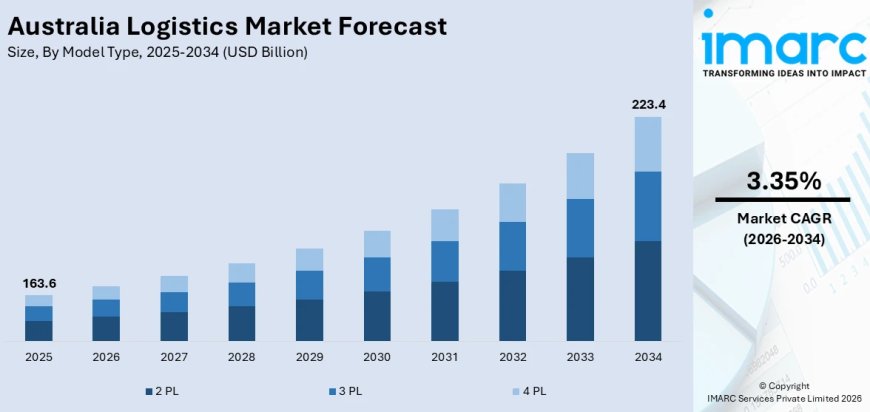
Australia logistics market size reached USD 163.6 Billion in 2025 and is projected to reach USD 223.4 Billion by 2034, exhibiting a growth rate (CAGR) of 3.35% during 2026–2034.

Market Overview
The Australia logistics market size reached USD 163.6 Billion in 2025 and is projected to reach USD 223.4 Billion by 2034, exhibiting a growth rate (CAGR) of 3.35% during 2026–2034. The increasing need for the execution of various interconnected activities and strategic coordination to facilitate the timely delivery of goods and services and continuous improvements in supply chain management are primarily augmenting the market growth across the country. The convergence of growing e-commerce activities, rising focus on sustainability, and government-backed infrastructure investments positions the sector for robust, sustained expansion throughout the forecast period.
Australia Logistics Market Summary
- Strong growth is being driven by increasing international trade ties and Australia's strategic geographical location stimulating demand for efficient logistics services
- Growing e-commerce industry is positively influencing how goods are stored, delivered, and handled, with four-in-five households (81%) buying something online during the year according to Australia Post
- Rising focus on sustainability is leading to utilization of electric vehicles for deliveries, route optimization to minimize CO2 emissions, and sustainable packaging solutions
- Government infrastructure investments include a robust 10-year infrastructure pipeline valued at US$120 Billion focusing on land transport projects
- Market segmentation includes model type (2 PL, 3 PL, 4 PL), transportation mode (roadways, seaways, railways, airways), and end use (manufacturing, retail, healthcare, automotive, etc.)
- Companies are introducing novel inventory management systems and integrating advanced technologies including automation, real-time tracking, and artificial intelligence
- Competitive landscape includes major logistics providers such as Aurizon, Centurion Transport, DB Schenker, DHL, FedEx, Linfox, and Qube Holdings
- Emerging trends such as digital freight platforms, autonomous vehicles, and cold chain expansion are reshaping market dynamics
Request for a sample report PDF:
https://www.imarcgroup.com/australia-logistics-market/requestsample
How AI is Reshaping the Australia Logistics Market
Artificial intelligence is increasingly central to the Australia logistics market, enabling providers, shippers, and supply chain managers to optimize operations, reduce costs, improve delivery accuracy, and enhance customer experiences across the vast geographic landscape.
- Route Optimization & Dynamic Routing: AI algorithms analyze real-time traffic, weather conditions, road closures, and delivery windows to determine the most efficient routes, reducing fuel consumption and delivery times across Australia's extensive distances.
- Predictive Demand Forecasting: Machine learning models analyze historical shipping data, seasonal patterns, and market trends to predict freight demand, enabling proactive capacity planning and inventory positioning.
- Warehouse Automation & Robotics: AI-powered systems manage inventory placement, picking routes, and robotic operations in distribution centers, improving throughput and reducing human error.
- Real-Time Shipment Tracking & Visibility: AI integrates data from IoT sensors, GPS devices, and telematics to provide end-to-end supply chain visibility, enabling proactive exception management and customer communication.
- Predictive Maintenance for Fleet: AI monitors vehicle telemetry data to predict equipment failures before they occur, reducing downtime and extending asset life for trucks, trains, and material handling equipment.
- Last-Mile Delivery Optimization: AI optimizes delivery sequencing, driver allocation, and parcel consolidation to meet growing consumer expectations for same-day and next-day delivery in urban areas.
- Supply Chain Risk Management: AI analyzes external data including weather forecasts, geopolitical events, and port congestion to identify potential disruptions and recommend alternative routing or modal shifts.
Key Trends Shaping the Australia Logistics Market
- Growing e-commerce industry is the foundational demand driver for logistics innovation, with Australia being the 12th largest market for e-commerce globally and predicted revenue of US$53,066.5 Million by 2024 — as reported by Australia Post, four-in-five households (81%) bought something online during the year, with shoppers spending US$62.3 Billion on online physical goods, driving logistics companies to innovate and meet evolving customer demands.
- Rising focus on sustainability is materially accelerating green logistics adoption, with companies utilizing electric vehicles for deliveries, optimizing routes to minimize carbon dioxide emissions, and implementing sustainable packaging solutions — exemplified by DHL Freight developing the Go Green Plus service to minimize CO2 emissions via carbon offsetting and investments in green road transportation technologies.
- Government infrastructure investments signal major policy support for the sector, with a robust 10-year infrastructure pipeline valued at US$120 Billion specifically focusing on delivering land transport projects of national significance — including port modernization, inland rail development (the Inland Rail project), and intermodal freight hubs aimed at connecting regional producers with major ports and urban centers.
- Cold chain logistics expansion is broadening the addressable market, as pharmaceutical, fresh produce, and frozen food industries expand — driving demand for temperature-controlled transport solutions, specialized vehicles, refrigerated storage units, and real-time temperature monitoring systems essential for exporting perishable goods to international markets.
- Digital freight platforms and logistics tech startups are transforming operational models, offering real-time pricing, availability tracking, and digital documentation that reduce manual tasks and improve efficiency for both shippers and carriers — creating a fertile ecosystem for innovation and scalable, cost-efficient logistics services.
- Healthcare and pharmaceutical logistics growth presents specialized opportunities, with growing demand for timely and secure delivery of pharmaceuticals, medical equipment, and vaccines — requiring tailored cold chain services, secure packaging, real-time tracking, and industry-specific certifications to capture this high-trust market segment.
- New infrastructure developments are expanding logistics capacity, with the Federal Government approving expanded activities at Port of Broome in Western Australia (February 2024) — while the Australian Rail Track Corporation (ARTC) completed duplication of the Botany Rail line and developed a new Cabramatta Loop after 2.5 years of construction (February 2024), and Brisbane Airport Corporation commenced construction on a new parcel facility for Australia Post (March 2024).
Browse the full report with TOC and list of figures:
https://www.imarcgroup.com/australia-logistics-market
Market Growth Drivers
E-Commerce Growth, Sustainability Focus, and Government Infrastructure Investment
The Australia logistics market growth is anchored in the rapid expansion of e-commerce activities — with Australia ranking as the 12th largest e-commerce market globally and 81% of households shopping online — creating powerful demand for innovative logistics solutions that meet evolving delivery expectations. The rising focus on sustainability among businesses and individuals is positively influencing logistics operations, with widespread adoption of electric delivery vehicles, route optimization to minimize emissions, and sustainable packaging solutions. Government infrastructure investment is a critical growth driver, including a robust 10-year pipeline valued at US$120 Billion focused on land transport projects, port modernization, the Inland Rail project connecting regional producers with major ports, and intermodal freight hubs that unlock regional economic growth while enhancing service reliability throughout the 2026–2034 forecast period.
Cold Chain Demand, Digital Transformation, and Regional Industrial Expansion
The increasing demand for temperature-controlled transport solutions, driven by expansion in pharmaceutical, fresh produce, and frozen food industries, is significantly boosting growth through investment in specialized vehicles, refrigerated storage, and real-time temperature monitoring. The surge in digital freight platforms and logistics tech startups is streamlining booking, routing, and fleet management processes, offering real-time pricing and digital documentation that reduce manual tasks and improve operational efficiency. Increased industrial activity in regional areas — particularly in mining, agriculture, and energy sectors — relies heavily on robust transportation networks to move equipment, raw materials, and finished goods across vast distances, positioning logistics providers capable of managing remote supply chains and offering customized freight solutions for continued growth.
Market Segmentation
IMARC Group's research categorizes the Australia logistics market as follows:
By Model Type:
- 2 PL
- 3 PL
- 4 PL
By Transportation Mode:
- Roadways
- Seaways
- Railways
- Airways
By End Use:
- Manufacturing
- Consumer Goods
- Retail
- Food and Beverages
- IT Hardware
- Healthcare
- Chemicals
- Construction
- Automotive
- Telecom
- Oil and Gas
- Others
By Region:
- Australia Capital Territory & New South Wales
- Victoria & Tasmania
- Queensland
- Northern Territory & Southern Australia
- Western Australia
Key Players
The Australia logistics market features competition among major logistics providers including integrated carriers, freight forwarders, and specialized supply chain solution providers. The market research report provides a comprehensive analysis of the competitive landscape including key player positioning, market structure, top winning strategies, competitive dashboard, and detailed company profiles including Aurizon LTD, Centurion Transport, DB Schenker, DHL Group, DSV A/S, FedEx, K&S Group, Kuehne+Nagel, Linfox Pty Ltd, and Qube Holdings Ltd.
Key Aspects Required for Australia Logistics Market
- Demand is driven primarily by e-commerce retailers, manufacturers, resource sector companies, and healthcare providers
- Strong linkage between international trade volumes and logistics service demand
- Product segmentation includes 2 PL, 3 PL, 4 PL models across multiple transportation modes
- Increasing preference for multimodal transport solutions and integrated supply chain services
- Customers prioritize delivery speed, tracking visibility, cost efficiency, and reliability
- Growing demand for cold chain logistics, healthcare logistics, and last-mile delivery solutions
- Competitive landscape includes global logistics giants, national carriers, and regional specialists
- Distribution channels include direct B2B contracts, digital freight platforms, and third-party logistics partnerships
- Expansion of omnichannel fulfilment and micro-fulfilment center networks
- Rising investment in autonomous vehicles, electric delivery fleets, and drone-based parcel delivery
- Supply chain includes transportation assets, warehousing facilities, technology platforms, and skilled workforce
- Increasing role of government infrastructure funding and regulatory policies in shaping market conditions
- Growing adoption across all Australian states and territories with varying infrastructure maturity
- Integration with port automation, rail network expansions, and intermodal terminals
- Rising demand for real-time visibility and customer-centric delivery experiences
- Expansion of sustainable logistics solutions and carbon-neutral shipping options
- Increasing focus on supply chain resilience and disaster recovery capabilities
Recent News and Developments
- March 2024: The Brisbane Airport Corporation (BAC) stated that construction has begun on a new state-of-the-art parcel facility for Australia Post, the largest industrial facility undertaken by the airport to date — with BAC managing the delivery and design of Australia Post's StarTrack Premium site, making it the postal service's second largest in Queensland.
- February 2024: The Federal Government approved efforts to increase the activities that can be undertaken at Port of Broome, Western Australia, including working with border agencies to secure expanded First Point of Entry (FPOE) status for the port — enhancing international trade capabilities for the region.
- February 2024: The Australian Rail Track Corporation (ARTC) organized a ribbon-cutting ceremony to mark the completion of works to duplicate the Botany Rail line and developed a new Cabramatta Loop after 2.5 years of construction — improving rail freight capacity and connectivity in New South Wales.
Speak to an analyst for a customized sample report:
https://www.imarcgroup.com/request?type=report&id=34494&flag=C
About Us
IMARC Group is a global management consulting firm that helps the world's most ambitious changemakers to create a lasting impact. The company provides a comprehensive suite of market entry and expansion services. IMARC offerings include thorough market assessment, feasibility studies, company incorporation assistance, factory setup support, regulatory approvals and licensing navigation, branding, marketing and sales strategies, competitive landscape and benchmarking analyses, pricing and cost research, and procurement research.
Contact Us
IMARC Group
134 N 4th St., Brooklyn, NY 11249, USA
Email: sales@imarcgroup.com
Tel. No.: (D) +91 120 433 0800
United States: +1-201-971-6302
What's Your Reaction?