




























Setting up a Dragon Fruit Processing Plant 2026: Detail Project Report, Cost and Revenue

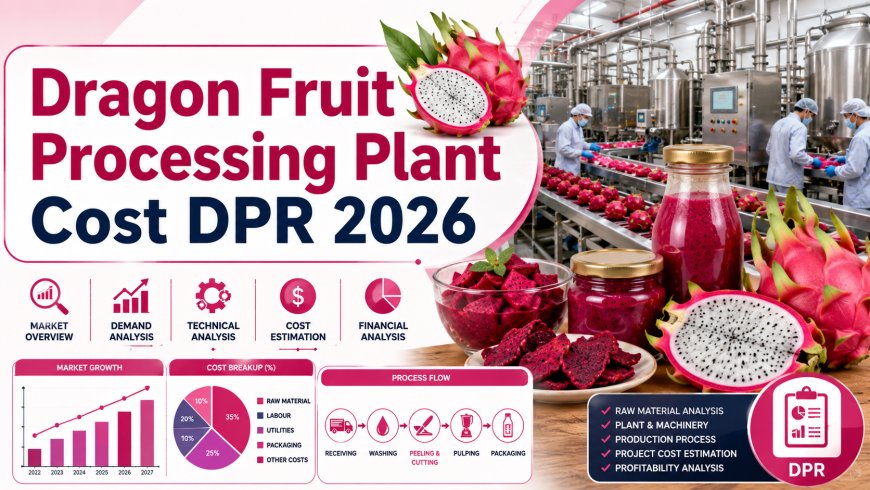
Setting up a dragon fruit (pitaya) processing plant involves a series of controlled operations including washing and sorting, mechanical peeling and cutting, pulping or puréeing, pasteurisation, dehydration or freeze-drying, and hygienic packaging. Key equipment includes washing lines, industrial pulpers, pasteurisers, IQF tunnels, spray or freeze dryers, and automated form-fill-seal packaging systems. As a food-grade facility serving fresh, frozen, and ingredient markets, maintaining hygiene standards, cold-chain discipline, and compliance with food-safety regulations such as FSSC 22000, BRC, and HACCP is critical.
Evaluating the dragon fruit processing plant setup cost is essential for understanding capital investment requirements, machinery selection, operational efficiency targets, and long-term profitability in this rapidly growing global market.
IMARC Group's report, titled 'Dragon Fruit Processing Plant Cost Analysis 2026: Industry Trends, Plant Setup, Machinery, Raw Materials, Investment Opportunities, Cost and Revenue,' provides a complete roadmap for setting up a dragon fruit plant project report. It covers a comprehensive market overview to micro-level information such as unit operations involved, raw material requirements, utility requirements, infrastructure requirements, machinery and technology requirements, manpower requirements, packaging requirements, and transportation requirements.
What is Dragon Fruit?
Dragon fruit (also called pitaya; primarily Hylocereus/Selenicereus species) is an edible cactus fruit characterised by a waxy, scale-like peel and a soft pulp containing small edible seeds. It is valued for its high moisture content, mild sweetness, and vivid natural pigments — especially in red-fleshed varieties — which make it useful as both a fresh fruit and a processed ingredient.
Dragon fruit is typically marketed as whole fruit or converted into pulp/purée, juice blends, frozen cubes, dehydrated pieces, and powders. Key quality attributes for processing include ripeness (brix/acid balance), colour stability, low defect rate, and hygienic handling to protect shelf life.
Key Investment Highlights
• Process Used: Washing, peeling & cutting, pulping/puréeing/de-seeding, packaging, and cold storage.
• End-use Industries: Food & beverage, ingredients & nutraceuticals, foodservice/HoReCa, and cosmetics & personal care.
• Applications: Fresh consumption, smoothies, juices/flavoured beverages, dehydrated chips, freeze-dried inclusions, and natural colour & flavour ingredients.
• Plant Capacity: 1,000–5,000 MT per annum, enabling economies of scale while maintaining operational flexibility.
• Gross Profit Margin: 40–50% under normal operating conditions.
• Net Profit Margin: 20–30% at steady-state utilisation.
Request Sample: https://www.imarcgroup.com/dragon-fruit-processing-plant-project-report/requestsample
Dragon Fruit Industry Outlook 2026
The dragon fruit processing industry is expected to witness robust growth through 2026 and beyond, driven by rising global demand for healthier exotic fruits, functional foods, and clean-label ingredients. The global dragon fruit market was valued at USD 15.60 Billion in 2025 and is projected to reach USD 23.80 Billion by 2034, exhibiting a CAGR of 4.8% during 2026–2034. As consumer preferences shift toward plant-based diets, smoothie bowls, and natural colouring agents, dragon fruit is emerging as a high-value raw material for food manufacturers, beverage companies, and nutraceutical producers worldwide.
According to the Indian Council of Agricultural Research (ICAR), Vietnam, China, and Indonesia together account for more than 90% of total global dragon fruit production. In India, dragon fruit is cultivated on approximately 14,510 hectares with a production of 53,720 MT, and the area under cultivation is expected to expand to 50,000 hectares in coming years — further improving raw material availability and export readiness.
Government initiatives promoting horticulture export, cold-chain infrastructure investment, and value-added agro-processing are further contributing to market expansion. However, challenges such as perishability of fresh fruit, high initial capital investment for cold-chain equipment, seasonal price volatility, and evolving food safety regulations may influence production costs and strategic investment decisions for new plant setups.
Dragon Fruit Processing — Detailed Process Flow
The dragon fruit processing procedure is a multi-step operation involving several unit operations, material handling stages, and quality checks. Below are the primary stages in the production flow:
Unit Operations Involved
• Receiving & Grading: Fresh dragon fruit is received, weighed, and graded by size, colour, and brix content. Defective or overripe fruit is segregated.
• Washing & Sanitising: Fruit is washed in potable water with food-grade sanitiser to remove field contamination, surface microbes, and residues.
• Peeling & Cutting: Mechanical peelers or trained operators remove the outer skin; fruit is halved or quartered and fed to the pulping line.
• Pulping / Puréeing: Industrial pulpers separate the soft flesh from seeds and fibrous material, producing a smooth purée or juice base.
• Pasteurisation: The purée is heat-treated (typically 85–90°C for 15–30 seconds) to eliminate pathogens and extend shelf life.
• Concentration (Optional): Evaporators concentrate the juice or purée to reduce volume and shipping costs for export markets.
• Dehydration / IQF (Optional): Sliced or cubed fruit is dehydrated in convective dryers or rapidly frozen in IQF tunnels for retail and ingredient channels.
• Packaging: Final product is packed in aseptic bags, retort pouches, Tetra Paks, or bulk frozen containers depending on end-use channel.
• Cold Storage & Dispatch: Packaged product is stored at –18°C (frozen) or 2–4°C (chilled) prior to distribution to domestic or export markets.
Quality Assurance Criteria & Technical Tests
• Brix content measurement (target: 10–14° for red-fleshed varieties)
• pH and titratable acidity checks at pulping and post-pasteurisation stages
• Microbial testing: Total Plate Count, Coliforms, Yeast & Mould per FSSC 22000 / BRC protocols
• Colour measurement (CIE L*a*b*) for red pigment (betacyanin) consistency
• Moisture content analysis for dehydrated products (<10% moisture)
• Heavy metals and pesticide residue screening for export compliance
• Packaging integrity: seal strength, headspace gas composition (MAP lines)
Key Cost Components
Raw Materials
Fresh dragon fruit is the primary cost driver, accounting for 65–75% of total OpEx. Reliable supplier contracts with trellised cultivation farms, proximity to production zones (Vietnam, Thailand, India, Mexico), and forward pricing agreements are critical to cost stability.
Energy Costs
Dragon fruit processing is moderately energy-intensive. Cold storage, IQF tunnelling, pasteurisation, and drying operations require significant electricity and thermal energy. Energy costs typically represent 10–15% of OpEx.
Machinery & Equipment
Capital investment is required for washing-sorting lines, industrial pulpers, pasteurisers, evaporators, IQF tunnels, spray/freeze dryers, aseptic fillers, and automated packaging systems. Machinery accounts for 35–40% of total CapEx, with ongoing maintenance costs of approximately 2–3% of equipment value per annum.
Labour
Includes salaries, training, and benefits for trained processing operators, QC technicians, cold-chain supervisors, maintenance engineers, and administrative staff. Labour typically represents 6–10% of OpEx depending on the level of automation.
Utilities
Costs for process water, CIP (clean-in-place) chemicals, compressed air, refrigeration systems, and effluent treatment account for 2–4% of OpEx. Water consumption is particularly significant, as dragon fruit processing involves intensive washing and pulping operations.
Packaging & Transportation
Expenses related to aseptic pouches, frozen cartons, labels, and stretch film represent 6–9% of OpEx. Inbound cold-chain logistics for fresh fruit and outbound refrigerated freight add a further 3–5% to operating costs.
Depreciation & Financing
Depreciation of fixed assets (typically 10–15% per annum on machinery) and interest or repayment obligations for project loans constitute significant fixed cost components, particularly in Years 1–3 of operations.
Compliance, Safety & Overheads
Investment in food-safety certification (FSSC 22000, BRC, Organic), environmental compliance, waste treatment, export documentation, insurance, and general plant management overhead represents approximately 2–3% of total OpEx.
Key Financial Assumptions
• Average ex-works selling price: USD 1,200–1,800 per MT (purée/frozen); USD 4,000–6,000 per MT (powder/freeze-dried)
• Fresh dragon fruit procurement cost: USD 300–500 per MT (farm-gate, Asia Pacific origin)
• Plant capacity utilisation ramps from 55% (Year 1) to 95% (Year 5)
• Debt-to-equity ratio: 60:40; loan tenor 7 years at 7–9% per annum interest
• Depreciation: Straight-line over 10 years for machinery; 20 years for civil structures
• Payback period: Estimated at 4–5 years at steady-state operations
Economic Trends Influencing Dragon Fruit Plant Setup Costs 2026
• Dragon Fruit Price Volatility: Fresh dragon fruit prices fluctuate with seasonal harvests, particularly in Vietnam and Thailand. Procurement volatility directly impacts both CapEx (cold storage sizing) and OpEx, making long-term supply contracts and diversified sourcing strategies essential.
• Cold-Chain Infrastructure Investment: Expanding export demand and food-safety compliance requirements are driving significant investment in refrigerated warehousing, IQF equipment, and refrigerated transport, increasing both initial CapEx and ongoing energy costs for new processing facilities.
• Inflation & Interest Rates: Rising inflation increases the cost of civil construction, stainless-steel food-grade equipment, and skilled labour, while higher interest rates elevate financing costs for project loans and working-capital facilities required for fruit procurement during peak seasons.
• Government Horticulture & Export Subsidies: Several governments — particularly in India, Vietnam, and Mexico — are providing grants, low-interest loans, and tax incentives for agro-processing investments targeting horticultural value addition and export promotion, partially offsetting capital setup costs.
• Technological Advancements: Innovations in high-efficiency pulpers, aseptic processing, spray-drying, and freeze-drying technology are increasing upfront CapEx but delivering significant productivity gains, reduced product losses, and higher-value output formats that improve long-term ROI.
• Clean Label & Organic Certification: Growing demand for certified organic and non-GMO dragon fruit ingredients is incentivising facility investment in dedicated organic processing lines and third-party audit compliance, adding 3–5% to certification-related CapEx.
• Labour Market Considerations: Shortages of trained food-processing technicians and cold-chain operators in high-growth producing regions can drive up wages or necessitate investment in training and automation, raising both initial setup and ongoing operational expenses.
Challenges and Considerations for Investors
• Perishability & Cold-Chain Dependency: Fresh dragon fruit has a short shelf life of 5–14 days at ambient temperature. The entire supply chain — from farm to factory — requires refrigerated transport and storage, adding complexity and cost to plant logistics.
• High Capital Intensity: Establishing a fully equipped dragon fruit processing plant with IQF, aseptic filling, and freeze-drying capabilities requires a capital outlay of USD 6.6–8.7 million. Long payback periods may deter risk-averse investors, particularly in emerging-market locations.
• Seasonal Supply Concentration: Dragon fruit production in major growing regions (Vietnam, Thailand, India) is concentrated in specific harvest windows. Investors must size cold-storage capacity and working-capital facilities to manage peak procurement and off-season production continuity.
• Food Safety & Export Compliance: Access to premium export markets (EU, US, Japan) requires certification to FSSC 22000, BRC Global Standard, and country-specific phytosanitary requirements. Compliance investment increases CapEx and ongoing audit costs.
• Market Competition & Commodity Pricing: The frozen purée and juice concentrate market is increasingly competitive, with established players from Vietnam, Thailand, and China holding cost advantages due to proximity to cultivation. Investors must differentiate through quality, certifications, or higher-value product formats.
• Logistics & Distribution: Shipping temperature-sensitive frozen or chilled dragon fruit products over long distances requires reliable cold-chain infrastructure. Poor logistics can lead to product spoilage, customer rejection, and increased distribution costs.
• Technological Barriers: Staying competitive requires adopting advanced, energy-efficient processing technologies. Outdated equipment leads to higher product losses, elevated energy consumption, and difficulty meeting food-safety certification requirements.
• Policy & Regulatory Risks: Changes in government policies — including export restrictions on fresh fruit, modifications to agro-processing subsidies, or updates to food safety legislation — can alter market dynamics and affect investment outcomes.
Speak to an Analyst: https://www.imarcgroup.com/request?type=report&id=10403&flag=C
About Us:
IMARC Group is a global management consulting firm that helps the world's most ambitious changemakers to create a lasting impact. The company excels in understanding its client's business priorities and delivering tailored solutions that drive meaningful outcomes. We provide a comprehensive suite of market entry and expansion services. Our offerings include thorough market assessment, feasibility studies, company incorporation assistance, factory setup support, regulatory approvals and licensing navigation, branding, marketing and sales strategies, competitive landscape, and benchmarking analyses, pricing and cost research, and procurement research.
Contact Us:
IMARC Group
134 N 4th St. Brooklyn, NY 11249, USA
Email: sales@imarcgroup.com
Tel No: (D) +91 120 433 0800
United States: (+1-201-971-6302)
What's Your Reaction?