




























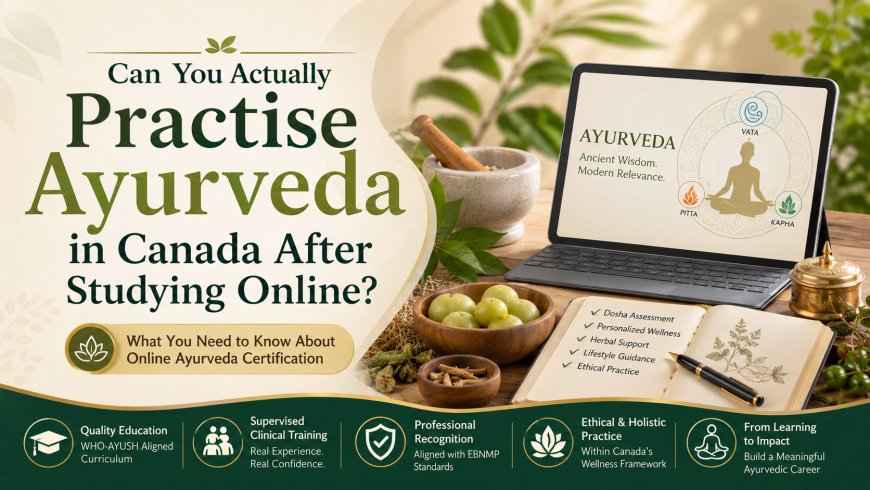
Can You Actually Practise Ayurveda in Canada After Studying Online?
Wondering if an online Ayurveda certification lets you practise in Canada? Here's an honest, detailed answer from an experienced Ayurvedic educator.

Introduction
This is one of the most frequently asked questions from people who are exploring Ayurveda certification in Canada, and it deserves a thorough, honest answer.
Online learning has transformed access to education in nearly every field. Ayurveda is no exception. The number of online Ayurveda courses, virtual certifications, and remote wellness programs available to Canadians has grown considerably in recent years, particularly since 2020 when the global shift toward digital education accelerated.
But Ayurveda is a clinical science. It involves assessing real clients, interpreting subtle physical and physiological signs, applying therapeutic protocols, and making informed decisions about a person's health. The question of whether online study alone can prepare someone to do that competently and professionally is worth examining carefully.
What Does "Practising Ayurveda" Mean in the Canadian Context?
Before answering whether online study qualifies you to practise, it is important to understand what practising Ayurveda in Canada actually involves.
An Ayurvedic practitioner in Canada typically offers:
Constitutional assessment through dosha analysis and pulse reading (Nadi Vigyan). Personalized wellness consultations covering diet, lifestyle, daily routine, and seasonal adjustments. Herbal support recommendations within an appropriate scope of practice. Referrals to other health professionals when indicated. Educational and preventive health guidance.
What Ayurvedic Practitioners in Canada Do Not Do
Practising Ayurveda in Canada is not the same as practising Ayurvedic medicine in India, where licensed BAMS (Bachelor of Ayurvedic Medicine and Surgery) physicians have authority to diagnose and treat disease. In Canada, Ayurvedic practitioners operate within a wellness and preventive health framework. They do not diagnose disease or prescribe treatments under provincial health regulations.
This distinction is important because it defines both the scope of what you can offer and the regulatory context in which you operate. A well-trained Ayurvedic practitioner in Canada who understands this scope can build a meaningful and ethical practice without stepping outside professional boundaries.
What Does Canadian Law Say About Practising Ayurveda?
Ayurveda is not a provincially regulated health profession in most Canadian provinces, which means there is no provincial college or licensing body that governs who can call themselves an Ayurvedic practitioner or offer Ayurvedic consultations.
This is often misunderstood in two ways. Some people assume that the lack of provincial regulation means anyone can practise without any accountability. Others assume it means Ayurveda cannot be practised at all. Both interpretations are incorrect.
The Role of Professional Associations in the Absence of Provincial Regulation
In the absence of provincial regulation, professional associations fill a critically important role. Organizations like EBNMP (Evidence-Based Natural Medicine Practitioners) establish standards for education, ethical practice, and professional accountability that practitioners voluntarily adopt.
Membership with a recognized professional association is not legally mandatory in most provinces, but it is professionally essential. It signals to clients, referring practitioners, and integrative wellness clinics that you have met a defined standard of training and that you are accountable to a code of ethics.
Health Canada's Natural Health Products Regulations, in place since 2004, also provide a legal framework within which Ayurvedic products and recommendations operate, further establishing Ayurveda's legitimacy within Canada's health landscape.
What Types of Online Ayurveda Programs Exist in Canada?
Not all online Ayurveda programs are the same. Understanding the different types helps you evaluate which ones might lead to a credible practice and which ones are unlikely to.
Type 1 — Short Online Courses and Workshops (Not Sufficient for Professional Practice)
These typically run from a few hours to a few weeks and cover introductory Ayurvedic concepts. They are valuable for personal education or as a supplement to existing study. They are not sufficient for professional practice and should not be presented as clinical certifications. Many are not aligned with any professional body and do not include clinical components.
Type 2 — Online Diploma Programs (Vary in Quality)
These are longer structured programs, typically ranging from six months to one year, delivered primarily or entirely online. Their value depends entirely on the depth of curriculum, the credentials of the faculty, and whether they include any supervised clinical component. Graduates of fully online diploma programs without clinical hours are generally not eligible for professional association membership with EBNMP and similar bodies.
Type 3 — Blended Designation Programs (Most Credible Path)
These are comprehensive programs that combine online or remote theory delivery with mandatory in-person clinical training. They typically run for one to three years and require a substantial number of supervised clinical hours. When offered by an institution aligned with WHO-AYUSH benchmarks and EBNMP recognition, these programs represent the most credible path to professional practice for Canadian students who prefer or require flexible learning delivery.
What Are the Requirements for Professional Practice in Canada?
If your goal is to practise Ayurveda professionally in Canada, the following requirements generally apply regardless of how your training was delivered:
Curriculum Depth
Your program should cover the full spectrum of classical Ayurvedic subjects, including Ayurvedic philosophy and tridosha theory, Nidana (assessment and differential analysis), Dravyaguna (herbal medicine), Panchakarma theory, Ahara (diet and nutrition), Dinacharya (lifestyle routines), and clinical practice. Programs that skip or superficially address these subjects will leave gaps in your clinical competency.
Supervised Clinical Hours
Professional associations typically require a minimum number of supervised clinical hours before granting membership to graduates. These hours must involve real client interactions under the supervision of qualified faculty. This is the requirement that most fully online programs cannot meet, and it is the most important criterion for distinguishing a professional certification from a recreational one.
Faculty Credentials
The people teaching your program should hold verifiable credentials, including formal Ayurvedic medical training, significant clinical experience, and ideally involvement with professional associations or research. Online programs that do not clearly list their faculty credentials should be approached with caution.
Professional Association Recognition
Before enrolling in any program, confirm that its graduates are eligible to apply for membership with a recognized body such as EBNMP. This is the most reliable external validation of a program's professional credibility.
The Honest Answer — Online Study Alone Is Usually Not Enough
The most accurate and honest answer to the question of whether you can practise Ayurveda in Canada after studying online is this: online study alone is usually not sufficient for professional practice, but online study as part of a well-structured blended program can absolutely lead to a credible and rewarding career.
The clinical component is what separates a practitioner from a student. Ayurvedic pulse reading, constitutional assessment, client intake, case formulation, and therapeutic recommendation all require real-world experience under skilled supervision. These skills are developed through practice, feedback, and repeated clinical exposure, not through watching videos or completing online assessments.
What to Look for in a Blended Program
If online learning is important to you for practical reasons such as location, schedule, or accessibility, look for programs that are transparent about exactly how clinical training is delivered. Ask how many in-person hours are required, where they are held, who supervises them, and how the program prepares you for EBNMP membership. A credible institution will answer these questions clearly and completely.
For students in Ontario and across Canada who are looking for a program that thoughtfully combines accessible learning with rigorous clinical training, CAISH Ayurveda offers structured designation pathways that address both the depth and the flexibility that serious students need.
H2: What About International Online Certifications?
Many prospective students in Canada are attracted to online Ayurveda programs offered by institutions in India, the United States, or the United Kingdom. Some of these programs are genuinely rigorous and well-respected. Others are not.
When evaluating an international online program, ask specifically whether it is recognized by Canadian professional associations such as EBNMP. A certification from an international institution, however respected in its home country, may not automatically qualify you for Canadian professional membership. Confirm this before you enrol, not after you graduate.
The most straightforward path to professional practice in Canada is through an institution that has an established relationship with Canadian professional bodies and a track record of graduates who are actively practising in this country.
H2: Frequently Asked Questions About Online Ayurveda Study in Canada
Is it legal to practise Ayurveda in Canada after online study?
In most Canadian provinces, there is no law that prohibits someone from offering Ayurvedic wellness consultations based on online study. However, practising professionally and responsibly requires training that meets recognized standards, including supervised clinical hours. Without these, you may be technically permitted to practise but professionally unqualified to do so safely.
Will clients in Canada accept a practitioner trained online?
Increasingly, Canadian clients are asking about practitioners' training backgrounds, professional memberships, and clinical experience. An online certification without clinical credentials or professional association membership is becoming harder to present credibly in a competitive wellness market. Clients seeking genuine Ayurvedic care tend to value practitioners who can demonstrate formal training and professional accountability.
Can I upgrade an online certification to a full designation later?
Some institutions allow students who have completed a foundational online program to continue into a more advanced clinical designation program. This bridging pathway can be an option if you have already completed some study and want to deepen your credentials. Ask any institution whether such pathways are available before enrolling at the foundational level.
How many clinical hours are typically required for EBNMP membership?
EBNMP has specific requirements for clinical training hours as part of its membership criteria. These requirements vary by designation level. Contact EBNMP directly or ask your prospective institution to confirm the current clinical hour requirements and how their program meets them.
Is a blended program significantly more expensive than a fully online one?
Blended programs that include in-person clinical intensives do tend to cost more than fully online courses, largely because of the faculty resources involved in delivering supervised clinical training. However, they also produce graduates who are eligible for professional membership, liability coverage, and genuine client practice, making the investment considerably more valuable over the course of a career.
What happens if I study online internationally and want to practise in Canada?
If you have completed an Ayurveda program through an international online institution and want to practise in Canada, your first step should be to contact EBNMP to assess whether your credentials meet their membership criteria. You may be required to complete additional clinical hours or bridging coursework before being eligible for professional membership.
Are there provinces in Canada where Ayurveda is regulated?
As of 2026, Ayurveda is not a provincially regulated profession in any Canadian province. This landscape may evolve as the profession grows and professional associations advocate for formal recognition. Staying current with EBNMP updates and provincial health policy developments is advisable for anyone building an Ayurvedic career in Canada.
Conclusion
Online study has made Ayurvedic education more accessible than at any point in history, and that is genuinely valuable. But accessibility alone does not equal professional readiness. If your goal is to practise Ayurveda professionally in Canada, your training needs to include supervised clinical hours, internationally aligned curriculum content, credentialed faculty, and recognition by a professional body.
The right program is one that takes Ayurveda seriously as a clinical science and prepares you to practise it with the same seriousness. To explore what that looks like in a Canadian context, visit CAISH Ayurveda to review program details and speak with an advisor.
What's Your Reaction?