


































Netherlands Logistics Market | Size, Growth, Trends and Analysis 2026-2034
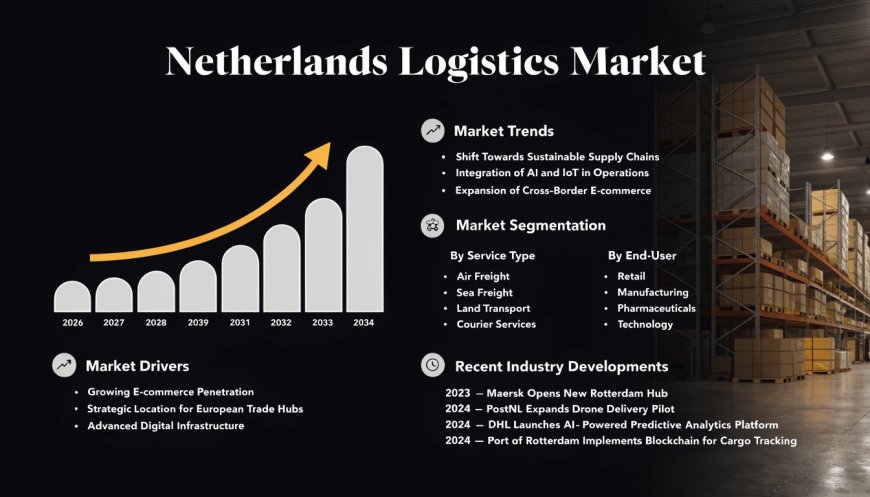
The Netherlands logistics market size reached USD 61.8 Billion in 2025. Looking forward, IMARC Group expects the market to reach USD 86.5 Billion by 2034, exhibiting a growth rate (CAGR) of 3.70% during 2026-2034.



Market Overview
The Netherlands logistics market is progressing steadily, strengthened by the country's strategic position as Europe's primary trade gateway, substantial infrastructure investment, and a strong emphasis on digital and green logistics solutions. According to IMARC Group, the market size reached USD 61.8 Billion in 2025 and is projected to reach USD 86.5 Billion by 2034, exhibiting a compound annual growth rate (CAGR) of 3.70% during 2026‑2034. The Netherlands is witnessing strong growth in e‑commerce, which is positively influencing the logistics industry, alongside the rise in investments in improving logistics infrastructure and enhancing ports, roads, railways, and airports. The Netherlands is central to global supply chains, with over 1,000 international companies having centralised their European distribution activities in the country, and the government's National Growth Fund, with a EUR 20 billion allocation, continues to target infrastructure, innovation, and R&D in digital technologies, thereby enhancing the market outlook.
The Netherlands logistics market is poised for sustained expansion, driven by a projected CAGR of 3.70% through 2034, the country's position as the "Gateway to Europe," and its leading role in zero‑emission freight. With the Port of Rotterdam's multi‑billion‑euro Delta‑Dock 2030 expansion, the rapid electrification of commercial vehicle fleets, and landmark mergers reshaping the competitive landscape, the market presents significant opportunities for logistics providers, technology vendors, and infrastructure partners seeking to capitalise on digitalisation and sustainable logistics solutions.
Netherlands Logistics Market Summary
- The Netherlands logistics market encompasses the transportation, warehousing, and value-added services associated with the movement of goods across roadways, seaways, railways, and airways, serving as a critical hub for goods entering and exiting the European Union.
- The ecosystem includes a dynamic mix of international logistics giants, specialised third‑party logistics (3PL) providers, parcel delivery specialists, and digital freight platforms, supported by world‑class infrastructure including the Port of Rotterdam and Schiphol Airport.
- Major segments identified in the market include model type (1PL, 2PL, 3PL, and others), transportation mode (roadways, seaways, railways, airways), end‑user (manufacturing, consumer goods and retail, food and beverages, IT hardware and telecom, healthcare, chemicals, construction, automotive, oil and gas, and others), and region.
- The market is driven by the Netherlands' high e‑commerce penetration, significant infrastructure investments, the adoption of sustainability practices, and its role as a strategic trade gateway following Brexit, which has prompted an influx of businesses relocating to the Netherlands to leverage its intermodal network for cross-border freight movement.
- The country ranks among Europe's top performers in digitalisation, with the highest internet usage in the EU at 84%, driving the adoption of digital freight platforms and smart logistics technologies.
PORTER'S FIVE FORCES ANALYSIS – NETHERLANDS LOGISTICS MARKET
Bargaining Power of Suppliers – Moderate
The market relies on a mix of domestic and international suppliers of transportation assets, warehouse space, and digital technologies. Major global logistics providers such as DHL, DSV, and Kuehne + Nagel have extensive operations in the Netherlands, and the ongoing consolidation in the sector, such as the full integration of DSV and DB Schenker in the Netherlands as of December 2025, creates large-scale suppliers with significant leverage. However, the presence of numerous regional players and the rise of digital freight platforms help moderate supplier power.
Bargaining Power of Buyers – High
Buyers range from large multinational manufacturers and retailers to small e‑commerce businesses. With a highly competitive market offering a wide range of logistics service providers, buyers have extensive choice and can compare pricing and service quality easily. The high degree of price transparency and the availability of integrated logistics services give buyers strong negotiating power, pushing providers to differentiate through technology, speed, and value‑added services.
Threat of New Entrants – Moderate
Capital requirements for establishing a nationwide logistics network and achieving regulatory compliance are significant, creating barriers to entry. However, the rise of digital freight platforms and asset-light logistics models is lowering entry barriers for niche players focused on specific corridors or customer segments. Niche opportunities exist in specialised contract logistics, cold chain, and e‑commerce fulfilment, attracting agile new entrants.
Threat of Substitutes – Low
While alternative transport modes exist (e.g., shifting between road and rail), the core need for logistics services to move goods across the supply chain remains essential. For e‑commerce deliveries and cross-border trade, there is no commercially viable substitute that fully replaces the efficiency and reach of the Netherlands' multimodal logistics network.
Competitive Rivalry – High
The market is highly competitive, featuring a mix of global logistics giants, national parcel carriers, and specialised 3PL providers. In 2025, the top logistics service providers in the Netherlands included DHL, DSV, Kuehne + Nagel, PostNL, and FedEx, among others. Mergers and acquisitions are reshaping the competitive landscape; as of December 2025, DSV and DB Schenker completed a full integration in the Netherlands, creating a combined European network. Rivalry centres on service reliability, digitalisation, sustainability credentials, and price, with intense competition in the express parcel and e‑commerce fulfilment segments.
Request for Sample Report: https://www.imarcgroup.com/netherlands-logistics-market/requestsample
MARKET GROWTH DRIVERS
E‑Commerce Growth Driving Parcel Volumes and Last‑mile Innovation
A primary factor propelling the Netherlands logistics market is the strong growth in e‑commerce. Dutch consumers are shopping online in greater numbers, leading companies to create better delivery systems and invest in warehousing, transportation, and last‑mile delivery services. The demand for quicker, more secure delivery times is driving the use of cutting-edge technologies like automation, drones, and artificial intelligence in the supply chain. The Netherlands boasts the highest internet usage in the EU at 84%, presenting significant opportunities for conversion, and e‑commerce adoption is particularly strong in the fashion and clothing sector, driven by consumer demand for personalised solutions. This growth is encouraging retailers to open fulfilment centers near urban areas to minimise delivery times and expenses, while logistics companies are constantly improving their infrastructure, streamlining routes, and expanding capacity for delivering a greater number of parcels.
Strategic Infrastructure Investment and Port Modernisation
The Netherlands is investing heavily in its logistics infrastructure, enhancing ports, roads, railways, and airports, which is making the nation increasingly appealing for logistics firms. Port facilities, including the Port of Rotterdam—one of Europe's largest—are constantly improved to deal with rising volumes of goods and to cater to larger ships, while rail systems are being upgraded to enable faster inland transport, and Amsterdam Schiphol Airport is upgrading its cargo facilities. In 2025, the Port of Rotterdam Authority invested €291.4 million in the port, focusing on energy and logistics infrastructure. In February 2026, the Port of Rotterdam launched the 'Delta-Dock 2030' initiative, a multi‑phase expansion project estimated to cost several billion euros, involving new deep-water berths, advanced automated stacking cranes, and significant upgrades to existing rail and road connections. Continuous improvements in multimodal transport solutions are offering higher flexibility for logistics providers, enabling quicker, more efficient, and cheaper logistics operations.
MARKET GROWTH DRIVERS
Sustainability and Zero‑Emission Freight Transition
Sustainability is increasingly shaping the Dutch logistics industry, with more focus on lowering the environmental footprint of transportation and supply chain operations. The Netherlands has become a global frontrunner in zero-emission freight transport, introducing nationwide Zero-Emission Zones for Freight (ZEZ-F) across 18 cities in January 2025. By mid-2025, 78% of new vans and 76% of medium trucks registered in the country were battery-electric—the highest figures in the EU, with electric truck sales rising by 188% year-on-year. Under the national rules, only zero-emission vans and trucks may enter these zones, with purchase subsidies of up to €5,000 for e‑vans and €115,200 for trucks, along with tax incentives and funding for public charging infrastructure. Furthermore, logistics operators are investing in cleaner vessels and inland transport networks; in July 2025, TotalEnergies and CMA CGM created a joint company to develop an LNG-bunkering supply chain in the ARA region, and a new 20,000 m³ LNG bunker vessel is planned for Rotterdam, expected to be operational by 2028.
Digitalisation, AI Integration, and Labour Market Dynamics
The Netherlands is pursuing a comprehensive digitalisation strategy, focusing on AI, data governance, connectivity, security, and skills development. The government's National Growth Fund is allocating EUR 20 billion to digital technologies, bolstering the country's digital infrastructure and enhancing digitalisation across industries. While the logistics sector is embracing AI for supply chain optimisation, companies face significant labour market tightness; 39% of organisations surveyed cited labour market tightness as a determining factor for their strategy in 2025. Rising labour costs and driver shortages are driving investment in automation and digital freight platforms, further accelerating technological adoption in the sector.
Netherlands Logistics Market Segmentation
Segmentation analysis provides a detailed view of the Netherlands logistics market by category:
- Model Type Insights: 1PL, 2PL, 3PL, Others.
- Transportation Mode Insights: Roadways, Seaways, Railways, Airways.
- End‑User Industry Insights: Manufacturing, Consumer Goods and Retail, Food and Beverages, IT Hardware and Telecom, Healthcare, Chemicals, Construction, Automotive, Oil and Gas, Others.
- Regional Insights: Noord‑Holland (Amsterdam), Zuid‑Holland (Rotterdam), Noord‑Brabant (Eindhoven), Gelderland, Utrecht, and others.
Competitive Landscape
The competitive landscape of the Netherlands logistics market is highly dynamic and characterised by a mix of global logistics giants, national parcel carriers, and specialised third‑party logistics providers. In 2025, the top logistics service providers in the Netherlands included DHL, DSV Panalpina, Kuehne + Nagel, FedEx, UPS, PostNL, and DB Schenker. Mergers and acquisitions have been a defining feature of the competitive environment; as of December 2025, DSV and DB Schenker completed a full integration in the Netherlands, operating under one brand and creating a combined European network. In the e‑commerce logistics segment, key players include PostNL, Spring GDS Nederland, DHL, General Logistics Systems Netherlands, and DPD Nederland. Companies such as De Rijke Group have also risen in the rankings, climbing to position 28 in the Top 100 Logistics Service Providers in 2025. Competition centres on service reliability, digitalisation, sustainability credentials, and price, with intense rivalry in the express parcel and e‑commerce fulfilment segments.
Regional Analysis
Regional dynamics within the Netherlands logistics market are shaped by the location of major ports, airports, and industrial clusters.
- Zuid‑Holland is a leading region, anchored by the Port of Rotterdam, Europe's largest seaport, which is undergoing the multi‑billion‑euro 'Delta-Dock 2030' expansion to enhance container handling capacity and intermodal connectivity. The region also benefits from a dense network of logistics parks and distribution centers.
- Noord‑Holland is another key hub, home to Amsterdam Airport Schiphol, one of the world's best‑connected airports for cargo, and a major center for e‑commerce fulfilment and high‑value logistics.
- Noord‑Brabant is a high‑tech industrial zone, with a high concentration of technology companies and automotive suppliers, driving demand for contract logistics and just‑in‑time delivery services.
- Gelderland and Utrecht benefit from their central location, serving as key nodes for road and rail freight networks. These provinces have also seen significant growth in warehousing and distribution activities, driven by e‑commerce expansion and supply‑chain centralisation.
Recent Industry Developments
- December 2025: DSV and DB Schenker completed a full integration in the Netherlands, operating under one brand and creating a combined European network in transport and contract logistics.
- October 2025: The Netherlands introduced nationwide Zero-Emission Zones for Freight across 18 cities. By mid-2025, 78% of new vans and 76% of medium trucks registered in the country were battery-electric, the highest figures in the EU.
- July 2025: TotalEnergies and CMA CGM created a joint company to develop an LNG-bunkering supply chain in the ARA region, with a new 20,000 m³ LNG bunker vessel planned for Rotterdam expected to be operational by 2028.
- March 2026: The Port of Rotterdam Authority released its 2025 Annual Report, revealing revenues rose by 6.6% to €940.4 million, with targeted investments of €291.4 million in energy and logistics infrastructure.
- February 2026: The Port of Rotterdam launched the 'Delta-Dock 2030' expansion project, a multi‑phase initiative estimated to cost several billion euros, aiming to add 2 million TEU to annual handling capacity and enhance intermodal connectivity.
- February 2026: The Port of Rotterdam Authority signed an agreement for the development of a distribution center on the last vacant lot at the City Terminal site with Neele-Vat Logistics, one of the Netherlands’ biggest logistics services providers, funded by both the Port Authority (US
 181.7 million).
Browse Full Report with TOC & List of Figures for In‑Depth Market Insights: https://www.imarcgroup.com/netherlands-logistics-market
Note: If you need any specific information that is not covered currently within the scope of the report, we will provide the same as a part of customisation.
About Us
IMARC Group is a global management consulting firm that helps the world's most ambitious changemakers to create a lasting impact. The company provides a comprehensive suite of market entry and expansion services. IMARC offerings include thorough market assessment, feasibility studies, company incorporation assistance, factory setup support, regulatory approvals and licensing navigation, branding, marketing and sales strategies, competitive landscape and benchmarking analyses, pricing and cost research, and procurement research.
Contact Us
IMARC Group
134 N 4th St., Brooklyn, NY 11249, USA
Email: sales@imarcgroup.com
Tel No.: (D) +91 120 433 0800
United States: +1-201-971-6302
What's Your Reaction?