



























Philippines Retail Sector Market Growth and Analysis Report 2026-2034
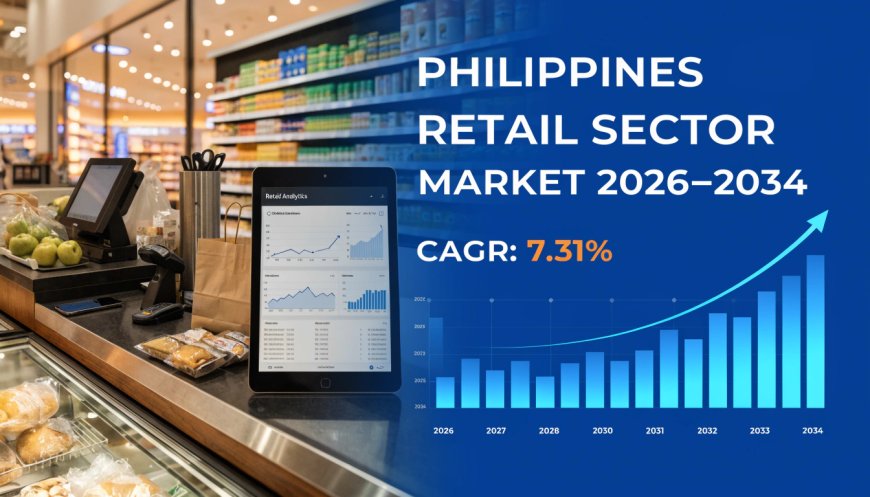
The Philippines retail sector market reached a size of USD 648.2 Billion in 2025 and is projected to expand to USD 1,223.1 Billion by 2034, growing at a CAGR of 7.31% between 2026 and 2034.

Market Overview
The Philippines retail sector market reached a size of USD 648.2 Billion in 2025 and is projected to expand to USD 1,223.1 Billion by 2034, growing at a CAGR of 7.31% between 2026 and 2034. Growth is driven by increasing consumer spending, e-commerce expansion, technological advancements, and urbanization. Rising disposable incomes, improved supply chain management, enhanced customer experiences, globalization, and strategic partnerships among retailers are further shaping the dynamic and rapidly evolving Philippines retail landscape.
Grab a sample PDF of this report: https://www.imarcgroup.com/philippines-retail-sector-market/requestsample
How AI is Reshaping the Future of the Philippines Retail Sector Market
- AI-powered big data analytics platforms are helping retailers in the Philippines gain real-time insights into consumer behavior, purchase patterns, and inventory velocity — a capability increasingly critical as 86% of Filipino knowledge workers integrate AI into their daily work routines, exceeding both the global average of 75% and the regional average of 83%.
- Machine learning algorithms are enabling Philippine retailers to implement dynamic pricing across both physical and digital channels, adjusting promotions and markdowns in real time based on stock levels, competitor pricing, and localized demand signals across Luzon, Visayas, and Mindanao.
- AI-driven demand forecasting tools help supermarket chains and convenience store operators like SM Retail and Alfamart optimize replenishment cycles, reduce food waste, and maintain product availability during high-demand periods such as the Christmas shopping season and major e-commerce sale events.
- Natural language processing powers AI chatbots and virtual shopping assistants deployed across retail apps and social commerce platforms, providing personalized product recommendations, order tracking, and customer support in Filipino and English — improving customer satisfaction while reducing service center costs.
- Computer vision and AI-based shelf-monitoring systems are being piloted by major Philippine retailers, automatically detecting out-of-stock conditions, misplaced items, and planogram non-compliance in store aisles, enabling faster restocking and improving the shopping experience across high-traffic mall locations.
- AI-assisted fraud detection systems integrated into e-wallets and digital checkout platforms help protect Filipino consumers from counterfeit goods and payment fraud — an increasingly critical capability as the counterfeit market in the Philippines is projected to grow at 15% annually, with counterfeit smartphone sales rising 30% in recent years.
Market Growth Factors
The Philippines retail sector market growth is significantly driven by rising disposable income. Consistent growth in middle-class household incomes has led to increased consumer spending on modern retail items including fashion, electronics, personal care, and packaged foods. The Philippines' GNI per capita reached approximately USD 4,470 in 2024 — just USD 26 below the World Bank's upper-middle-income threshold — with continued economic momentum expected to push it into this bracket by 2026 or 2027. This income growth is driving demand for branded goods, premium offerings, and improved shopping experiences.
Urbanization and modern lifestyle shifts are propelling market expansion substantially. More Filipinos are relocating to cities where modern living demands greater convenience and accessibility, favoring organized retail formats such as malls, supermarkets, and convenience stores over traditional wet markets. Exposure to global trends is accelerating demand for international brands and lifestyle products. Retailers are broadening store networks and adopting online-to-offline models in response to fast-paced urban lifestyles. In Q2 2025, the Philippines recorded a 5.5% year-on-year GDP growth, with robust household consumption directly boosting consumer spending power across retail categories.
Government infrastructure development is further accelerating market development. Expanding transportation networks, improved logistics systems, and the development of commercial centers are making retail spaces more accessible for consumers and businesses alike. Enhanced road connectivity and urban planning initiatives enable retailers to reach emerging provincial markets beyond metropolitan areas. Modern logistics facilities facilitate efficient supply chains, lowering costs and ensuring timely product delivery. These investments attract both foreign and domestic investment in shopping malls, supermarkets, and mixed-use developments, directly strengthening retail accessibility, distribution efficiency, and long-term market competitiveness.
Market Segmentation
Product Insights:
- Food and Beverages
- Personal and Household Care
- Apparel, Footwear and Accessories
- Furniture, Toys and Hobby
- Electronic and Household Appliances
- Others
Distribution Channel Insights:
- Supermarkets and Hypermarkets
- Convenience Stores
- Specialty Stores
- Online Stores
- Others
Regional Insights:
- Luzon
- Visayas
- Mindanao
Key Players
- SM Retail Inc. (SM Investments Corporation)
- Robinsons Retail Holdings Inc.
- Puregold Price Club Inc.
- Metro Retail Stores Group Inc.
- Ayala Malls / Ayala Corporation
- Lazada Philippines
- Shopee Philippines
- 7-Eleven Philippines (Philippine Seven Corporation)
- Alfamart Philippines
Recent Developments & News
- December 2025: SM Retail Inc. president Jonathan Ng confirmed that the company rolled out at least 200 new Alfamart stores across the Philippines in 2025 and announced plans to open a further 200–250 new stores in 2026, with Alfamart reaching 2,337 locations as of end-September 2025. SM Retail also launched an Alfamart franchising program in October 2025 targeting micro, small and medium enterprises, underscoring the rapid expansion of neighborhood convenience retail as a key growth channel for the country's largest retail conglomerate.
- October 2025: Premium supermarket chain Spinneys announced a partnership with Ayala Corporation to enter the Philippine market, targeting rising demand for premium fresh food driven by a growing affluent consumer segment. The entry of the UAE-headquartered grocer reinforces the Philippines' emergence as a priority market for international premium retail brands and signals the continued premiumization trend reshaping the modern grocery segment across Metro Manila and key provincial cities.
- September 2025: The Philippine Retailers Association (PRA) reported that the country's retail industry was expected to grow revenue at a double-digit rate year-on-year through late 2025, driven by greater consumer confidence, expanding mobile commerce adoption, and recovering household spending. The Philippines retail e-commerce segment recorded its highest-ever quarterly growth rate in Q3 2025, with mobile commerce as the primary acquisition channel across mass-market and premium categories alike.
- August 2025: Japan's ABC-MART announced plans to enter the Philippine market, with its first store in Bonifacio Global City, Taguig, opening in late September 2025, and a second following in November 2025. The company targets five store openings in fiscal 2026, with Metro Manila as the anchor market and potential expansion into Cebu and Davao. Concurrently, Samsung C&T's casual fashion brand 8 Seconds opened its first international store in the Philippines at SM Mall of Asia, with two additional stores planned before year-end.
- May 2025: China-based retail concept group KK Group announced plans to open 200 stores in the Philippines by 2028, building on its current four locations through its flagship KKV brand. The Colorist and X11 sub-brands are also set to launch, targeting Gen Z consumers with vibrant, lifestyle-oriented store formats. In the same period, SM Investments announced plans to open at least 200 new Alfamart stores across Luzon in 2025, reinforcing the structural shift toward high-frequency, small-format convenience retail in densely populated urban and suburban communities.
- January 2026: Industry analysis confirmed that Luzon accounted for 59.39% of Philippines retail market share in 2025, while Mindanao was forecast to record the highest regional CAGR at 7.84% through 2031, supported by cold chain improvements and port upgrades. Food and Beverages led all product categories with 41.38% revenue share in 2025, while Cosmetics and Personal Care was identified as the fastest-growing category, projected to expand at an 11.87% CAGR through 2031, driven by rising health awareness and growing beauty commerce activity on Shopee and TikTok Shop.
Note: If you require any specific information that is not covered currently within the scope of the report, we will provide the same as a part of the customization.
Ask an Analyst for Your Customized Sample Report: https://www.imarcgroup.com/request?type=report&id=23546&flag=C
About Us
IMARC Group is a global management consulting firm that helps the world's most ambitious changemakers to create a lasting impact. The company provides a comprehensive suite of market entry and expansion services. IMARC offerings include thorough market assessment, feasibility studies, company incorporation assistance, factory setup support, regulatory approvals and licensing navigation, branding, marketing and sales strategies, competitive landscape and benchmarking analyses, pricing and cost research, and procurement research.
Contact Us
IMARC Group
134 N 4th St. Brooklyn, NY 11249, USA
Email: sales@imarcgroup.com
Tel No: (D) +91 120 433 0800
United States: +1-201-971-6302
What's Your Reaction?