


























Australia Wood Plastic Composites Market 2026 | Worth USD 273.7 Million by 2034
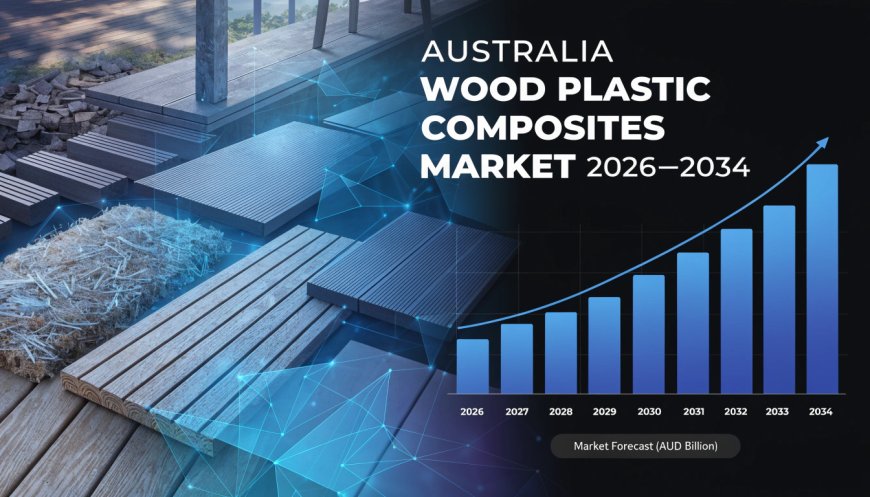
The Australia wood plastic composites market size reached USD 132.8 Million in 2025. Looking forward, the market is expected to reach USD 273.7 Million by 2034, exhibiting a growth rate (CAGR) of 8.37% during 2026-2034.

Australia Wood Plastic Composites Market Overview
The Australia wood plastic composites (WPC) market is experiencing strong growth, driven by the nation's booming home renovation sector, increasing demand for sustainable and low-maintenance building materials, and the superior climate resistance that WPC products offer in Australia's harsh outdoor conditions. Wood plastic composites—engineered materials combining wood fibers or flour with thermoplastic polymers such as polyethylene, polypropylene, and polyvinylchloride—have emerged as preferred alternatives to traditional timber for decking, fencing, cladding, and outdoor furniture applications. The Australia wood plastic composites market size reached USD 132.8 Million in 2025. Looking forward, IMARC Group expects the market to reach USD 273.7 Million by 2034, exhibiting a growth rate (CAGR) of 8.37% during 2026-2034. With Australians spending over AUD 54 billion annually on home renovations and outdoor living spaces adding 5-10% to property values, composite decking and outdoor products have become a cornerstone of the residential improvement market.
The Australian WPC market is being shaped by a convergence of sustainability imperatives, regulatory evolution, and construction industry transformation. High-density construction has grown by 39.4% over five years, expanding the addressable market for composite materials in multi-residential and commercial building applications. WPC products are predominantly crafted from recycled plastics and wood byproducts such as sawdust and wood chips, significantly reducing waste and curbing demand for virgin raw materials—aligning with Australia's growing circular economy priorities. The Green Building Council of Australia's Green Star Buildings v1.1 update, mandatory for all new projects from May 2026, focuses on climate action, nature, and circularity, directly supporting adoption of WPC products that incorporate recycled content. The market encompasses polyethylene, polyvinylchloride, polypropylene, and other polymer types, serving applications across building and construction, automotive, industrial and consumer goods sectors, with regional demand distributed across New South Wales, Victoria, Queensland, Western Australia, and other territories.
Request for a sample copy of this report: https://www.imarcgroup.com/australia-wood-plastic-composites-market/requestsample
How AI is Reshaping the Future of the Australia Wood Plastic Composites Market
Artificial intelligence is transforming the wood plastic composites industry across the entire value chain, from raw material formulation and manufacturing optimization to quality assurance and sustainable product design. AI-driven technologies are enabling WPC manufacturers to produce higher-quality, more consistent products while reducing waste, energy consumption, and environmental impact.
- AI-Optimized Extrusion Process Control: Machine learning algorithms are being applied to WPC production lines to monitor the extrusion molding process in real time, continuously adjusting temperature profiles, screw speeds, die pressures, and cooling rates to ensure consistent product quality. These AI systems analyze sensor data from multiple points along the extrusion line to predict and prevent defects before they occur, optimizing energy consumption and minimizing material waste by 25-30%. By maintaining precise control over processing parameters, manufacturers achieve uniform density, surface finish, and dimensional accuracy across production runs.
- Computer Vision Quality Inspection Systems: AI-powered imaging systems are being deployed on WPC manufacturing lines to detect surface defects, color inconsistencies, and dimensional variations at production speed. These computer vision platforms analyze every board, plank, or profile as it exits the extrusion line, identifying imperfections invisible to the human eye such as micro-cracks, fiber distribution irregularities, and surface texture anomalies. Automated rejection of non-conforming products ensures that only consistently high-quality WPC materials reach Australian construction sites, supporting the premium positioning and warranty commitments that brands require in this competitive market.
- Digital Twin Simulation for Product Development: AI-powered digital twin technologies are enabling WPC manufacturers to simulate the performance of new composite formulations under Australian climate conditions—including extreme UV exposure, temperature cycling, moisture absorption, and bushfire proximity—before committing to physical prototyping. These virtual testing platforms evaluate thousands of polymer-wood fiber combinations, additive packages, and capping technologies to predict long-term performance, weathering behavior, and structural integrity, improving production efficiency by up to 30% and significantly reducing the time and cost of bringing new products to market.
- AI-Driven Recycled Material Optimization: Machine learning models are being used to optimize the blending of recycled plastic feedstocks—which vary significantly in composition, contamination levels, and melt flow characteristics—with wood fiber inputs to produce WPC products that meet consistent mechanical and aesthetic specifications. These AI systems analyze incoming recycled material batches, predict their processing behavior, and automatically adjust formulation ratios and additive packages to compensate for variability. This technology is critical for manufacturers committed to high recycled content, enabling them to maintain product quality while maximizing the use of post-consumer waste plastics and wood processing byproducts.
- Predictive Maintenance and Energy Optimization: AI-driven predictive maintenance systems are monitoring WPC manufacturing equipment to forecast component wear, bearing degradation, and heater element failures before they cause unplanned downtime. By analyzing vibration signatures, temperature trends, and power consumption patterns, these systems schedule maintenance interventions during planned shutdowns, maximizing production uptime and equipment lifespan. Simultaneously, AI energy management platforms optimize electricity and gas consumption across the manufacturing facility, reducing the carbon footprint of WPC production in alignment with Green Star sustainability certification requirements.
Australia Wood Plastic Composites Market Trends
Home Renovation Boom Driving Premium Outdoor Living Applications
One of the most significant trends driving the Australia wood plastic composites market is the sustained home renovation boom, with Australians investing over AUD 54 billion annually in property improvements. The combination of record property prices and housing shortages has made home improvement the preferred lifestyle upgrade strategy, with outdoor living spaces—including composite decking, pergola structures, pool surrounds, and alfresco entertainment areas—emerging as high-priority renovation projects that add an estimated 5-10% to property values. WPC decking has become the material of choice for these applications, offering homeowners the natural timber aesthetic they desire combined with the low-maintenance durability, termite resistance, and weather resilience that Australia's harsh climate demands. Large-format decking projects and integrated alfresco areas are driving homeowners toward composite materials that maintain their appearance without the annual oiling, sanding, and sealing required by traditional hardwood alternatives. Manufacturers are responding with expanded product ranges featuring realistic timber grain textures, broader color palettes, and advanced capping technologies that provide 25-year warranty protection against fading, staining, and structural degradation.
Green Building Standards and Circular Economy Integration
A second defining trend reshaping the Australian WPC market is the tightening of green building standards and the growing emphasis on circular economy principles across the construction industry. The Green Building Council of Australia's Green Star Buildings v1.1 update, mandatory for all new projects from May 2026, prioritizes climate action, nature preservation, and circularity—directly supporting the adoption of WPC products manufactured from recycled materials. WPC products are inherently aligned with circular economy objectives, as they are predominantly crafted from recycled plastics—including post-consumer milk bottles, packaging waste, and industrial plastic scrap—combined with wood byproducts such as sawdust, wood chips, and forestry residues that would otherwise be sent to landfill. Australian manufacturers such as ModWood have built their entire brand proposition around turning recycled plastic milk bottles and reclaimed pine into high-performance composite decking, with specialist product ranges designed specifically for extreme Australian conditions. Advanced bio-resins and fiber treatment technologies are reducing the environmental impact of WPC production by 40-60% compared to virgin material alternatives. This regulatory momentum and sustainability consciousness is creating structural tailwinds for WPC adoption across both residential and commercial construction sectors.
Australia Wood Plastic Composites Market Summary
- Market Size (2025): USD 132.8 Million
- Forecast Value (2034): USD 273.7 Million
- Growth Rate (CAGR 2026-2034): 8.37%
- Key Polymer Types: Polyethylene, Polyvinylchloride, Polypropylene, Others
- Primary Growth Drivers: AUD 54 billion annual home renovation market, Green Star Buildings v1.1 mandatory from May 2026, high-density construction growth of 39.4%, circular economy and recycled material adoption, and superior climate resistance for Australian outdoor conditions
Australia Wood Plastic Composites Market Growth Drivers
High-Density Construction Growth and Multi-Residential Development
A primary driver fueling the Australia wood plastic composites market is the rapid growth in high-density construction, which has expanded by 39.4% over the past five years. As Australia's major cities—particularly Sydney, Melbourne, and Brisbane—address housing affordability challenges through increased medium and high-density residential development, the demand for durable, low-maintenance, and fire-resistant building materials is escalating. WPC products are increasingly specified for common area decking, balcony surfaces, privacy screening, planter boxes, and communal outdoor spaces in apartment and townhouse developments, where their low-maintenance characteristics reduce body corporate maintenance budgets and their consistent manufactured quality ensures uniform aesthetic standards across large-scale projects. The building and construction sector remains the dominant application segment for WPC in Australia, and the sustained pipeline of multi-residential and mixed-use developments across metropolitan growth corridors is creating a reliable demand base for composite building materials.
Superior Performance in Australian Climate Conditions
The superior climate resistance of WPC products in Australia's extreme outdoor conditions represents another critical growth driver. Australia's intense UV exposure, wide temperature ranges, coastal salt spray environments, and seasonal moisture variations create demanding conditions that accelerate the degradation of traditional timber products—requiring frequent maintenance, replacement, and chemical treatment. Modern WPC products, particularly those featuring advanced 360-degree capping technologies, are engineered to withstand these conditions with minimal maintenance over 25-year warranty periods. Products such as NewTechWood's UltraShield range carry BAL29 bushfire attack level ratings, addressing a critical safety requirement for properties in bushfire-prone zones that cover significant portions of Australia's suburban fringe. The performance advantage over traditional timber is driving material substitution across both new construction and renovation projects, as homeowners and builders increasingly recognize the long-term cost benefits of WPC's eliminate-and-forget maintenance profile compared to the ongoing expense of timber upkeep in Australian conditions.
Australia Wood Plastic Composites Market Segments
The Australia wood plastic composites market is segmented across polymer type, application, and region, reflecting the diverse end-use requirements of the Australian construction and manufacturing sectors:
- Breakup by Type: The market is categorized into polyethylene (PE), polyvinylchloride (PVC), polypropylene (PP), and others. Polyethylene-based WPC products are widely used in decking and outdoor applications due to their moisture resistance and processability, while PVC composites offer enhanced fire resistance and dimensional stability suited to commercial construction. Polypropylene variants provide superior heat resistance and are gaining traction in automotive and industrial applications.
- Breakup by Application: Applications span building and construction, automotive, industrial and consumer goods, and others. Building and construction dominates the market, encompassing decking, cladding, fencing, railing, pergola structures, and interior paneling. The automotive segment is growing as manufacturers adopt WPC for interior trim panels, door components, and trunk liners to reduce vehicle weight and improve sustainability credentials.
- Breakup by Construction Sub-Application: Within building and construction, key sub-applications include residential decking and outdoor living (the largest segment, driven by the AUD 54 billion renovation market), commercial and public infrastructure (boardwalks, park furniture, marina structures), multi-residential common areas (balconies, communal spaces, screening), and interior applications (wall paneling, ceiling elements, decorative profiles).
- Breakup by Product Technology: WPC products are segmented by manufacturing technology into standard extrusion, coextrusion (capped composites), and advanced processing methods including compression molding and selective laser sintering. Coextruded or capped WPC products—featuring a protective polymer shell over the composite core—represent the premium segment, offering superior weather resistance, stain protection, and extended warranty periods of up to 25 years.
- Breakup by Region: Regional segmentation covers Australia Capital Territory and New South Wales, Victoria and Tasmania, Queensland, Northern Territory and Southern Australia, and Western Australia. New South Wales and Victoria lead WPC consumption driven by their large metropolitan populations, high residential renovation activity, and concentration of multi-residential development projects, while Queensland contributes significant demand through outdoor living applications suited to its subtropical climate.
Australia Wood Plastic Composites Market Competitive Landscape
The competitive landscape of the Australia wood plastic composites market features a mix of Australian manufacturers, international composite brands, and building materials distributors. Key players include ModWood, an Australian-made brand that converts recycled plastic milk bottles and reclaimed pine into high-performance composite decking, with its XTG range designed specifically for extreme Australian conditions and high-traffic areas; NewTechWood, featuring patented UltraShield 360-degree capped technology with a 25-year warranty and BAL29 bushfire rating; and APR Composites, a specialist WPC supplier serving the Australian construction market. The broader competitive environment includes international construction groups entering the Australian market, with European construction giant STRABAG acquiring Georgiou Group and Japan's Sumitomo Forestry acquiring a 51% stake in Metricon homebuilder—both moves signaling growing international interest in Australia's construction materials market. These players compete on product performance, recycled content credentials, warranty terms, bushfire ratings, and distribution reach across Australia's building supply chains.
Latest News and Development in the Australia Wood Plastic Composites Market
- 2025: European construction giant STRABAG completed its acquisition of Georgiou Group, expanding its Australian presence and bringing additional construction materials expertise to the market, including advanced composite building product specification capabilities across major infrastructure and residential projects.
- 2025: Japan's Sumitomo Forestry acquired a 51% stake in Metricon, one of Australia's largest homebuilders, bringing Japanese timber engineering and sustainable materials expertise to the Australian residential construction market and strengthening the pipeline for WPC product specification in new home construction.
- 2025: ModWood continued to expand its Australian-made recycled composite decking range, reinforcing its market position through sustainability credentials—converting post-consumer plastic milk bottles and reclaimed pine into high-performance WPC products specifically engineered for extreme Australian climate conditions.
- May 2026 (Upcoming): The Green Building Council of Australia's Green Star Buildings v1.1 update becomes mandatory for all new projects, with its focus on climate action, nature, and circularity expected to significantly accelerate the specification and adoption of WPC products made from recycled materials across commercial and multi-residential construction sectors.
- 2025-2026: Advanced WPC manufacturing technologies including coextrusion capping, compression molding, and AI-powered quality control systems gained further adoption among Australian and international manufacturers, with AI-driven defect detection reducing material waste by 25-30% and digital twin simulations improving production efficiency by up to 30% across WPC production facilities.
Note: If you require any specific information not currently covered within the scope of the report, IMARC Group will provide it as part of customization.
Speak to an analyst:
https://www.imarcgroup.com/request?type=report&id=36012&flag=E
What's Your Reaction?