



























Australia Used Car Market Growth and Analysis Report 2026-2034
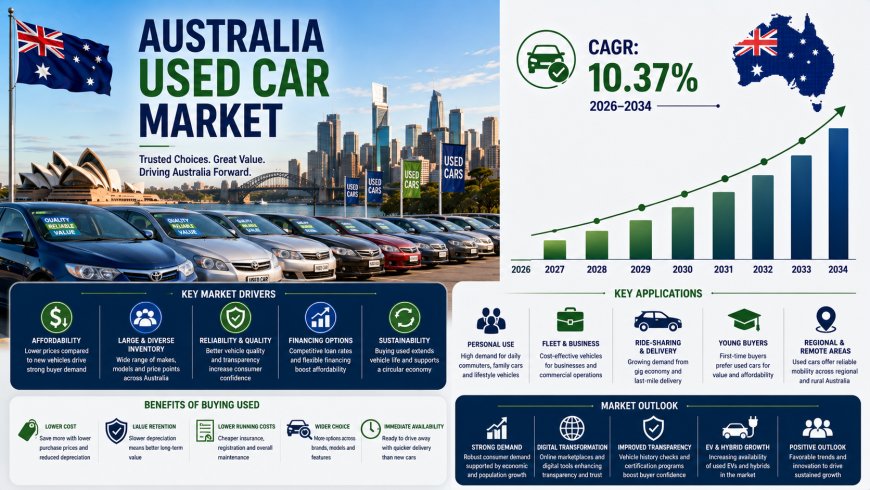
The Australia used car market size was valued at USD 85.54 Billion in 2025 and is projected to reach USD 217.42 Billion by 2034, exhibiting a CAGR of 10.37% during 2026–2034.

Market Overview
The Australia used car market size was valued at USD 85.54 Billion in 2025 and is projected to reach USD 217.42 Billion by 2034, exhibiting a CAGR of 10.37% during 2026–2034. Rising cost-of-living pressures, rapid expansion of digital automotive platforms, and sustained consumer demand for affordable pre-owned vehicles are the primary growth levers. Gasoline-powered vehicles dominate at 61.4% fuel-type share, while organised vendors lead at 57.2% driven by certified pre-owned programmes and transparent digital pricing. The Australian Capital Territory and New South Wales lead regionally at 35.7%, underpinned by high population density and strong digital platform adoption, while Western Australia is identified as the fastest-growing regional market through the forecast period.
How AI is Reshaping the Future of Australia Used Car Market
- AI-driven pricing algorithms are being deployed by Australian used car platforms including Carsales.com and CARS24 to ingest real-time supply and demand data, historical transaction records, and macroeconomic indicators, generating dynamic pricing recommendations that improve margin management for organised dealers while delivering the pricing transparency that increasingly influences buyer trust and platform preference across Australia's growing digital automotive marketplace.
- Machine learning-powered vehicle valuation tools are being integrated into dealer management systems and consumer-facing appraisal platforms across Australia, enabling instant automated assessment of trade-in vehicle values based on mileage, condition, age, regional demand signals, and comparable transaction data, improving procurement accuracy for dealers, reducing negotiation friction for sellers, and accelerating inventory turnover velocity across organised used car channels.
- AI-enabled EV battery health assessment platforms are being adopted by Australian organised dealers and certified pre-owned operators as the supply of pre-owned electric and hybrid vehicles expands from 2026, providing buyers with independently verified state-of-health diagnostics, remaining range estimates, and degradation projections that underpin credible EV CPO programmes and address consumer concerns about battery performance in the emerging used EV sub-segment.
- Predictive inventory management systems powered by machine learning are being implemented by Australian used car dealer groups to forecast regional demand across vehicle types, fuel segments, and price tiers, enabling more strategic vehicle sourcing at auction and from trade-in channels, reducing days-to-sale metrics, and optimizing working capital deployment across multi-site dealer networks operating under tightening inventory conditions as new car supply normalizes post-pandemic.
- AI-powered fraud detection and identity verification tools are being integrated into Australian digital used car transaction platforms and FinTech settlement services, enabling real-time authentication of buyer and seller identities, automated PPSR encumbrance checks, and anomaly detection across payment workflows, reducing transaction fraud exposure and improving buyer confidence in online purchase channels that are growing at an estimated 13.1% CAGR through 2034.
Request for Sample Report: https://www.imarcgroup.com/australia-used-car-market/requestsample
Market Trends
Digital-First Buying Experience and Online Platform Proliferation
Online platforms including Carsales.com, CARS24, and Drive.com.au accounted for a growing share of used car transactions in Australia by 2024, offering end-to-end digital experiences from vehicle discovery through to financing and home delivery. The launch of AutoSettle in March 2024 further digitised settlement and payment workflows, enabling instant digital settlement, enhanced security protocols, and identity verification integrated with dealerships, financiers, and state motor registries. This trend is reshaping buyer expectations toward transparency, speed, and convenience, permanently reducing the information asymmetry that previously supported unorganised private sale channel pricing power.
Accelerating SUV and Crossover Demand in Pre-Owned Segment
Pre-owned SUV demand has reached record levels, reflecting a structural shift in Australian consumer preferences toward versatile, family-oriented vehicles. Organised dealers are increasingly aligning inventory strategies to prioritize SUVs and crossovers, with models such as the Toyota HiLux, Ford Ranger, and Mazda CX-5 consistently ranking among the most actively traded in the used vehicle market across Queensland and Western Australia. Global supply chain disruptions between 2021 and 2023 constrained new vehicle supply, with popular models like the Land Rover Defender retaining or exceeding original value and reinforcing persistent supply-demand dynamics that continue to support strong pricing in pre-owned channels.
Rise of Certified Pre-Owned Programmes and Organised Channel Formalisation
Organised vendors held 57.2% of the market in 2025, reflecting ongoing formalisation supported by certified pre-owned programmes, digital inventory management, and structured buyer financing. OEM-backed CPO offerings from BMW, Toyota, and Hyundai are gaining share over unorganised channels by providing warranty coverage, multi-point inspections, and transparent pricing, building consumer confidence particularly among first-time pre-owned buyers. FinTech platforms are enabling faster credit approvals and reducing friction in the purchase journey, extending the buyer base to individuals previously excluded from traditional dealer financing models through novated leases, personal loans, and subscription-based access options.
Market Growth Drivers
Affordability and Cost-of-Living Pressures
New vehicle prices in Australia have increased significantly due to supply chain disruptions and currency pressures, making pre-owned vehicles a considerably more attractive alternative for first-time buyers, young families, and budget-conscious consumers facing higher living expenses across all major cities. With substantial cost advantages compared to new models, used vehicles are increasingly preferred across income segments, with the market recording USD 52.23 Billion in 2020 and growing to USD 85.54 Billion by 2025, affirming more than 63% cumulative historical growth underpinned by structural affordability-driven demand that is expected to persist throughout the forecast period.
Digital Platform Adoption and FinTech Integration
Widespread smartphone adoption and deeply embedded digital consumer behaviours have enabled Australian used car platforms to build end-to-end purchasing journeys that match or exceed new car dealership experiences in transparency and convenience. AI-driven pricing benchmarks, PPSR vehicle history integration, and instant financing pre-approval are removing the traditional risk barriers associated with pre-owned vehicle purchases. The March 2024 AutoSettle launch introduced purpose-built digital settlement infrastructure reducing transaction completion timeframes from days to hours, while deepening cybersecurity and identity verification capabilities that build sustained consumer confidence in digital transaction channels across Australia's used car market.
Expanding Pre-Owned EV and Hybrid Sub-Segment
Rising EV registrations are expanding the supply of pre-owned electric and hybrid vehicles, creating the highest-growth sub-segment in Australia's used car market projected at approximately 14.5% CAGR through 2034. Organised dealers establishing specialist EV reconditioning and battery health-check certification capabilities are positioned to capture premium margins as the first cohort of Australian electric vehicles completes initial ownership cycles from approximately 2027. Plug-in hybrid models from Toyota, Hyundai, and Mitsubishi Motors are gaining greater visibility in pre-owned inventory, with consumer interest in fuel cost reduction and sustainability driving growing demand for eco-friendly pre-owned alternatives across urban and suburban buyer segments.
Market Segments
By Vehicle Type:
- Hatchbacks
- Sedan
- Sports Utility Vehicle
- Others
By Vendor Type:
- Organised
- Unorganised
By Fuel Type:
- Gasoline
- Diesel
- Others
By Sales Channel:
- Online
- Offline
By Region:
- Australia Capital Territory & New South Wales
- Victoria & Tasmania
- Queensland
- Northern Territory & Southern Australia
- Western Australia
Competitive Landscape
The market research report has provided a comprehensive analysis of the competitive landscape in the Australia used car market. Competitive analysis covering market structure, key player positioning, top winning strategies, competitive dashboard, and a company evaluation quadrant with detailed profiles of all major companies has been included in the report. Key players include BMW Group, Carma, CARS24, CAR Group Limited (Carsales.com), Only Sales Limited, and Nine Entertainment Company (Drive.com.au), among others. Competition centres on inventory transparency, digital platform experience, AI-powered pricing tools, financing integration, EV reconditioning capabilities, and the ability to build buyer trust through certification standards across a market undergoing sustained formalisation in favour of organised channels.
Latest News and Developments
May 2026: Australia’s used car market continued strengthening as rising new vehicle prices and cost-of-living pressures pushed more consumers toward second-hand vehicles. Industry analysts noted that the market is increasingly driven by affordability-focused buyers seeking faster vehicle availability and lower financing costs compared with new cars.
April 2026: Australia’s second-hand EV segment experienced exceptional growth as fuel prices surged, with used EV sales jumping from approximately 3,176 units in February 2026 to 7,557 units in March 2026, representing an increase of more than 100% month-on-month. At the same time, used EV inventory declined by approximately 38%, tightening market supply significantly.
March 2026: Australia’s automotive market witnessed rapid expansion of Chinese vehicle brands, with analysts forecasting Chinese automakers could capture nearly 25% of Australia’s new vehicle market during 2026. The influx of affordable Chinese vehicles and EVs is expected to substantially influence future used car inventory and pricing trends nationwide.
February 2026: Australia’s used car sales rebounded strongly at the beginning of 2026, increasing approximately 9.7% month-on-month to 188,421 vehicles sold in January 2026, despite a 5.4% decline in active vehicle listings. Market observers highlighted tightening inventory conditions and stronger buyer demand across hybrid and fuel-efficient vehicle categories.
January 2026: Hybrid and low-emission vehicles gained stronger traction within Australia’s used car market, with low-emission vehicles accounting for approximately 8.9% of used car sales. Plug-in hybrid vehicles emerged as the fastest-growing category, recording sales growth of approximately 30.3% despite softer broader market conditions.
2025: Australia maintained one of the world’s highest motorization rates, creating a large resale vehicle ecosystem supporting long-term used car market expansion. Industry reports estimated that the Australian used car market reached approximately USD 49.86 billion in 2026, driven by digital used-car platforms, certified pre-owned programs, and rising demand for affordable mobility solutions.
Note: If you require any specific information that is not covered currently within the scope of the report, we will provide the same as a part of the customization.
Speak to an Analyst for a Customized Sample Report: https://www.imarcgroup.com/request?type=report&id=21959&flag=C
About Us
IMARC Group is a global management consulting firm that helps the world's most ambitious changemakers to create a lasting impact. The company provides a comprehensive suite of market entry and expansion services. IMARC offerings include thorough market assessment, feasibility studies, company incorporation assistance, factory setup support, regulatory approvals and licensing navigation, branding, marketing and sales strategies, competitive landscape and benchmarking analyses, pricing and cost research, and procurement research.
Contact Us
IMARC Group
134 N 4th St., Brooklyn, NY 11249, USA
Email: sales@imarcgroup.com
Tel. No.: (D) +91 120 433 0800
United States: +1-201-971-6302
What's Your Reaction?